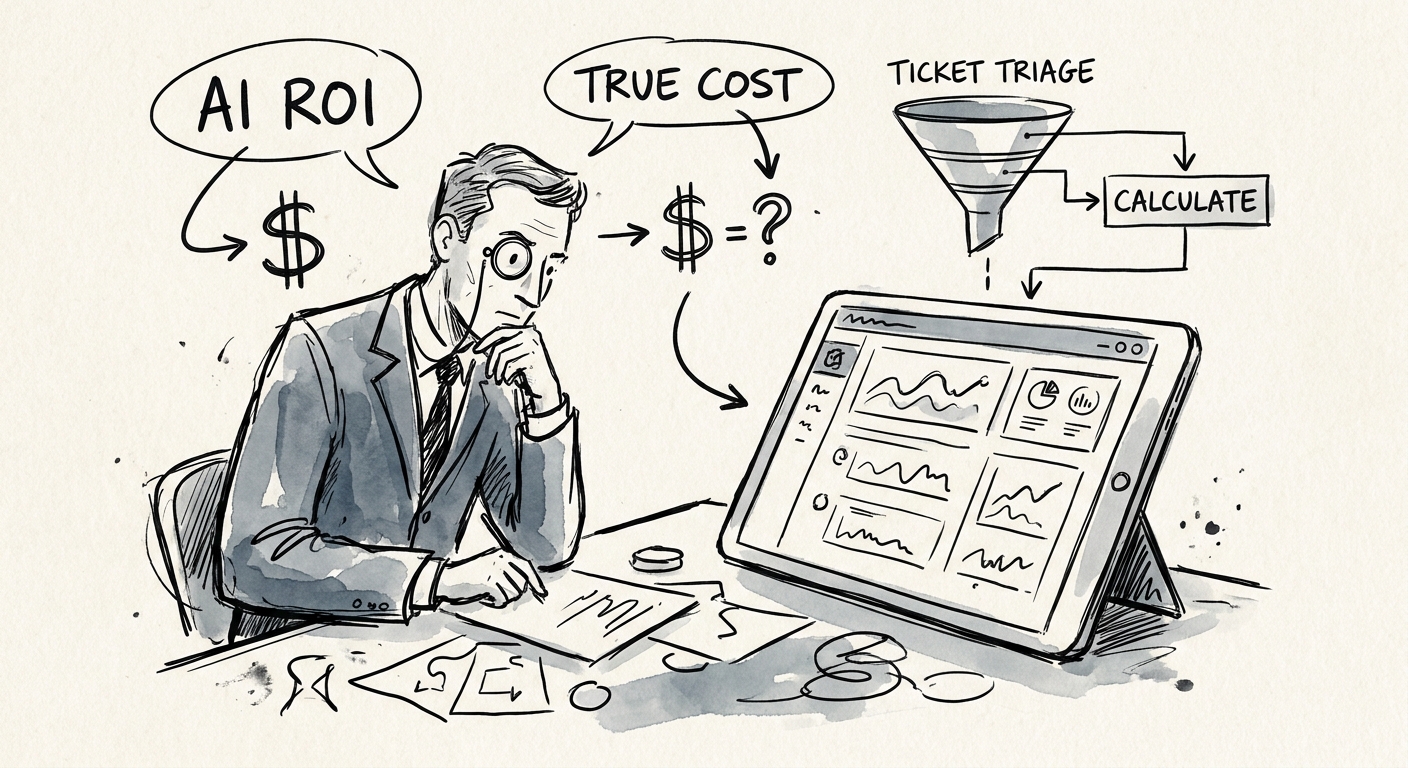
The vanity number is "minutes saved." The honest number is "tickets that landed in the wrong queue."
Say a 90-person technology-services shop turns on AI triage. Week one, the dashboard lights up: average handle time down, tickets auto-tagged, queue assignments happening before an agent even reads the subject line. Leadership sees the chart and starts modeling headcount. Then a P1 outage ticket from a tier-one account sits in the "billing questions" queue for four hours because the model latched onto the word "charge" in the body. The SLA credit you owe that customer erases a quarter of the labor you thought you saved.
That is the trap with ticket-triage ROI: the easy metric to celebrate (speed) is the one least correlated with whether the queue is actually healthier. The Salesforce State of Service report is the right anchor here precisely because service AI has to improve the customer's workflow while a human stays accountable for the outcome—a faster misroute is still a misroute, and the customer feels it. Before you claim a dollar of savings, baseline the things that go wrong: severity misclassification, SLA exposure, duplicate tickets that fragment a single incident, backlog age in high-priority queues, escalation leakage, and—the one everyone forgets—how often agents silently override the suggested route. The IBM Institute for Business Value AI capabilities research makes the same point structurally: you measure the whole capability, not a single chatbot stat. If you can't state today's misroute rate before the model goes live, you have no denominator, and every "improvement" later is a guess.
A triage model doesn't just sort tickets—it decides what your support org is allowed to see
Here's the failure mode nobody puts on the ROI slide. When a model routes a renewal-risk ticket—an account quietly threatening to churn—into a generic "feature request" bucket, it doesn't just delay a response. It removes that signal from the eyes of the people who'd act on it. The old, slow, manual queue was visible; a confident, fast, wrong queue is a blind spot you paid to install. That's why the NIST AI Risk Management Framework belongs in the ROI conversation and not just the security review: it forces you to name the specific things that can go wrong—missed severity, exposed customer data, false confidence, hidden risk—and put a number on each before you net them against labor savings.
The data-permission problem is sharper for triage than for most AI use cases, because a single support ticket pulls context from everywhere: the agent's case notes, the customer's email thread, a knowledge-base article, and often a shared customer document or contract. The Microsoft 365 Copilot data protection architecture is the relevant reference here: when the model reaches across those sources to make a routing call, permissions, logging, and a named reviewer for disputed routes have to be in the model—not bolted on after an incident. Put a real cost on this. If one mis-permissioned routing decision surfaces another customer's data in a reply, that's not a rounding error against handle-time savings; it's the kind of event that ends the program. A fast queue that occasionally leaks is more expensive than the slow queue it replaced.
The expand-or-kill decision, and how to make it on evidence
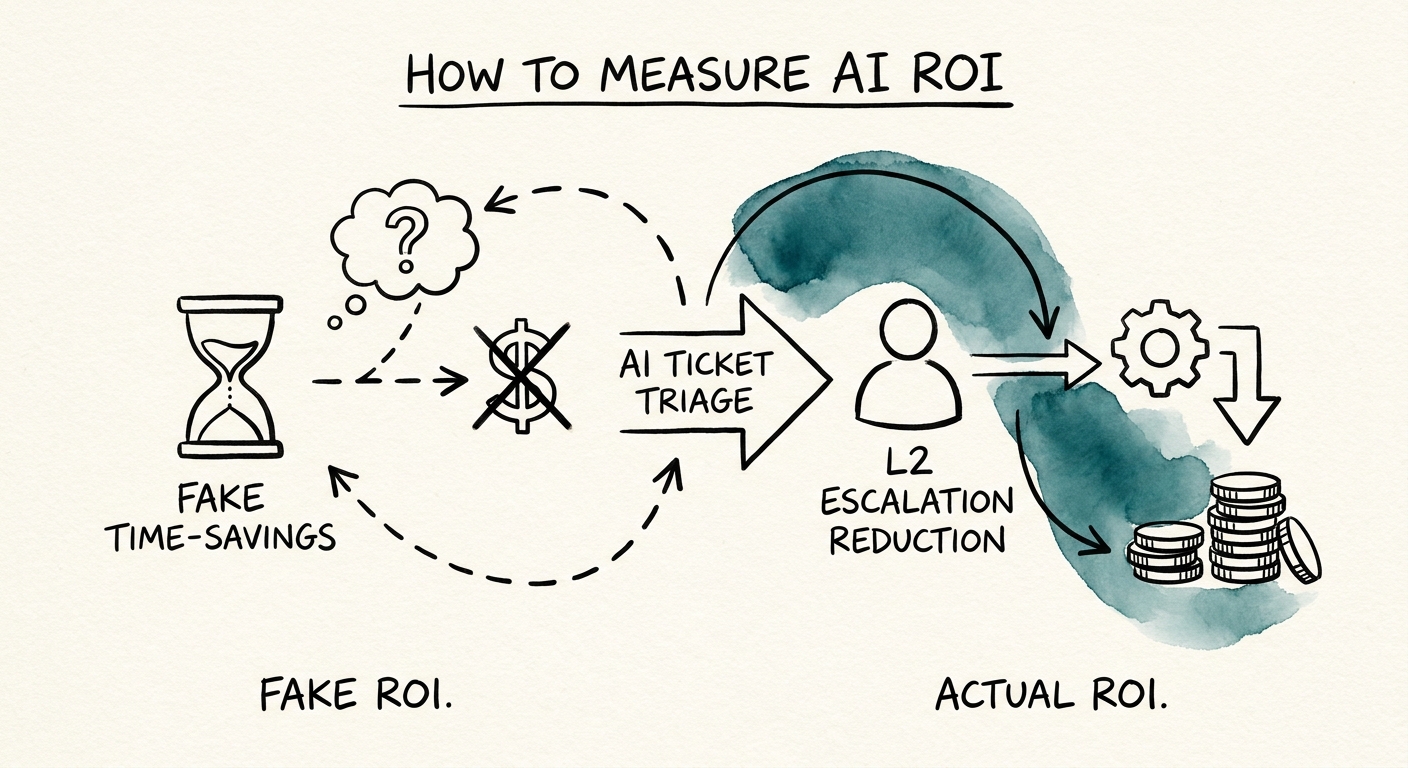
Run the first deployment narrow—one product line, one severity tier—and give it 90 days against your baseline. You're not looking for a speed chart. You're looking for five specific movements: fewer misroutes, shorter time to first qualified response (qualified meaning it reached someone who could actually resolve it), less duplicate-ticket rework, cleaner escalations, and lower aging in your P1/P2 queues. If all five move the right way, expand. If volume is flowing faster but your agents are quietly re-assigning severity and ownership ticket after ticket, you don't have an adoption problem—you have a queue-design problem, and scaling it just multiplies the corrections. Retrain the routing rules before you touch the next product line.
The discipline that separates real triage ROI from a handle-time press release is one number: override rate. Pull it weekly. When agents accept the model's route and the ticket resolves cleanly, that's value you can bank. When they override and re-route, that's the model telling you where its judgment isn't trusted yet—and that's the list you fix next, in priority order. Make this a service-quality decision, not a productivity claim. To put numbers behind it, use the AI ROI Calculator to model the misroute and SLA costs against labor, run the AI Opportunity Score to gauge whether your queue is even structured enough for triage to help, and see Human Renaissance AI transformation services when you want the measurement framework built before the model is live, not reverse-engineered after.