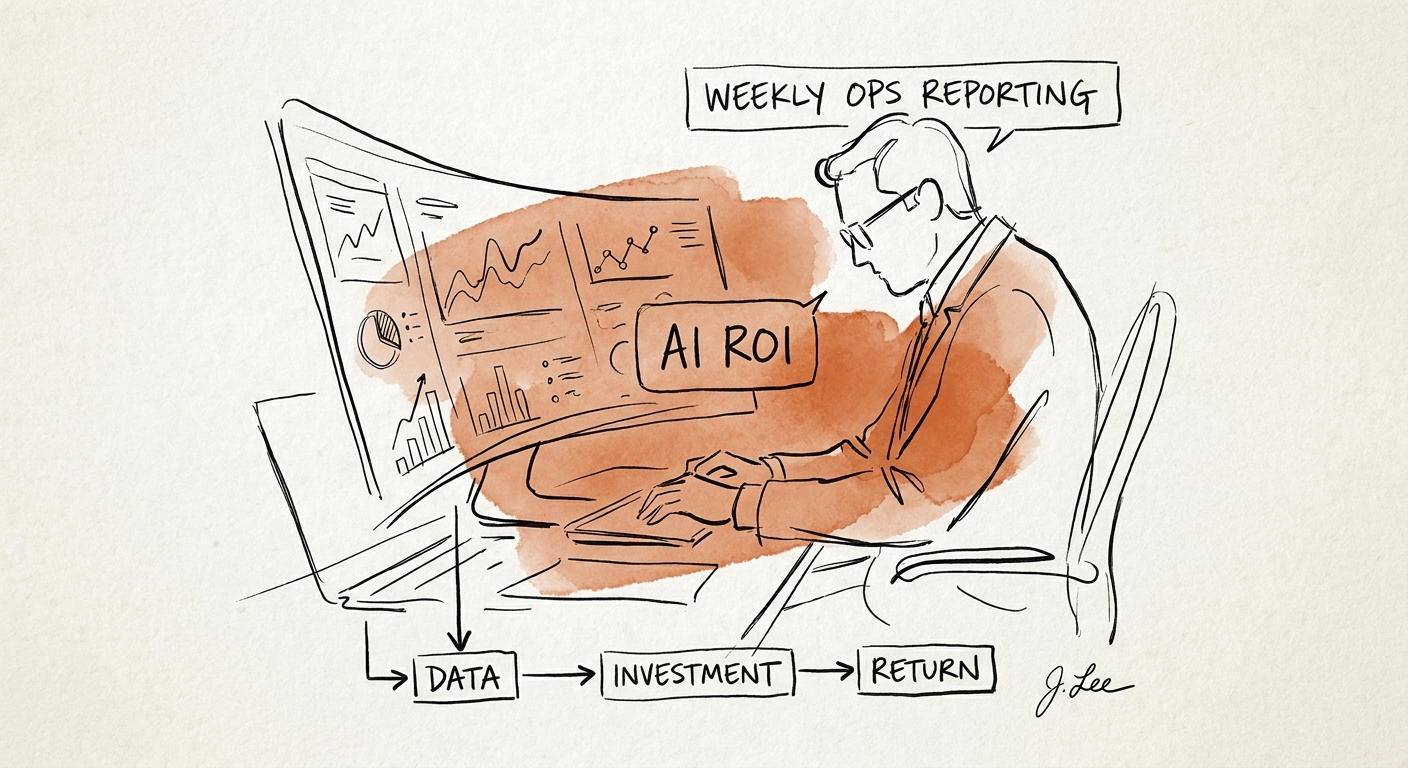
The deck was never the problem
Picture the Monday 9am ops review. Eight leaders on a call, a 14-slide packet that someone spent Sunday night assembling, and the first ten minutes spent not deciding anything — just re-litigating which pipeline number is current, why the churn figure on slide 6 contradicts the one finance sent Friday, and who owns the action item that's now in its third consecutive week. The deck got built faster this quarter because someone wired up an AI assistant. Nobody can tell whether the meeting got better.
That gap is the whole problem with measuring AI ROI on weekly operations reporting. The tempting metric — hours saved assembling the packet — is the cheap one, and it almost always improves. The metric that matters is whether the leadership meeting now reaches decisions with fresher facts and fewer reopened arguments. Atlassian's State of Teams 2025 is the most useful lens here precisely because it ties reporting value to coordination, visibility, and cadence — not document throughput. A faster deck that feeds the same confused meeting is motion, not progress.
So baseline the meeting, not the build. Before you trust any AI-assisted reporting, spend three or four weeks logging the unglamorous stuff: how many KPI inputs land late, how many minutes go to reconciling conflicting numbers, how old the oldest open action item is, and how many decisions get pushed to next week because nobody trusted the report enough to commit. IBM's Institute for Business Value research on AI capabilities frames the prerequisite bluntly: do the data owners, the operating rhythm, and an adoption path actually exist? If they don't, AI just generates a prettier version of the same disputed numbers.
The expensive failure mode is a confident wrong number
Here's what most teams get wrong when they automate the weekly report: they optimize for assembly speed and accidentally remove the friction that used to catch errors. When a human spent Sunday building the deck, they noticed when the revenue figure looked off and pinged the owner. An AI that pulls from five systems and renders a clean slide does not have that gut reaction. It will present a stale or wrong number with total composure, and now your leadership team is making a call on it.
This is why the NIST AI Risk Management Framework earns its place in a reporting workflow that most people think is too mundane to govern. Map it to three concrete questions: which KPI owner is allowed to change a given number, which source wins when two systems disagree (and they will — the CRM and the billing system rarely agree on revenue), and which exceptions must get human eyes before the meeting rather than after a bad decision. Write those answers down once and your "fewer reopened arguments" metric starts moving on its own.
The data-plumbing risk is just as real when the packet pulls from collaboration spaces — shared spreadsheets, threads, dashboards, the email where someone updated a forecast. Microsoft's documentation on Copilot data protection and auditing matters because an assistant inherits whatever permission mess already exists; surface the wrong tab to the wrong room and you've created a problem the old manual process never had. So add two unglamorous lines to your ROI ledger: permission near-misses caught, and minutes no longer spent reconciling whose version of the operating truth is the real one. Those are the numbers that prove the AI made the report more trustworthy, not just faster.
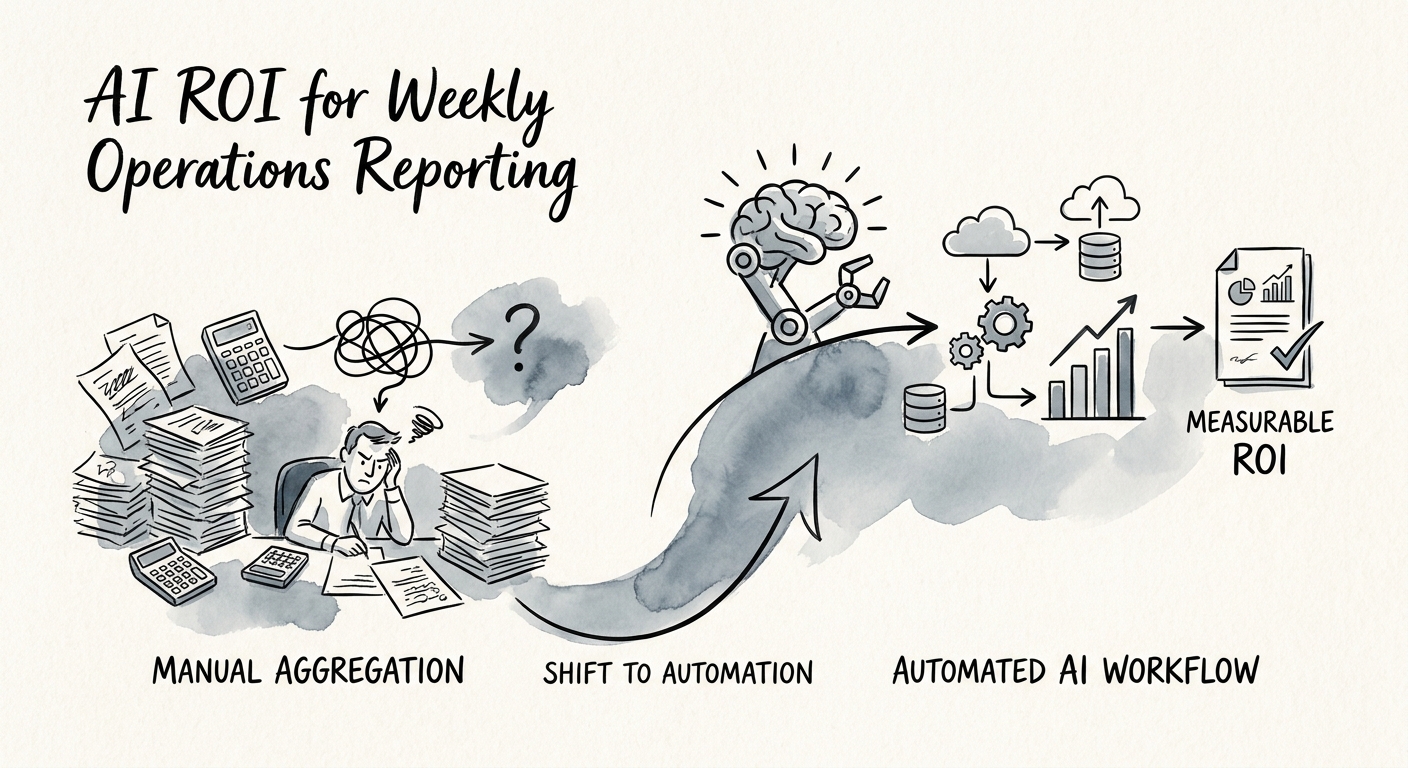
Five measures that decide whether the cadence actually improved
After 90 days, you should be able to answer one question with data, not vibes: do leaders now spend less time reconstructing status and more time deciding? Track these five against your baseline. Decision latency — how long between an issue surfacing in the report and a named owner committing to act. Open action age — is the oldest unresolved item getting younger, or still aging into month two? Updates accepted without rework — what share of the packet went into the meeting unchallenged. Meeting prep hours — the cheap metric, kept honest by the other four. And owner follow-through — did last week's commitments actually close. If prep time dropped but decision latency didn't, you sped up the deck and changed nothing that counts.
The honest outcome of a 90-day pilot is sometimes "stop and fix the cadence first." If your numbers don't agree across systems, no amount of AI assembly fixes a meeting built on disputed data — you tighten source ownership before you automate. That's a perfectly good result; it's cheaper to learn it in a pilot than after you've rolled the workflow across every function. McKinsey's State of AI keeps making the same point in different words: value concentrates where organizations redesign the workflow, not where they bolt AI onto a broken one.
This Monday, do one thing: open your last four weekly packets and mark every number that got disputed in the meeting. That list is your real automation backlog. When you're ready to put dollars on it, run the AI ROI Calculator and the AI Opportunity Score, or talk through the sequencing with Human Renaissance AI transformation services — whether the weekly report deserves broader automation or a tighter operating cadence first.
