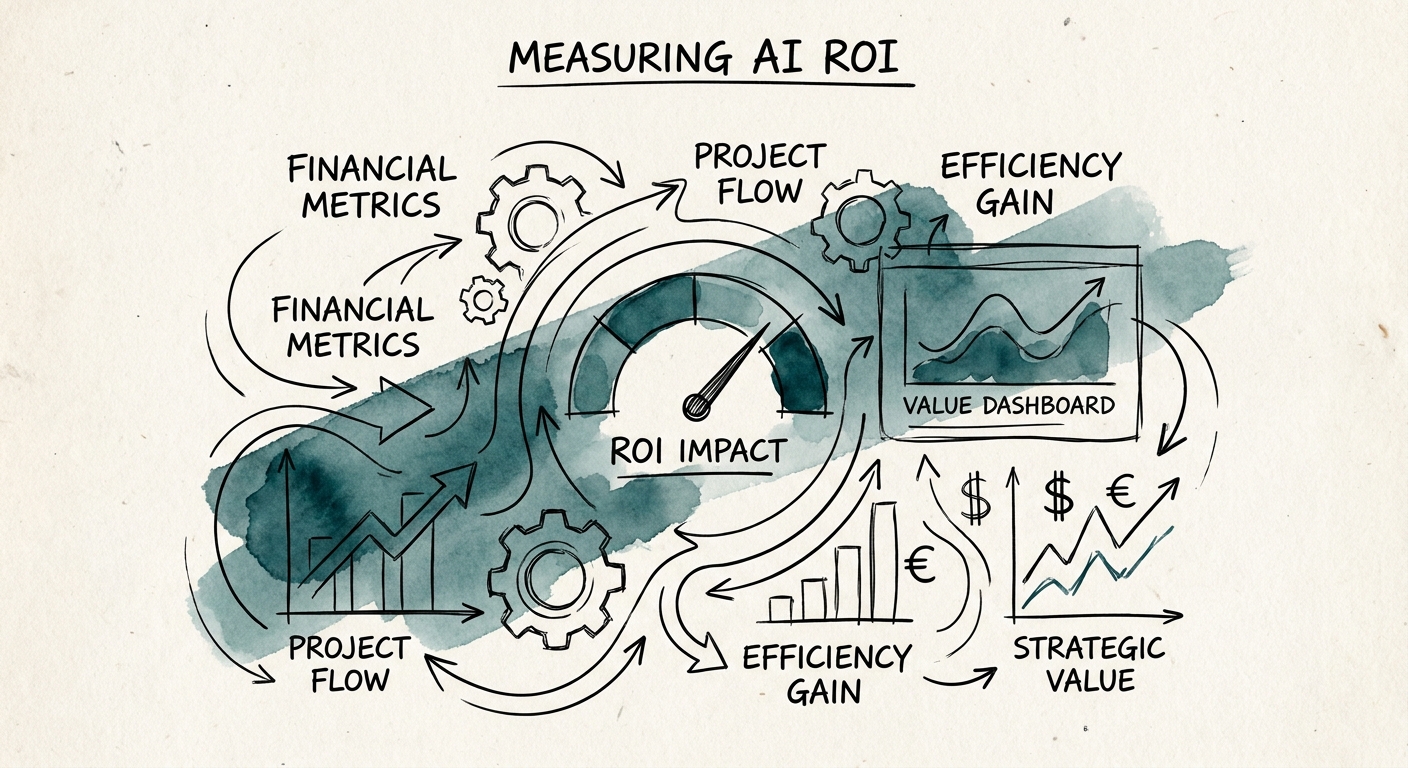
The green dashboard nobody trusted
Picture a 120-person technology-services firm running eleven client deliveries at once. Every Friday the delivery leads spend two hours each assembling status decks — pulling from the ticket system, three Slack channels, last week's deck, and whatever the engineer muttered in standup. The AI rollout was supposed to kill that two hours. It did. The new tool drafts every status in ninety seconds.
Six weeks later the steering committee is still asking the same three questions in every review: Is the integration milestone actually at risk? Who owns the data-migration sign-off? Why did this slip and when did we know? The report got faster. The meeting didn't get shorter. That gap is the entire ROI question, and it's specific to this document type: a status report's value isn't in how it looks, it's in whether it changes what leaders do on Monday.
Atlassian's State of Teams 2025 is the relevant lens here because status value lives in coordination and work visibility — not formatting. A faster draft that still leaves owners ambiguous and dependencies fuzzy has automated the typing, not the coordination. And as IBM's Institute for Business Value AI capabilities research frames it, the thing worth measuring is the capability behind the report, not the report. So baseline five things before the tool touches a single deck: how old blockers are when leadership first sees them, how often a milestone slips without warning, how many statuses arrive late, how many owners are listed as "the team," and how many decisions get deferred because nobody trusted the narrative enough to act.
The failure mode is omission, not error
Most AI-quality worry is about hallucination — the model inventing a fact. Status reporting has a quieter, more dangerous failure: omission and softening. The AI summarizes a thread where an engineer flagged a red dependency in passing, and the draft renders it as "integration progressing on schedule." Nobody lied. The signal just didn't survive summarization. In a status report, a buried red is worse than a wrong number, because the whole point of the document is escalation.
This is exactly the map-measure-manage-govern discipline in the NIST AI Risk Management Framework. For status reporting, the failure modes to measure are concrete: does the draft preserve every flagged risk, does it name a human owner for each open item, does it carry the date a slip was first known? Write those as acceptance checks the draft must pass — a status that downgrades a red without a human confirming it is a defect, not a style preference.
Then there's the source-of-truth problem, which is unusually thorny for status because the inputs are scattered: email, chat, decks, the task system, shared docs, half of them with mixed permissions. The Microsoft 365 Copilot data protection architecture is the right reference for why this matters — if the tool can read a channel a contractor shouldn't see, your status report can quietly leak client-confidential delivery detail into the wrong deck. Your ROI model has to price in source approval, permission boundaries, and a named reviewer who signs the draft. A status report that's fast but indefensible isn't a win in a client-services firm; it's a liability with a timestamp.
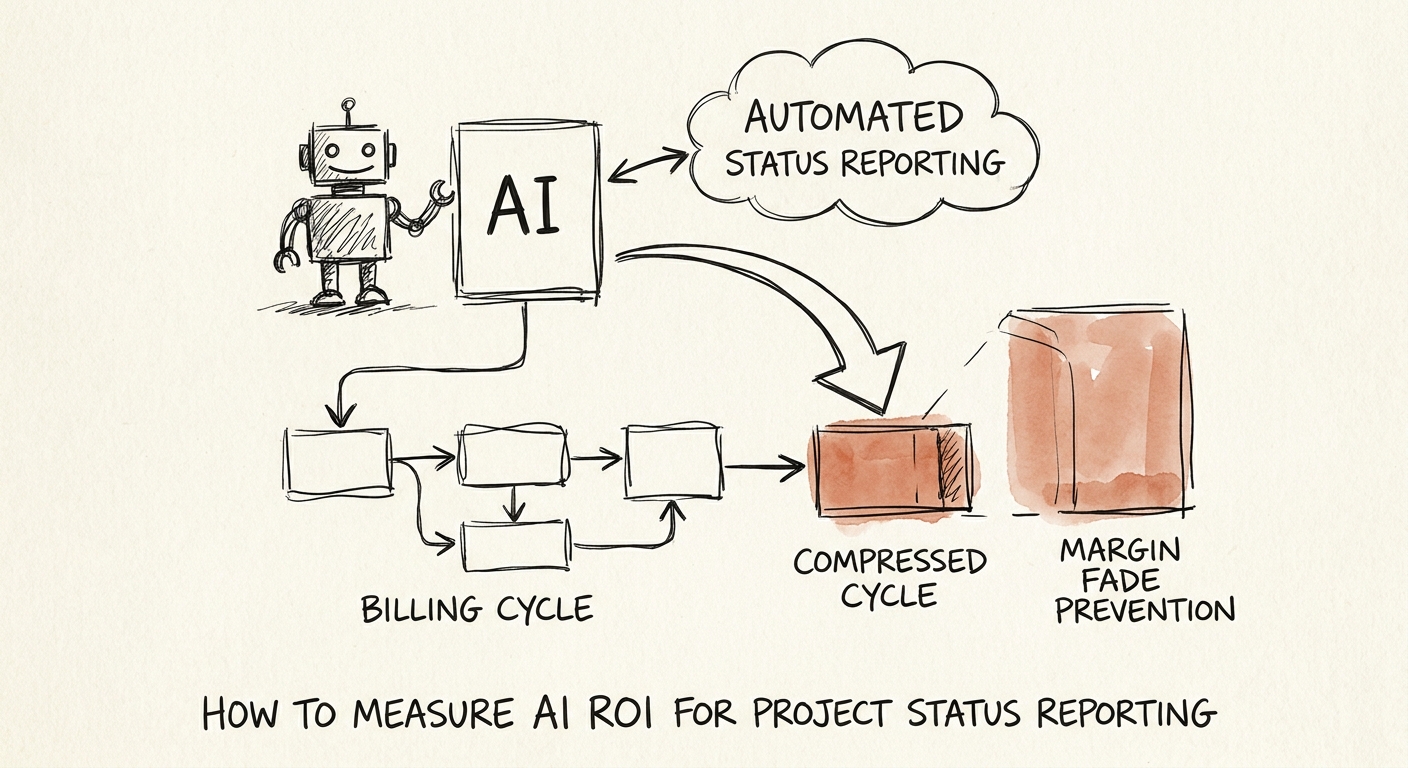
Run the 90-day test that actually settles it
Pick one delivery portfolio. Keep the old hand-built status running in parallel with the AI draft for ninety days — same projects, same cadence, two versions. Then compare the things that matter: did blocker age at first-escalation drop, did the steering committee stop re-asking clarification questions, did decision latency shorten, did prep time fall without a reviewer having to rebuild the draft from scratch every week? If a delivery lead has to spend forty minutes correcting omissions before sending, you haven't saved two hours; you've moved them.
Two honest outcomes. If the AI draft surfaces reds earlier and the review meetings get shorter, expand it across portfolios — you've proven the capability, not just the speed. If the meetings stay long, the answer is almost never "buy a better model." It's that your projects don't have clean owners or trustworthy inputs, and no summarizer fixes that. In that case the AI told you something valuable for free: fix project governance first, then automate the reporting on top of it.
Want to put numbers to your own baseline? Run the AI ROI Calculator against your current status-prep hours and decision-latency, check the AI Opportunity Score to see whether reporting is even your highest-leverage starting point, and see how we'd scope it at Human Renaissance AI transformation services.