At ten people, a failed rollout costs more than the invoice
Picture a 10-person professional services firm. The owner runs sales, signs off on every proposal, and is the escalation point when a client gets cranky. There is no operations department. There is no "innovation budget." When someone sells this firm a $40,000 AI transformation program, the real cost is not the $40,000. It is the six weeks the owner spends in discovery workshops, the prompt library nobody opens after week two, and the credibility hit when the team concludes "AI doesn't work for us."
That is the trap. So before you ask what AI consulting costs, ask what you are actually buying. At your size, you are not buying a strategy. You are buying back one specific hour that one specific person spends every week on work a machine could draft. If a consultant cannot name that hour, that person, and that workflow before quoting you a number, the number is meaningless.
The research consensus is blunt about why these projects die. Across PwC's CEO survey, RAND's reports, MIT Sloan, Gartner, and McKinsey's State of AI, the recurring failure is treating the model as the strategy and ignoring the workflow wrapped around it. A 250-person company can eat that mistake. A 10-person firm cannot — every botched rollout burns management attention you don't have a backup for.
Three scopes, and which one your firm should buy
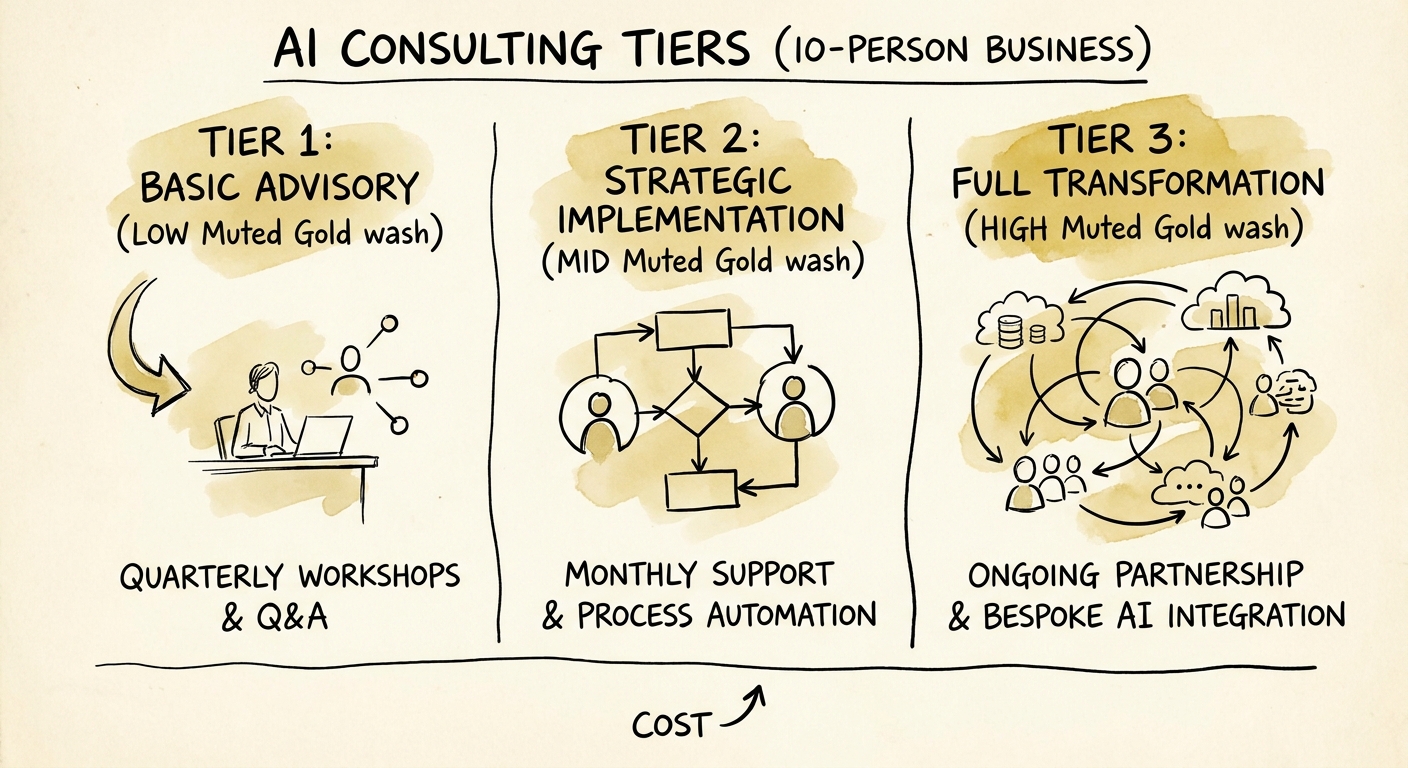
AI consulting at your size comes in three honest shapes. The difference is not price tier — it's how much certainty you already have.
Scope one: the workflow audit. Buy this when you genuinely don't know whether your bottleneck is process, data, adoption, or tooling. A good audit maps your real workflows, finds where work repeats or stalls, checks whether the source data is clean enough to feed a model, and comes back with a short list: do this first, do this later, don't touch this yet. Watch for the tell — if the deliverable is a vague "roadmap" instead of a ranked list of three named workflows with owners attached, you bought a slide deck.
Scope two: one workflow, built. Buy this when you already know the target. Say the firm's proposals are slow because every one starts from a blank page and the owner's scattered call notes. A scoped build turns those notes into a structured first draft that the owner still reads and edits before it reaches a client. That single change can hand back the Friday afternoon that used to vanish into proposal formatting. Notice what it is not: it is not "deploy AI across the business." It is one workflow, one owner, one before-and-after number.
Scope three: multi-system automation. This is the one to be suspicious of at ten people. Chaining steps across your CRM, email, and billing sounds efficient, but agentic workflows demand cleaner data, real exception handling, and ongoing babysitting that a team your size has nobody to staff. Don't buy this until scope two has already proven, in numbers, that the simpler version works.
Before you approve any of it, run the candidate through the AI use-case scoring model — value, feasibility, risk, adoption effort, measurement clarity. If it scores weak, the smartest place for the next dollar isn't a bigger AI build. It's cleaning up the process you were about to automate.
The four questions to ask before you sign
You don't need a procurement department to negotiate this well. You need four answers in writing before the statement of work is approved.
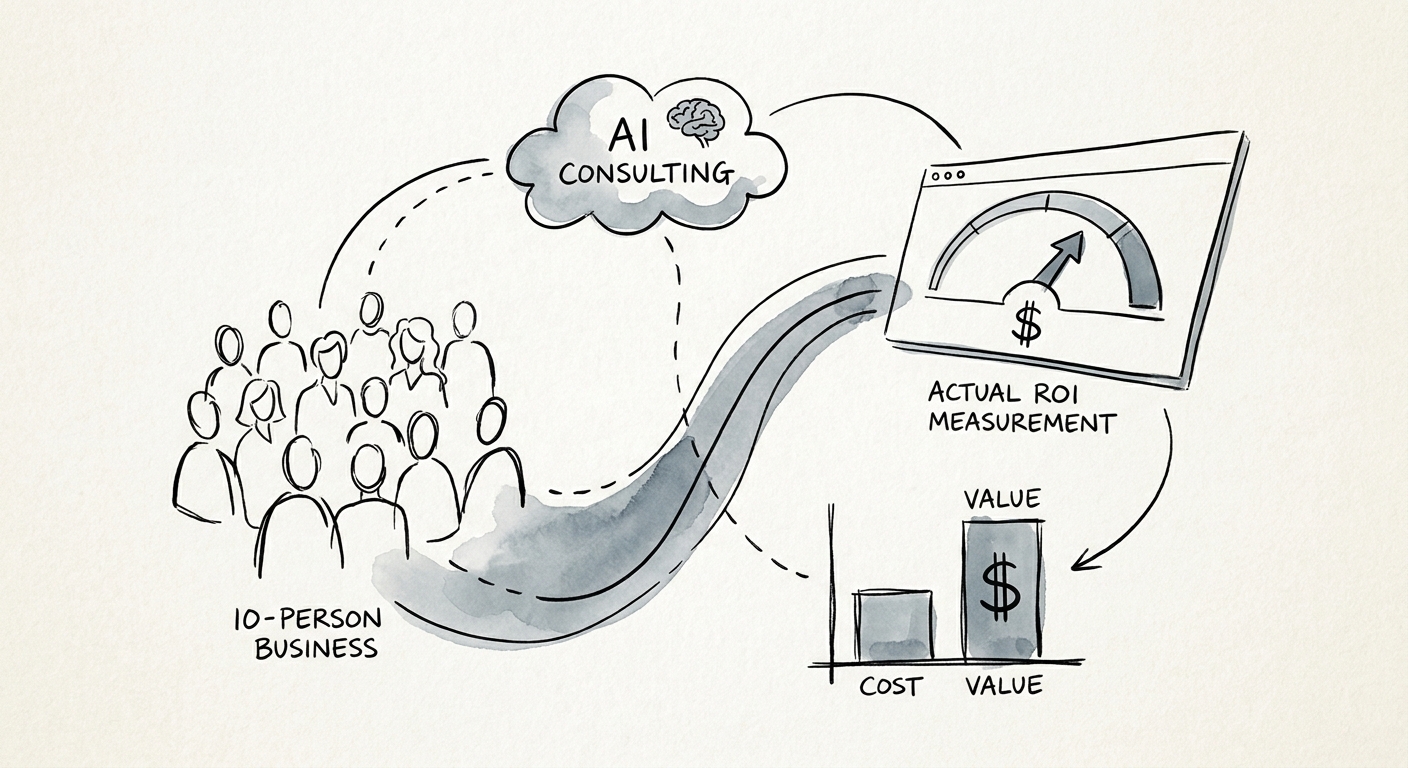
Where does the value land? Not "saves 20 hours a month" — that's a saved-minutes fantasy unless those minutes turn into something. Make the consultant show whether the freed time becomes billable capacity, faster client response, a hire you can delay, or rework you stop paying for. One of those, named.
Who reviews the output? At your size the answer matters more than at scale, because the reviewer is usually the owner. Which drafts go straight to staff? Which need a sign-off? Which client-facing message can never auto-send? Which data must never touch a public tool? That review map isn't bureaucracy — it's what lets ten people use AI without creating a privacy or client-trust mess that takes the whole firm down.
What's the baseline? If nobody wrote down how long proposals take today, you will never prove they got faster. Measure before you build.
What happens when it's wrong? Every AI workflow produces a bad output eventually. The plan for that day is part of what you're buying.
Two practical starting moves. If your first candidate workflow leans on messy sales data, do CRM cleanup before you automate — automating bad data just produces wrong answers faster. If you want to weigh a few paths before spending a dollar on a consultant, run the AI Opportunity Score, then pressure-test the money with the AI ROI Calculator. The right spend for a 10-person firm is the smallest one that proves a single real workflow improves under human review. Start narrow. Scale only after the result is something you can point at.