The 50-person trap: too big to wing it, too small to staff it
Picture a 50-person company. Say a regional services firm or a B2B software shop doing $8-15M. Someone's already running Copilot or ChatGPT on a personal account. A department head wired up an automation in a free tool that now quietly handles invoices, and nobody documented how. You're past the experiment stage. But you don't have a VP of Data, a security team, or a spare director to babysit a rollout. That's the squeeze: enough process repeatability for AI to pay off, not enough management bandwidth to run it loose.
So when a consulting quote lands, the real question isn't "is this expensive?" It's "does the first dollar attach to work I can actually measure three weeks from now?" McKinsey's State of AI 2025 is blunt about why this matters: the value shows up when AI is wired into a redesigned workflow, not when it's bolted onto the side as a clever toy. The companies seeing returns changed how work flows. The ones that didn't bought licenses and hoped.
Here's the trap to watch for. A vague engagement hides everything — diagnosis, data cleanup, integration, security review, training, and benefits tracking — under one line that says "AI implementation." At 50 people, that's how you end up six weeks in, $40K down, with a slide deck and no faster Tuesday. IBM's Institute for Business Value frames the same point as capability: working AI rests on data, operating model, adoption, and measurement. A serious estimate names those lanes separately so you can see what you're paying for — and cut what you don't need yet.
The line item that quietly doubles the bill: your permissions are a mess
Here's what most 50-person buyers underprice. The moment you point an AI assistant at your company's content, it inherits whatever access your people already have — and at this size, that access is almost always sloppy. The old SharePoint folder everyone can see. The Teams channel with the comp spreadsheet in it. The CRM export sitting in a shared drive. Microsoft's Copilot data protection architecture spells it out: the assistant respects your permission boundaries, which is great if those boundaries are clean and a liability if they're a decade of "just give them access so they stop asking."
If a consulting scope says nothing about auditing who can see what before turning the model loose, that engagement isn't pricing the actual risk — and the cleanup will surface mid-build as a surprise invoice. Make permission review a named gate, not a footnote.
You don't need an enterprise governance program for this. You need a small, owned sequence. NIST's AI Risk Management Framework gives the shape: map the context, measure how it can fail, manage the controls, and — the part 50-person companies skip — assign an owner. One name. PwC's 2025 Responsible AI survey makes the case that these controls only work when they live with the people making build-and-rollout calls, not in a policy PDF nobody opens. Budget the controls into the first engagement. Pricing them as an afterthought is how the afterthought becomes the emergency.
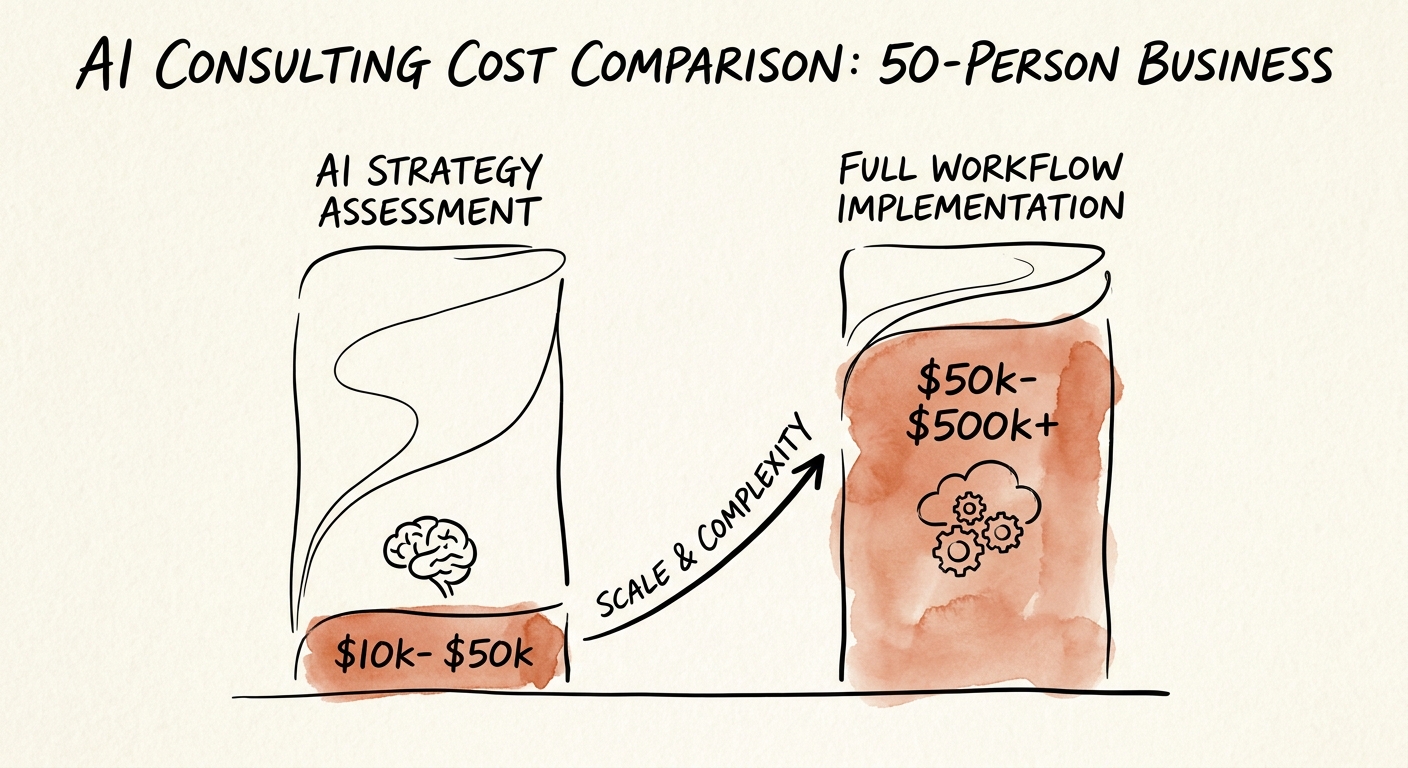
What a good first check actually buys: one workflow, proven
Resist the urge to fund a "transformation." At 50 people, the first engagement should be small enough to finish and concrete enough to judge. Its job is to produce four things: a ranked backlog of use cases, one workflow rebuilt and running with controls on it, a baseline-vs-after number you trust, and a stop-or-scale decision you make on a set date. That's it. Bain's agentic AI research is clear that the more ambitious automated workflows only pay off once the foundation work is done — so doing the foundation as your first proof isn't slow, it's the thing that makes everything after it cheaper.
A useful gut check on any quote: would your CFO, your ops lead, and your most technical person each be able to point at the result and say what changed? If the engagement can't survive that three-person inspection, it's a tour, not an investment.
If you want to pressure-test a quote before you sign it, run your shortlist of workflows through the AI Opportunity Score to see which one earns the first dollar, then model the before/after on the AI ROI Calculator so the number is yours, not the vendor's. When you're ready to scope the engagement around proof instead of hours, our AI transformation services are built for exactly this size of company.