The quote that should make you walk
You run a 25-person company. A consultant sends a proposal: "AI Transformation Program — Phase 1: Discovery & Roadmap, $45,000." No named workflow. No baseline number. No person on your team who owns the result. That's the quote you walk from, because at 25 people you don't have a five-person AI office to absorb a roadmap that goes stale by the next quarter. You have one ops lead who's already running payroll, the help desk, and the new hire's laptop setup.
The cost question isn't "is this consultant expensive." It's "does the first dollar tie to work I can measure." McKinsey's State of AI 2025 is blunt on this: the value shows up when AI is wired into a redesigned workflow, not when it's bolted on as an experiment. A roadmap deck is not a redesigned workflow. It's a bill for a slide library.
So before you read the dollar figure, read the scope for a noun and a number. The noun is the workflow — "drafting client onboarding docs," "triaging inbound support tickets," "reconciling the AP queue." The number is what that workflow costs you today in hours. If the proposal can't name both, you're not buying an implementation. You're buying optionality you'll never exercise.
The line item nobody quotes you — until it breaks
Here's where 25-person companies get burned, and it's not the consulting rate. It's the control work that never made it into the estimate. Say you drop an AI assistant on top of your file storage and chat tool to answer "where's the contract for account X." The assistant inherits whatever permissions your content already has. If your SharePoint, your shared drives, your CRM exports, and your finance folder are loosely governed — and at 25 people, they almost always are, because nobody's had time — the assistant will happily surface the salary spreadsheet to whoever asks. Microsoft's own Copilot data-protection architecture spells this out: the tool respects your existing access boundaries, which means your existing mess becomes its blast radius.
That cleanup is real budget, and a consultant who doesn't quote it is either inexperienced or hoping you won't notice until it's a change order. Ask for it as a line item. The NIST AI Risk Management Framework gives you the sequence to demand in plain terms: map where the tool will reach, measure how it can fail, manage the controls, and name who owns each one. At your size, "who owns it" is the trap — it can't be a committee, and it can't be the consultant after they leave. PwC's 2025 Responsible AI survey makes the point that policy only protects you when it lives with the people actually shipping the work. In a company your size, that's likely one named person. Put their name in the contract.
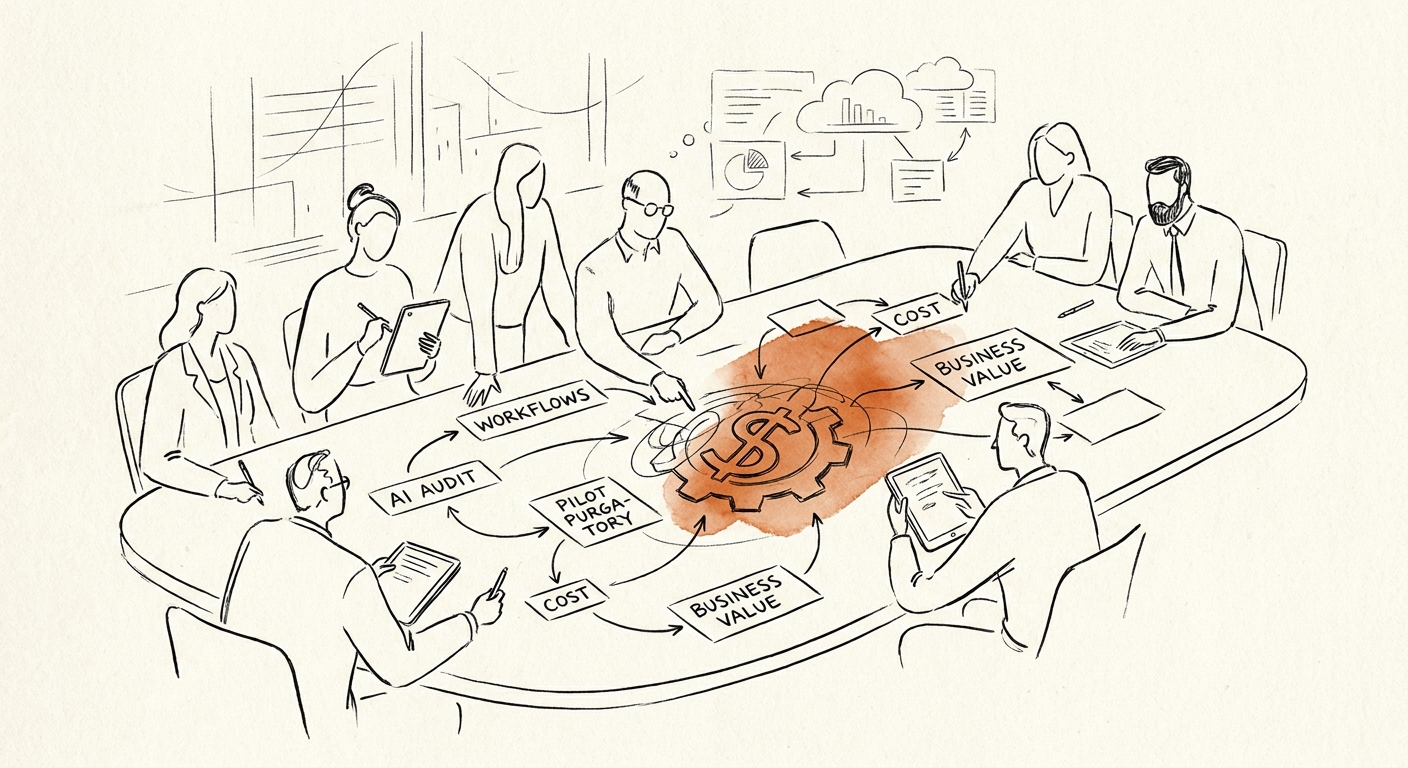
Buy one workflow, not a transformation
Restructure the engagement around a single proof. For a 25-person business, a sane first scope reads: a ranked shortlist of where AI actually saves hours, one workflow built and governed end to end, a baseline metric captured before you start, and a clear stop-or-scale decision at 90 days. That's it. Bain's 2025 research on agentic AI reinforces why this order matters: the ambitious autonomous-agent stuff only works once the foundation — clean data access, a defined process, an owner — is in place. Skip the foundation and you've paid for a demo that can't survive contact with your real Tuesday.
So when the quote arrives, do three things. Force a noun and a number into the first scope. Make them itemize the data and access cleanup instead of burying it in "implementation." And name the one person who owns the result after the consultant's gone. If a vendor won't do all three, the price was never the problem.
If you want to pressure-test a proposal before you sign, run the AI Opportunity Score to see which workflow is worth funding first, then put the consultant's promised savings through the AI ROI Calculator. Both feed into how we scope AI transformation work — as an operating case your finance, ops, and tech people can each inspect line by line.