The 250-person trap nobody quotes you for
Here is the spot a 250-person company sits in, and why it makes AI consulting so easy to overpay for. You're past the stage where one person knows where every file lives. You have real departments — sales, finance, ops, a help desk, maybe an actual IT manager — but you almost certainly don't have a dedicated AI team. So when a consultant hands you a proposal with a tidy "AI implementation" line, you have no internal counterweight to ask the only question that matters: what work is actually behind that number?
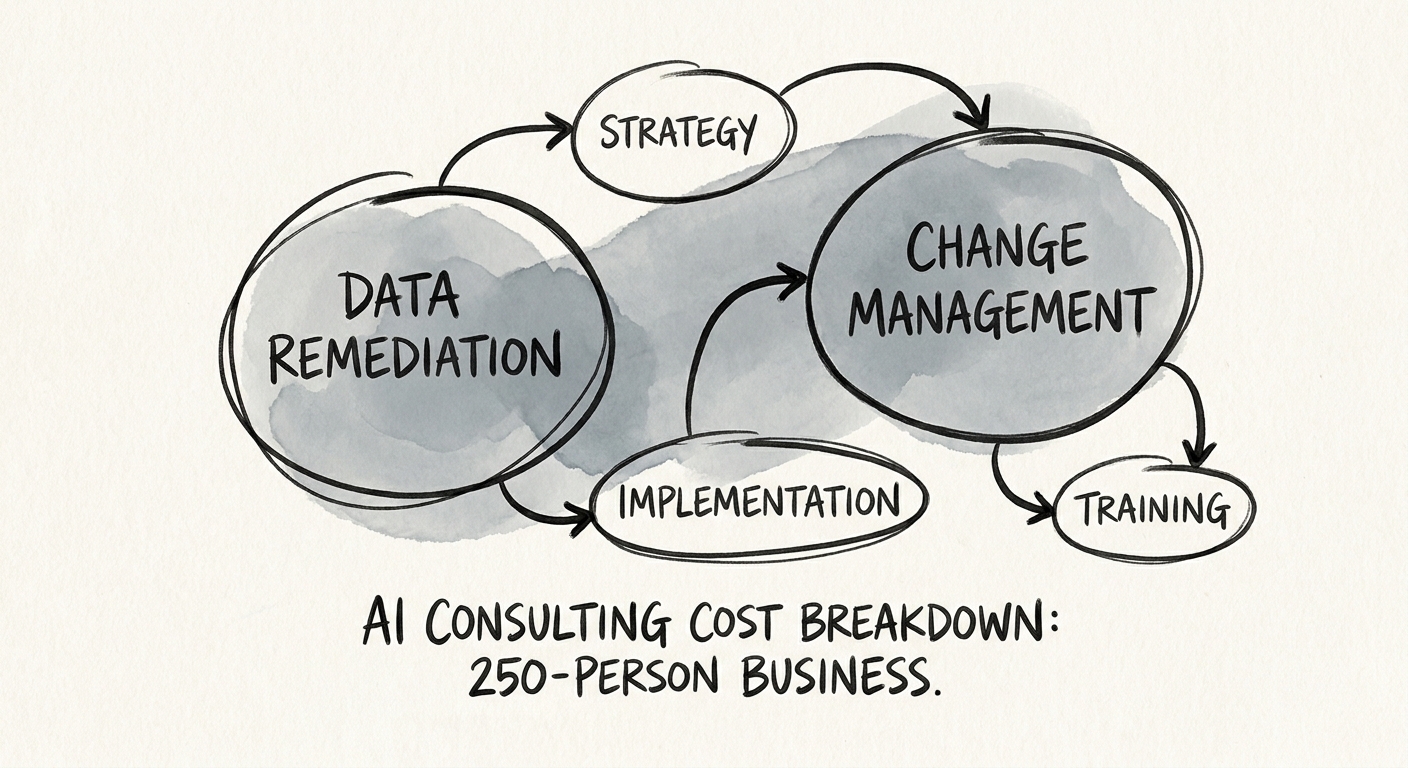
Most of the real cost has nothing to do with the model. Say you want to roll a copilot across your 60-person sales and service org. The "build" might be a week. The expensive parts are: figuring out which of your six years of SharePoint folders the assistant is allowed to read, cleaning a CRM export full of duplicate accounts, deciding who owns adoption when the reps stop using it in week three, and proving the thing saved anyone time. McKinsey's State of AI 2025 keeps landing on the same finding — value shows up when AI is wired into a redesigned workflow, not bolted onto an existing one. A proposal that doesn't price the workflow redesign is pricing a demo.
IBM's Institute for Business Value frames it as a capability problem: data, operating model, adoption, measurement. Translate that into a 250-person budget and you should see distinct line items for diagnostic, data cleanup, workflow integration, security review, training, and benefits tracking. If those six things are collapsed into one word, that's not a discount — it's where the overruns hide.
At your size, access is the line item that bites
This is the part that's specific to a company your size, and it's where the cheap-looking quote turns expensive. A 5-person shop has one shared drive. A 5,000-person enterprise has an identity team policing permissions. You have neither — you have 250 people, years of accumulated folders, a finance directory nobody has audited, and HR files that absolutely cannot surface in a chat answer. An AI assistant inherits whatever permissions you already have, which means it inherits whatever mess you already have.
Microsoft's Copilot data protection architecture spells out why this is a budget question and not an IT footnote: the assistant respects your existing content boundaries, so if your boundaries are loose, the tool will confidently expose things you forgot were shared. Pricing an engagement that skips the SharePoint, Teams, CRM, and finance-file review isn't a lean scope. It's an uninsured one.
The fix isn't a 40-page policy. NIST's AI Risk Management Framework gives a sequence a mid-market team can actually run: map where it'll be used, measure how it can fail, manage the controls, and put a name next to each one. And PwC's 2025 Responsible AI survey makes the point that matters for you specifically — at 250 people, "governance" can't be a committee that meets quarterly. It has to live inside the team shipping the workflow, because that team is also the team that owns the cleanup. Budget the controls into the first scope, or pay for them later as an incident.
Buy one governed workflow, not a transformation
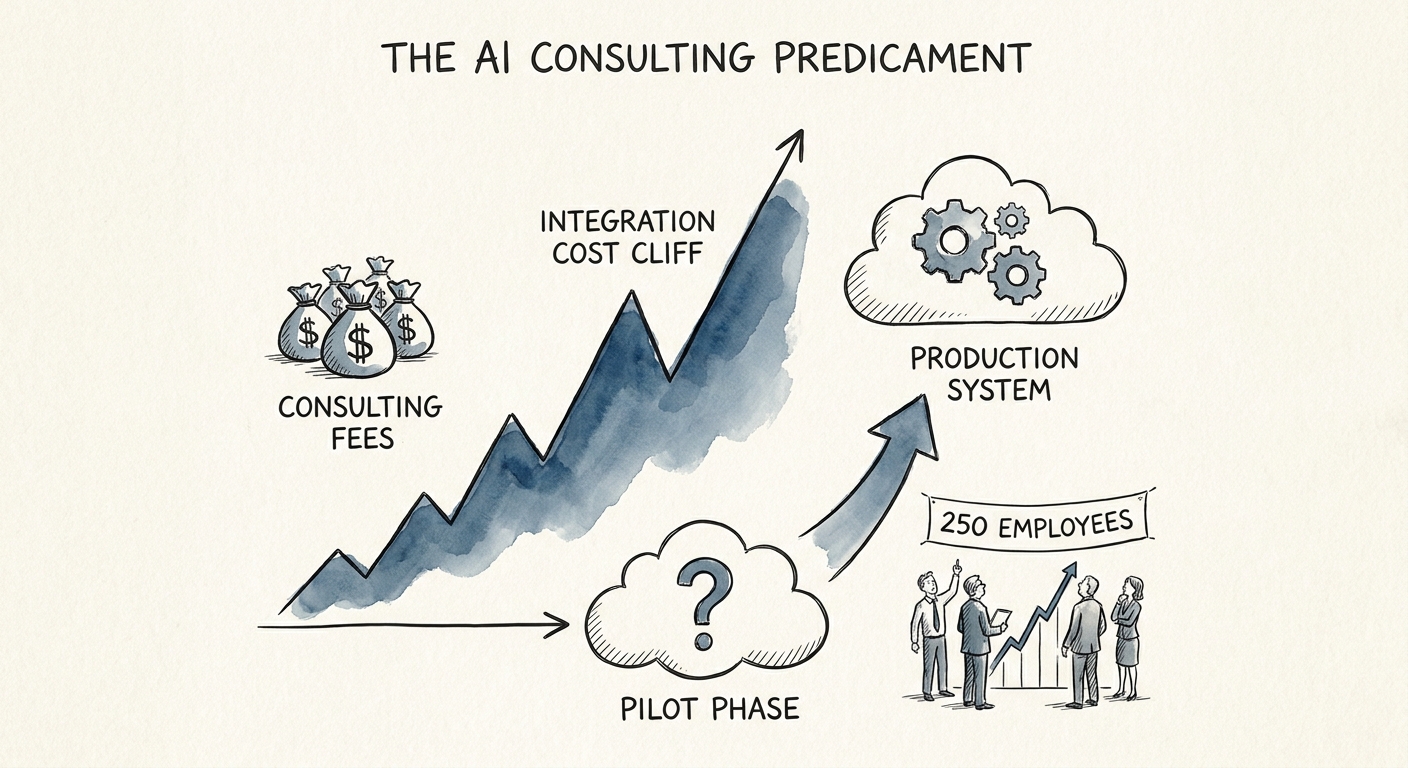
Here's the decision in front of you on Monday. A consultant wants funding for an enterprise-wide rollout. You don't have the org muscle to absorb that yet, and you can't tell finance what you'd get for it. So don't buy it. Buy a first engagement that fits a 250-person company: a use-case backlog ranked by value and risk, one workflow built and governed end to end, a baseline metric measured before and after, and a clear stop-or-scale call in roughly 90 days. Bain's agentic AI research is blunt about why — the ambitious agentic stuff only pays off once the foundation work is done, and the foundation work is exactly what a focused first scope is for.
Three gates make a proposal worth signing at your size: workflow value (does it change a real Tuesday for a real team), data access (is the cleanup and permission review priced in), and an adoption owner (a named person, not "the org"). If a quote can't answer those, the number on it is irrelevant.
Pressure-test your next proposal before you sign. The AI Opportunity Score ranks where the value actually is for a company your size, the AI ROI Calculator turns a vendor's promise into a number finance can check, and Human Renaissance AI transformation services scopes the first engagement so operations, finance, and IT are all looking at the same case.