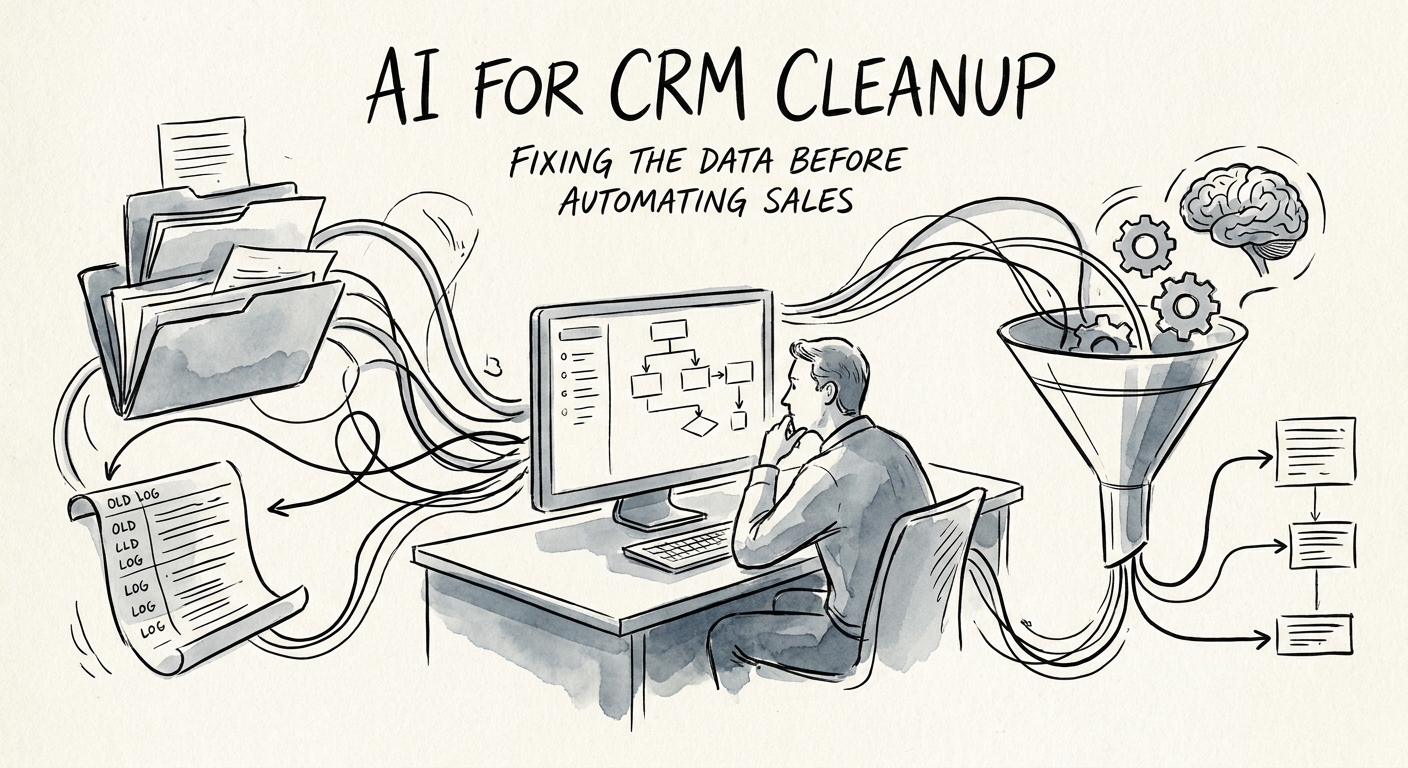
The Friday pipeline meeting nobody believes
Picture the deal review at a 60-person software company. The dashboard says $4.2M in commit. The VP of Sales pulls up the top ten opportunities and within four minutes the meeting has degraded into archaeology: that account closed in March under a different name, this one has a next step of "follow up" dated nine weeks ago, that $300K deal has been in "Negotiation" so long the buyer changed jobs. Nobody is forecasting. Everybody is arguing about whether the data is real.
This is the actual starting condition for most sales-AI projects, and it's exactly why pointing automation at the CRM first is a mistake. AI doesn't audit a dirty record before it acts on it. It scores it, routes it, drafts a follow-up email off it, and feeds it into the forecast roll-up at speed. A duplicate account doesn't get resolved; it gets two AI-generated sequences fired at the same buyer. A stale stage doesn't get questioned; it gets weighted into the number you take to your investors. The mess doesn't go away. It gets industrialized and harder to challenge.
The RSM middle-market AI survey shows growing companies are racing to adopt, but the right first question for a sales leader isn't "can AI clean my CRM." It's narrower and more useful: which specific records are corrupting the forecast, breaking rep follow-up, or blowing up handoffs to onboarding? Answer that, and cleanup stays tethered to revenue instead of drifting into a data-hygiene project nobody can connect to a closed deal.
Which records to fix, and who gets to overwrite them
Skip the urge to "clean everything." Start by listing the nine fields that actually move a decision: account owner, stage, close date, amount, next step, last activity date, lead source, product interest, and expansion or renewal signal. Everything else is cosmetic. Then rank defects by how often the field is used in a real moment, the pipeline meeting, the renewal forecast, the rep's Monday call list, not by how ugly the record looks in a spreadsheet.
AI is genuinely good at the grunt work here. It can cluster likely duplicate accounts ("Acme Inc." vs. "Acme, Incorporated" vs. the contact's gmail address), summarize a 40-minute call recording into a clean next step, flag every opportunity whose close date is in the past but is still marked open, and catch the deals sitting in a stage that contradicts their last activity. What AI must not do is silently overwrite a forecast-bearing field.
So tier the changes by blast radius. Low-risk normalization, fixing "Calfornia" to "California," merging an obvious dupe with no open deal, can run in batch with a log. Anything that touches stage, amount, or close date routes to the deal owner or RevOps lead as a suggestion, with the source evidence attached: "Proposing stage move to Closed Lost; last activity 73 days ago, no reply to three emails." Enrichment pulls from your contracted data provider, not whatever the model scraped off the open web and presented with false confidence. The OECD SME AI adoption report frames usable data and organizational readiness as the real adoption gates for smaller firms, and CRM cleanup is the cheapest readiness test you'll ever run: if your team can't agree on who approves a stage change, you are not ready to let AI auto-progress deals.
The only metric that proves it worked: forecast variance
A prettier CRM is not a result. The result is a forecast your VP of Sales will sign her name to. So measure the cleanup in operating terms, not record counts: duplicate rate, count of opportunities missing a next step, number of stage changes the AI proposed versus how many a manager overrode, and above all forecast variance, the gap between what you called at the start of the quarter and what actually closed. If duplicate rate drops but forecast variance doesn't move, you cleaned the wrong fields.
Watch the override volume specifically, because it's your early-warning signal. High override rates in week two mean the AI's suggestion logic doesn't match how your team actually qualifies a deal, fix the rules before you scale, not after. The Deloitte State of AI report keeps hammering that value comes from process change, not the tool. In CRM terms, process change is concrete: reps trust the cleanup enough to stop keeping a private spreadsheet, managers actually review the flagged exceptions, and the Friday pipeline meeting argues about strategy instead of about whether the number is fake.
Do this Monday: pull your open pipeline, sort by last activity date, and count how many "commit" deals haven't been touched in 30 days. That number is your starting forecast risk, and it's the baseline you'll measure the cleanup against. When you're ready to extend past cleanup into scoring, routing, and outreach, AI for Sales and Marketing is the next step, the same forecast-accuracy discipline behind our infrastructure work, applied to the rest of the revenue motion. Scope sales and marketing AI once the data underneath it is something you'd defend to your board.