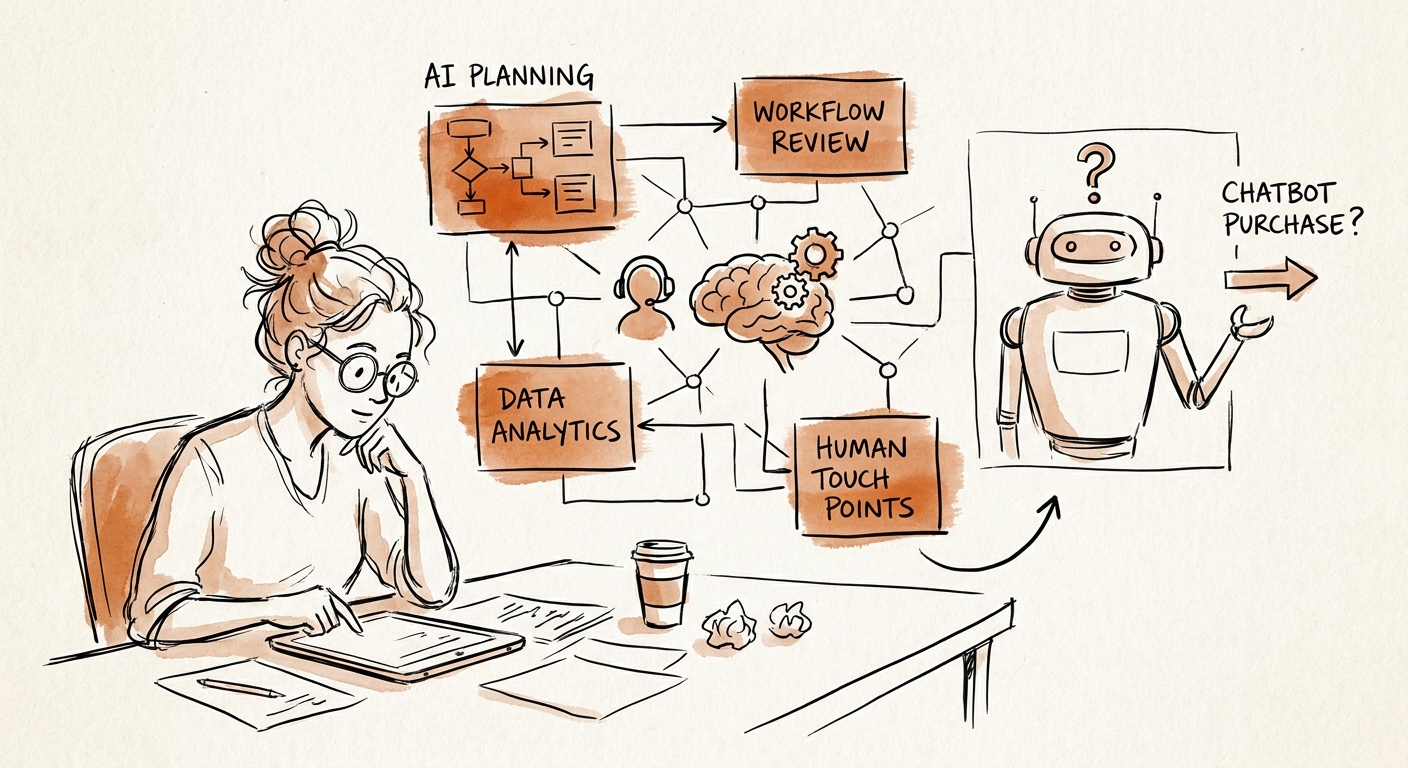
The chatbot is the most public place to be wrong
Picture a customer who emailed twice last week about a billing error, never got a clean answer, and is now staring at a chat widget that opens with "Hi! How can I help you today?" Whatever that bot says next is the first thing they read. If it's confidently wrong, you didn't save a ticket — you handed an already-irritated customer a fresh reason to screenshot you. That's the problem with starting support automation at the chatbot: it's the single most visible surface you own, and every mistake lands directly on the person you can least afford to lose.
Most support teams aren't slow because they lack a front-end bot. They're slow because tickets sit unclassified, the answer lives in a doc nobody updated since the last pricing change, and the agent burns four minutes hunting before typing a word. A 50-to-300-person company often has plenty of ticket volume to justify AI and almost none of the documentation hygiene, QA sampling, or routing discipline that an unsupervised public bot quietly assumes you already have. The San Francisco Fed's small-business AI analysis finds real interest across smaller firms — but interest in a tool is not the same as readiness to put it in front of customers.
The move is to automate everything that helps the agent answer faster and more consistently, and to do it where a wrong output gets caught before a customer ever sees it. That's not a downgrade from the chatbot dream. It's the work that has to exist before the chatbot is anything other than a liability.
Six workflows that earn the chatbot you want later
Walk a single ticket through its life and the automation map writes itself. One: triage on arrival. AI tags issue type, urgency, product area, and account context the moment a ticket lands — so the billing escalation from your largest account doesn't sit in the same undifferentiated queue as a password reset. Two: retrieval, not searching. Pull the approved knowledge article to the agent instead of making them dig through a folder where three versions of the refund policy coexist. Three: drafted replies with sources attached. The agent gets a proposed answer plus the document it came from, and approves or edits — they never blind-copy. Four: risk-based routing. Send the high-value or legally sensitive escalation to a human by rule, not by luck. Five: QA sampling. Score closed tickets for tone, completeness, and policy alignment at a volume no manager could review by hand. Six: theme summaries. Roll recurring complaints up to product and ops so the same issue stops generating the same fifty tickets.
Notice the pattern: every one of these has a human between the AI and the customer. A mislabeled ticket gets re-sorted in seconds. A weak draft gets rewritten before send. That review seat is the entire safety design, and the OECD's SME AI adoption report keeps landing on the same point — outcomes track organizational readiness, not tool access. The RSM middle-market AI survey shows adoption climbing fast in exactly this size band, which is precisely why the unglamorous internal work is where the advantage hides.
Keep an explicit do-not-automate-yet list and post it where the team can see it: sensitive complaints, policy or legal exceptions, escalations on your top accounts, and any answer that depends on a document you can't confirm is current. Holding those cases human-only isn't timidity — it's what makes customers trust the automated parts. The Gartner agentic AI forecast projects a wave of cancellations by 2027, and the projects that die are usually the ones that pointed an autonomous agent at customers before the boring guardrails existed.
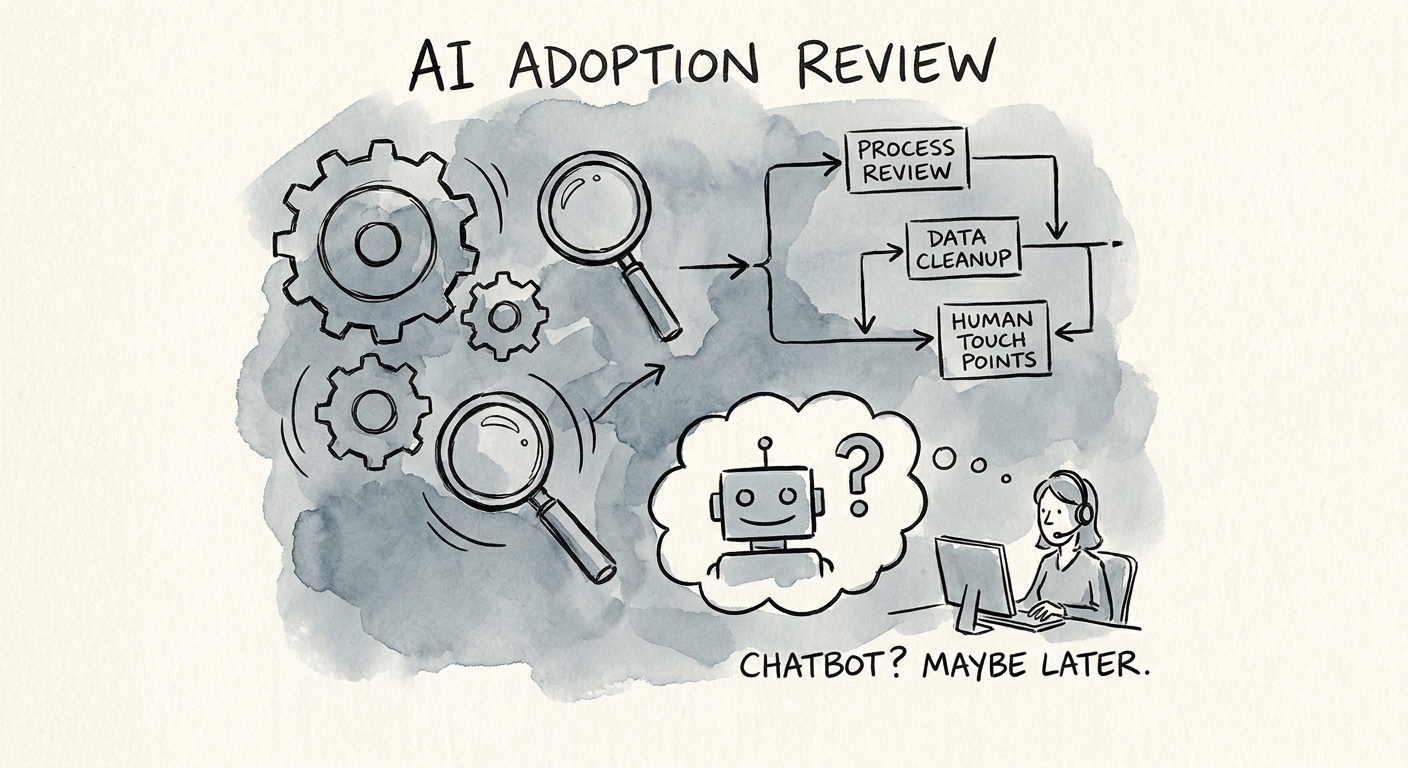
If CSAT drops while your numbers improve, the design is wrong
Measure support AI with support instruments, not AI vanity stats. Track first response time, reassignment rate, resolution time, escalation accuracy, reopen rate, backlog age, and what your QA sampling is actually finding. Here's the test that matters: if first response time falls and reopen rate falls but CSAT slips, your customers are telling you they feel processed instead of heard. Faster and more consistent is the goal — faster and colder is a failure you instrumented yourself into.
Build the trust controls into the system from day one, not as a later patch: confidence thresholds that send low-certainty cases to a person, source links on every draft so an agent can verify before sending, a human fallback path that's always one click away, and a named owner for stale content so the knowledge base doesn't quietly rot underneath the retrieval step. The Deloitte State of AI report keeps surfacing the gap between using AI and changing how work runs — in support, you close that gap when the review loop becomes part of daily shift management, not a quarterly audit.
So on Monday: pull last month's closed tickets, sort by issue type, and find the top three categories eating agent time. That's your first customer service workflow to automate — triage or retrieval, almost certainly, not a chatbot. We bring the same implementation discipline behind outcomes like 95% customer retention post-merger: the relationship gets protected first. Fix the service system before you buy the bot.