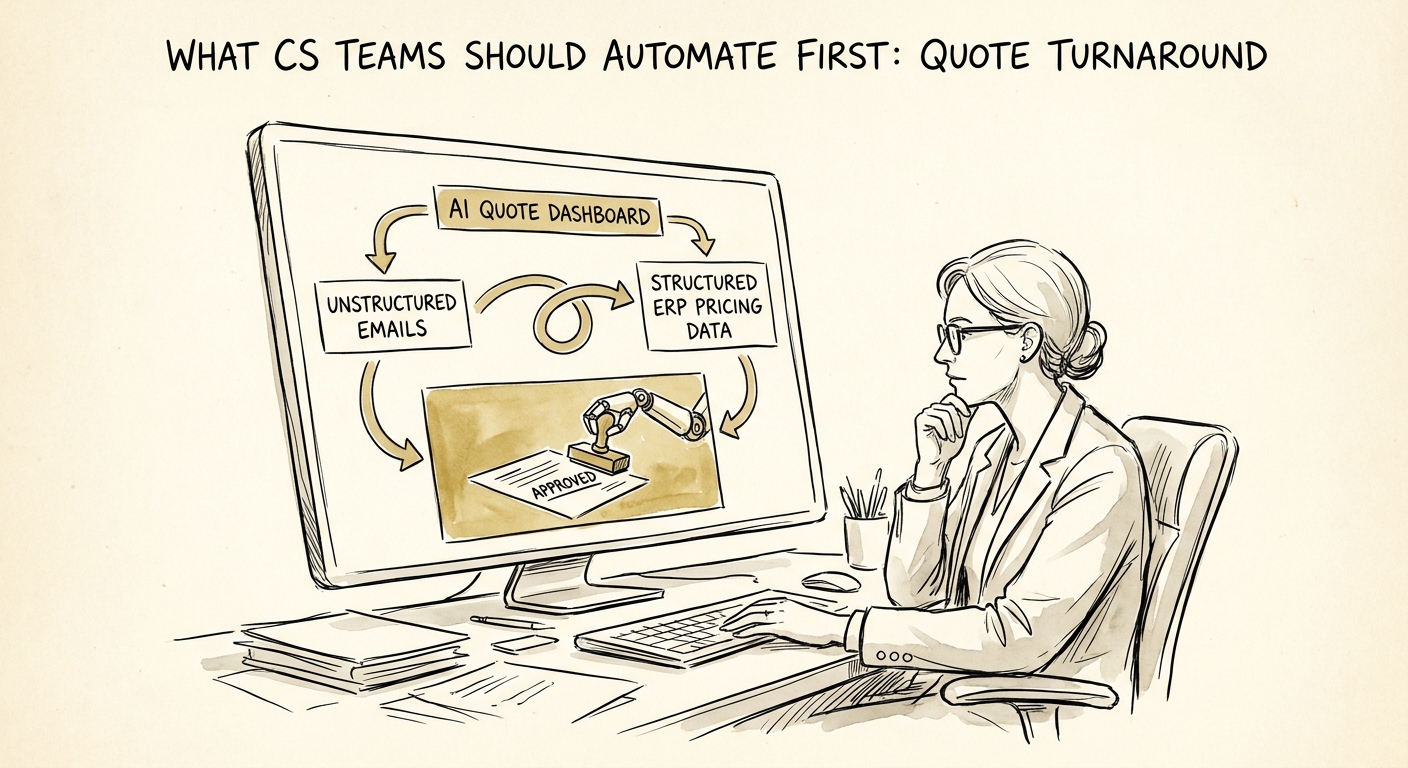
The quote that arrived Tuesday for a request sent Friday
Picture a 60-person industrial distributor. A buyer emails Friday at 4:12 p.m.: "Need pricing on 14 SKUs, two of them non-standard, ship to three locations." That email sits over the weekend. Monday morning a rep opens it, realizes two part numbers are ambiguous, emails back for clarification, waits, pulls pricing from a spreadsheet that's a version behind, and routes the non-standard items to a manager who's in meetings until 2. The quote goes out Tuesday afternoon. By then the buyer has two competing numbers and a preference. You weren't beaten on price. You were beaten on the clock.
That is exactly why quote turnaround is the right first AI use case for a customer service team, and why it beats "answer FAQs faster" or "summarize tickets." The work is repeated dozens of times a week, it's time-sensitive in a way that directly costs revenue, and every output is reviewable before it leaves the building. Both the Salesforce State of Service research and Salesforce State of Sales research describe the same squeeze service and sales teams feel: respond faster without dropping quality. Quote turnaround is where that squeeze is most expensive, because the customer is literally deciding who to buy from while you assemble the answer.
So be precise about what the AI does and does not touch. It reads the inbound request, extracts the line items, flags the ambiguous SKUs ("part #4471 — is this the 12V or 24V variant?"), checks what's missing before a human has to, pulls product and availability context, and assembles a draft quote packet. It does not set price, approve margin, or hit send. The first thing to do Monday is to map where your quotes actually stall — and you'll usually find the delay isn't the pricing math, it's the back-and-forth to nail down what the customer even asked for.
Bad source data turns a fast quote into a confident wrong answer
An AI that drafts quotes off a stale price file or an out-of-date inventory feed doesn't make you faster — it makes you wrong faster, and it makes you wrong with a polished tone the customer trusts. This is the unglamorous gate most teams skip. The RSM middle-market AI survey shows mid-market firms moving past experiments into real deployment, but quote work punishes sloppiness, because every error is a number a customer can hold you to. The OECD report on AI adoption by small and medium-sized enterprises lands on the same point from the data side: adoption succeeds or fails on data quality, clear process ownership, and skills — not on the model.
For a distributor or B2B services shop, that means deciding, before you build anything: which price list is the system of record, how current the inventory feed has to be, which customer-specific contract terms override list pricing, and which line items are simply not allowed to be auto-drafted (custom fabrication, freight on oversized items, anything with a tiered volume break). The NIST AI Risk Management Framework gives you the shape of the discipline without the jargon: map the workflow, measure whether the output is actually right, and manage what happens when it isn't. In practice that's three concrete rules — the AI may only read from one approved price source, it must mark any line it's unsure about instead of guessing, and it must hand off to a named human the moment it hits a non-standard item or a margin floor. Then pressure-test the savings against a real ROI model, because "we cut quote time 40%" means nothing if a third of those quotes now need a correction email.
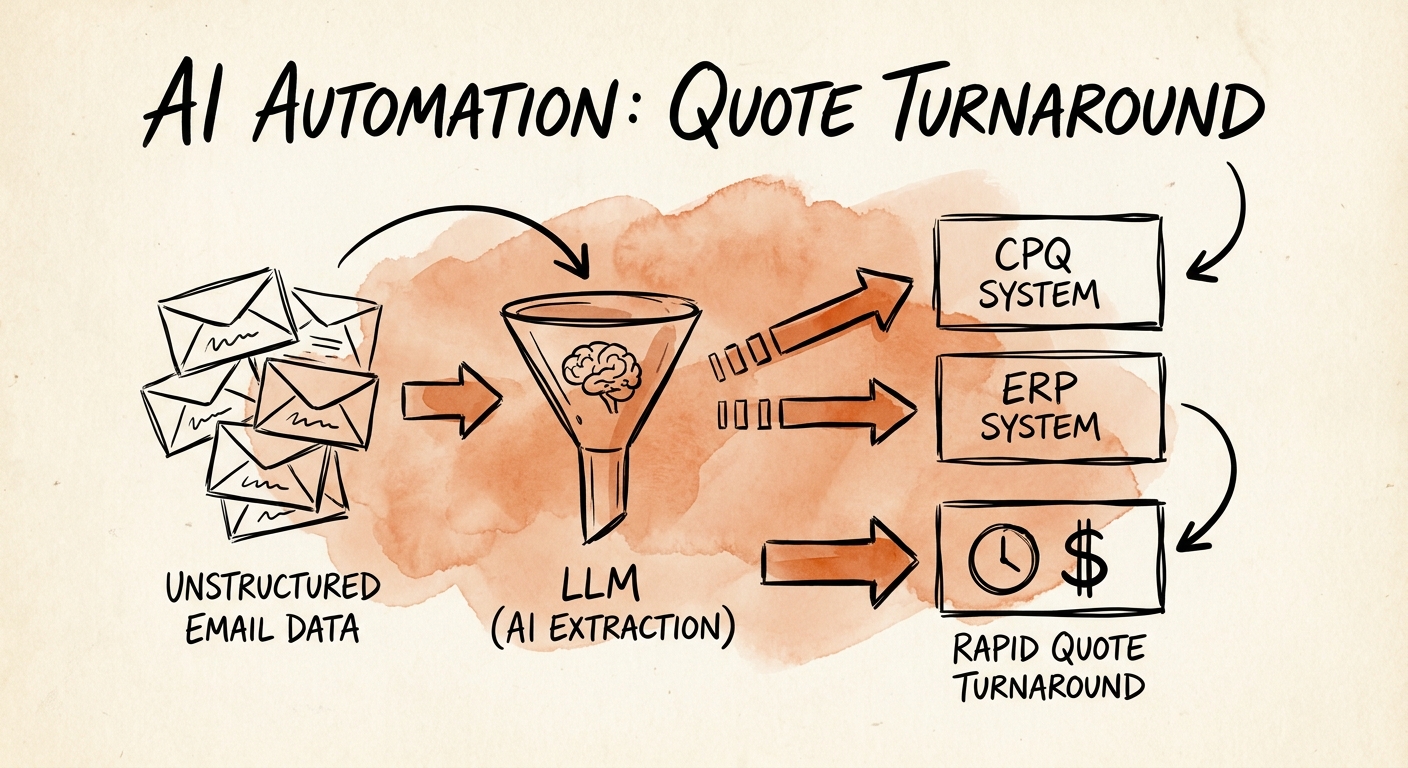
What "review weekly" actually looks like on a quote desk
The Deloitte State of AI report makes the distinction that decides whether this pilot is worth anything: are you redesigning the path from request to approved quote, or just generating a faster email at the end of the same broken process? The win isn't a slicker draft. It's that the rep who used to chase missing part numbers all morning now spends that time on the two deals that actually need a human to negotiate.
Run a tight weekly read of five numbers, not a vibe check: median quote cycle time (request in to approved quote out), the rate of quotes that went out missing information, how often a draft stalled waiting on an approval, the rework rate (quotes that needed a correction after sending), and the hours of rep capacity you handed back to higher-value work. If cycle time drops but rework climbs, you've automated the wrong step — usually because the AI is guessing on items it should be flagging. Tune the escalation rules, not the prose.
And hold one line without exception: no quote leaves without a human owning the price, the margin, and the customer commitment. The AI prepares the packet and drafts the message; a named person approves it. Speed and accountability ride together or the whole thing eventually burns a customer. If you want a concrete starting scope, take one quote workflow — say your most common multi-SKU reorder — one reviewer path, and one value measure, and run it through a 90-day implementation plan before you touch anything else.