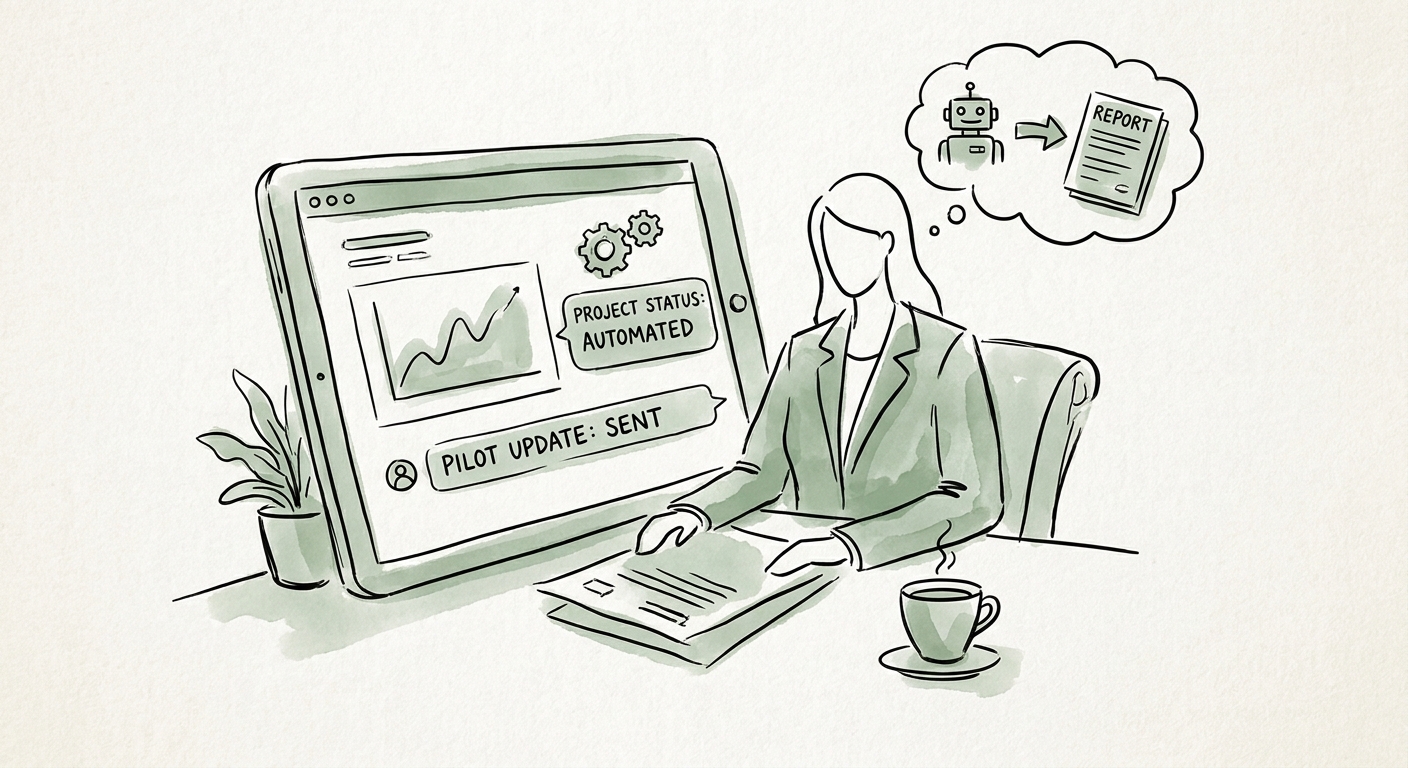
The deal that "closed" but never actually shipped
Picture a Friday forecast call. The rep says the 60-seat rollout is on track to recognize revenue this quarter. The CRM says "Implementation: In Progress." Both are technically true. What neither says is that the customer's IT lead went dark eleven days ago, the SSO integration is blocked on a ticket nobody owns, and the champion who signed the contract just changed jobs. The number on the board is fiction, and everybody finds out three weeks too late.
That gap — between what the CRM record claims and what is actually happening between signature and go-live — is exactly where sales teams should point their first AI automation. Not the cold-email generator, not the call-summary tool everyone demos first. Status reporting. The Salesforce State of Sales report documents how much of a seller's week disappears into updating, reconciling, and re-explaining deal state, and the Deloitte State of AI in the Enterprise 2026 shows adoption pressure landing hardest on exactly these handoff-and-forecast workflows. But adoption pressure doesn't tell you which workflow to start with. The reason to start here is specific: a status report is a closed-loop document where you can check whether the AI told the truth, because the truth shows up in the next forecast call.
For a sales org, the dangerous failure isn't a clumsy email. It's a polished summary that converts "champion went silent" into "onboarding proceeding nominally." The pilot's whole job is to make the AI surface the blocker — the stalled integration, the procurement hold, the slipped proposal deadline — and flag it for the account owner, instead of smoothing it into a green checkmark.
Pick a baseline that shows up on the forecast, not in a dashboard
Most AI pilots fail at measurement because they count outputs — "we generated 400 status summaries." That tells you nothing. For sales status reporting, measure the four things that actually cost you revenue when status reporting goes wrong:
Handoff misses: deals marked closed-won where Sales-to-CS handoff happened with stale or missing implementation context. Forecast surprises: deals that slipped a quarter where a known blocker existed but never made it into a forecast review. Proposal slippage: open deals where a deadline (security review, redlines, renewal date) passed silently. CRM-vs-reality drift: records where the stage or note didn't match what the implementation team or customer actually believed.
Count those for the four weeks before the pilot. Then, each week of the pilot, inspect the corrections an account owner had to make, the blockers the AI escalated versus the ones it buried, and the customer-facing claims it held for review. If the AI is working, those four baseline numbers move — fewer handoff misses, fewer Friday surprises. If they don't move but you're producing more drafts, the pilot failed quietly and you should kill it. Run the AI Opportunity Score to confirm status reporting is the highest-leverage starting point for your specific deal motion, and the AI ROI Calculator to put a number on what one prevented forecast miss is worth — but only after a named owner is on the hook for those baseline metrics, not the tool.
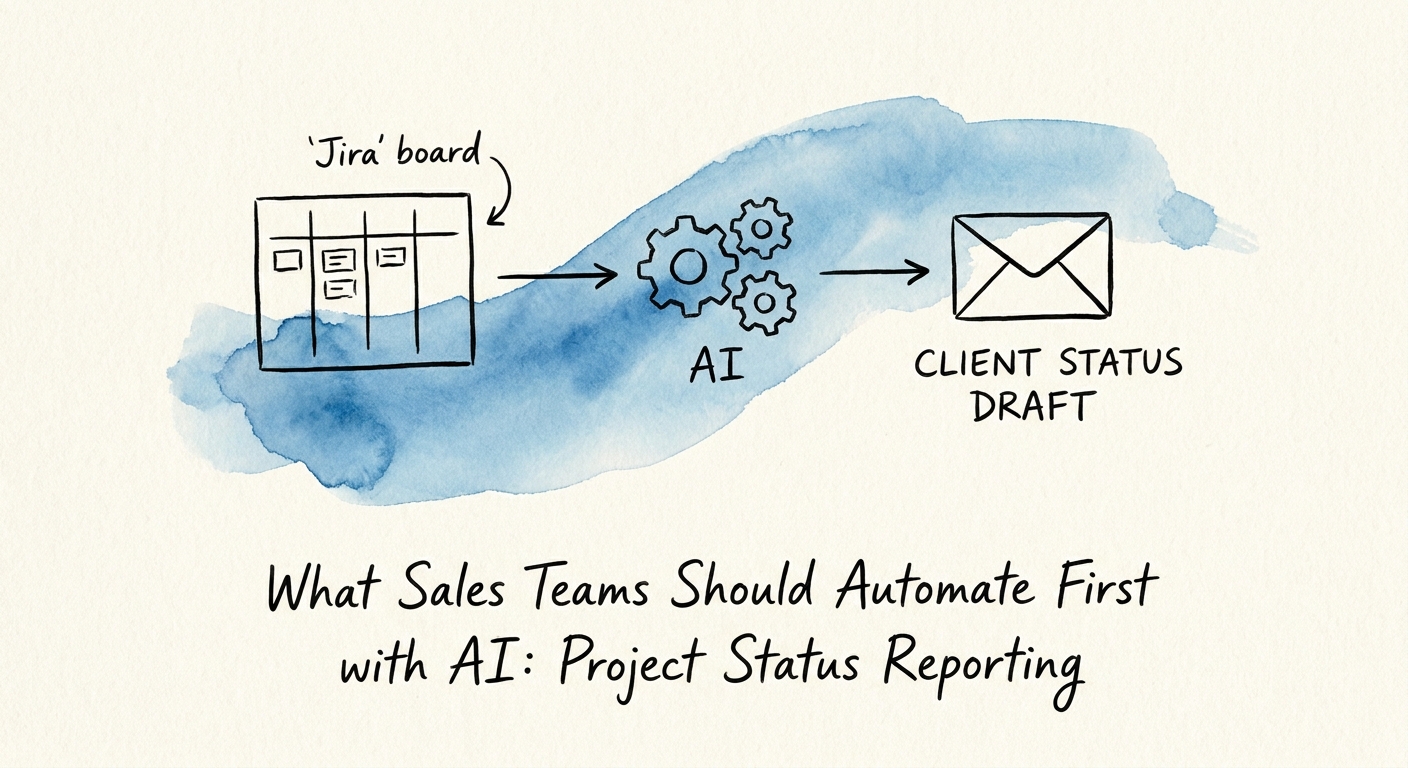
Govern the part the customer can see
A status report is unusual among sales documents because it often becomes customer-facing — it gets pasted into a QBR deck, forwarded to a procurement contact, or read aloud on a renewal call. That raises the governance bar. The NIST AI Risk Management Framework gives you the structure: state the intended use (internal forecast hygiene vs. external commitment), map where a wrong claim creates real risk, and name who is accountable when the AI gets a deal state wrong. The CISA AI data-security best practices should set how the tool touches your CRM and project systems — least-privilege access to deal records, no training on customer data it shouldn't retain, and an evidence trail for every status claim.
Make four rules non-negotiable for the pilot: every status item traces to a specific CRM field or project artifact, not the model's inference; the account owner reviews before anything reaches a customer; any blocker that touches the forecast escalates the same day; and customer-visible language stays locked until a human approves it. Say a 90-person SaaS company runs this on its post-sale handoff lane for one quarter. Only after the drift between CRM and reality shrinks — and no customer ever receives an AI claim a rep didn't stand behind — do you extend it to renewals, expansion deals, or the broader pipeline. Build the AI roadmap that sequences those expansions deliberately instead of bolting AI onto every revenue motion at once.