The Tuesday that tells you where to start
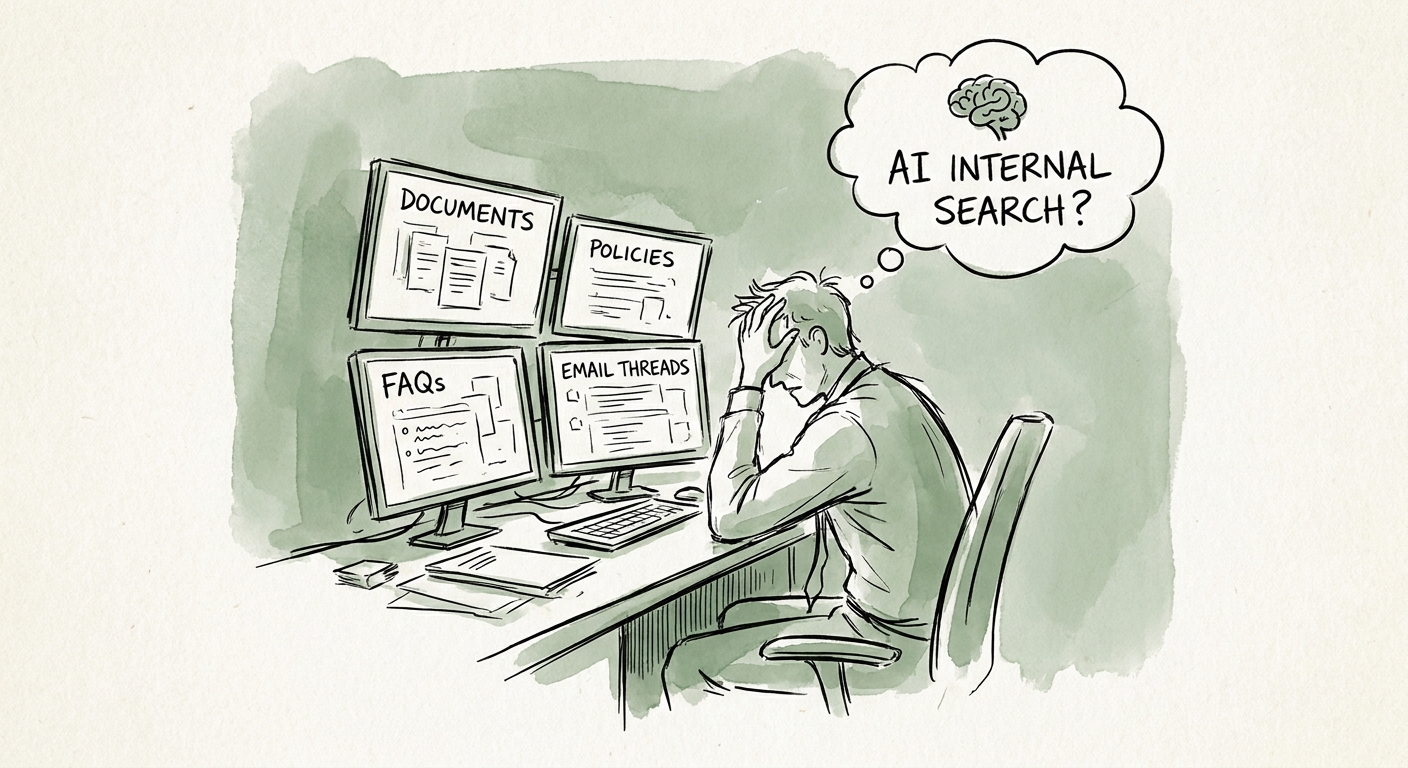
Picture a 60-person software company. A senior rep is mid-cycle on a six-figure deal when the prospect's security team fires over a 90-question questionnaire. The rep doesn't know the answers. So they Slack the solutions engineer, who's on another call; ping the CISO, who answered this exact question for a different deal four months ago; and eventually find a half-right version in a Google Doc nobody has owned since the last person who maintained it left. Two days gone. The prospect's momentum cooling the whole time.
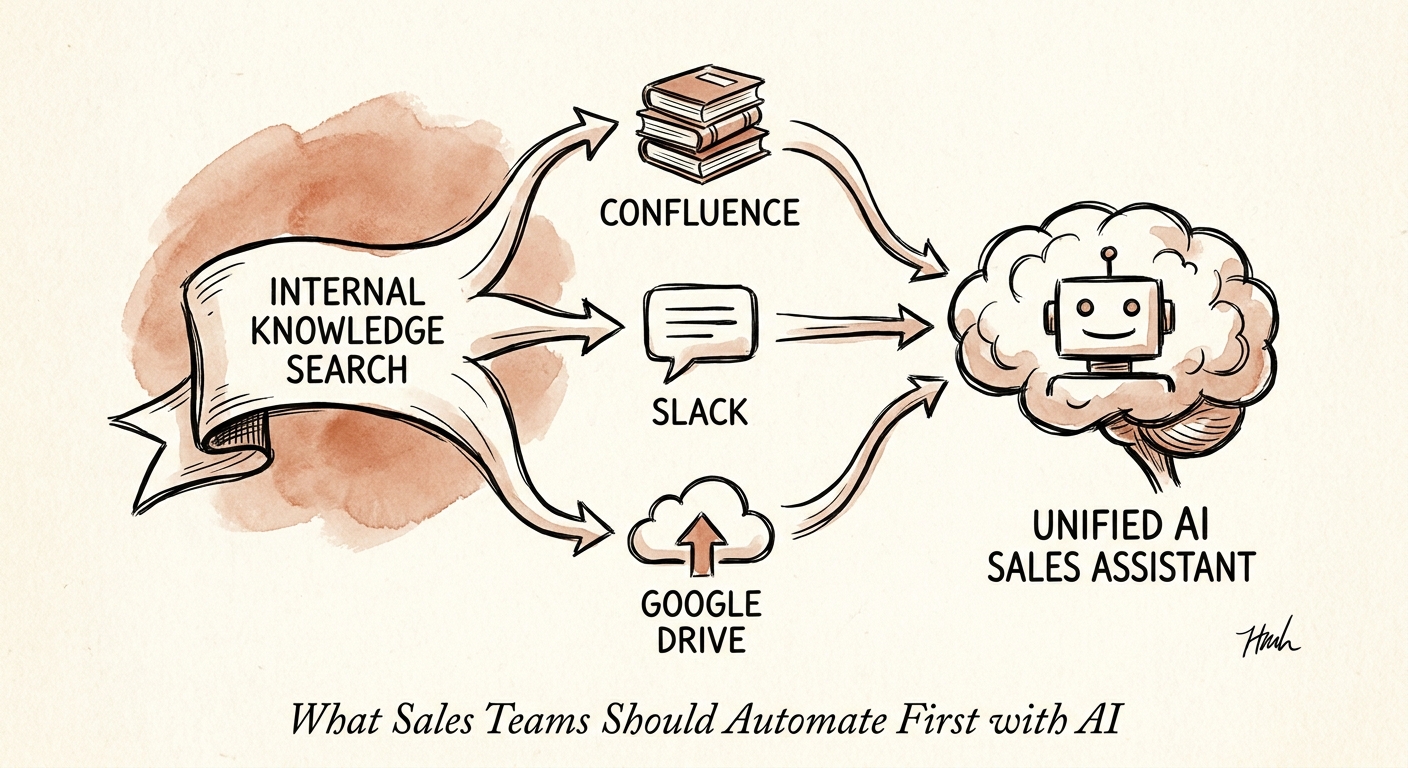
That hunt — "what is our actual, approved answer to this?" — is the job to automate first. Not drafting emails, not scoring leads, not summarizing calls. The single highest-leverage AI use case in most sales orgs is internal knowledge search: pricing exceptions, the security-questionnaire history, the current competitive teardown, the deal-desk rules on discounting and terms. The Salesforce State of Sales report and Deloitte State of AI in the Enterprise 2026 both show AI pressure landing hardest on sales, but neither tells you which workflow to touch first. The answer search is it, because it's where your reps already lose hours and where a wrong answer is recoverable as long as a human still hits send.
The danger is precise and worth naming: a tool that confidently surfaces last year's price list, a discount your deal desk killed in January, or legal language your reps aren't cleared to quote. That's not a hallucination problem in the abstract — it's a stale-source problem that puts a wrong number in front of a buyer. Which is exactly why the answer search comes before the email writer.
What "working" actually looks like — and how to measure it
Most teams launch a sales knowledge bot and declare victory when it returns something. Wrong bar. The thing you're testing is whether a rep can trust the answer enough to put it in front of a buyer without re-verifying it themselves — because if they re-verify every time, you've added a step, not removed one.
So measure the behavior, not the output volume. Before you turn anything on, write down four numbers for a normal week: how long reps spend hunting for answers, how many questions get escalated to your SE or deal desk, how many security/RFP responses are reused versus rebuilt from scratch, and how often the "answer" turns out to be stale. Then, each week after launch, look at a different four: how many AI answers came with a working citation a rep could click to confirm; how many were flagged low-confidence (good — the tool refusing to guess is a feature); how many pulled from a source that should've been restricted; and which questions returned nothing, because those gaps are now a content backlog with an owner's name on them.
The win is narrow and real: a rep gets a pricing or product answer in under a minute, with a link to the approved source, instead of waiting two days for a human. Notice what's not in scope yet — the tool isn't recommending next steps or writing the follow-up. It's answering "what's our position on X" and showing its work. Once those weekly numbers hold steady, run the AI Opportunity Score or the AI ROI Calculator to size the next move. Not before — early numbers from an unstable pilot just give you false confidence.
The four guardrails that keep a sales answer-bot honest
Sales content is uniquely treacherous for retrieval because so much of it is conditionally true. The price is real — for that segment, that term length, that quarter. The discount was approved — for one deal that no longer applies. The competitive claim was accurate — until the competitor shipped the feature last month. Generic document search doesn't know any of that, so you have to build the knowing-in.
The NIST AI Risk Management Framework gives you the spine: name the intended use, name the risk, decide how you'll measure it, and assign who's accountable when it's wrong. On top of that, CISA's AI data-security best practices shape how the tool sees data in the first place — permission-aware retrieval so a rep can't surface another segment's pricing or unredacted legal terms, and retained query logs so you can audit what was asked and answered. Concretely, that's four rules you can stand up in a sprint: every source set has a named owner who keeps it current; every answer carries a citation a rep can click; stale content gets flagged and pulled, not silently served; and restricted material (legal language, unapproved pricing, anything segment-specific) is walled off by permission, not by hoping nobody asks.
Do this and you've earned the right to expand — into draft RFP responses, then suggested next steps, then the email writer everyone wanted to build first. Skip it and you'll teach your best reps the most expensive lesson there is: that the tool can't be trusted, so they go back to Slacking the SE. Start with the answer search, govern it like it's quoting your customers a price — because it is — and build outward from there. If you want that sequence mapped to your stack and your weekly numbers, that's the work of the AI roadmap.