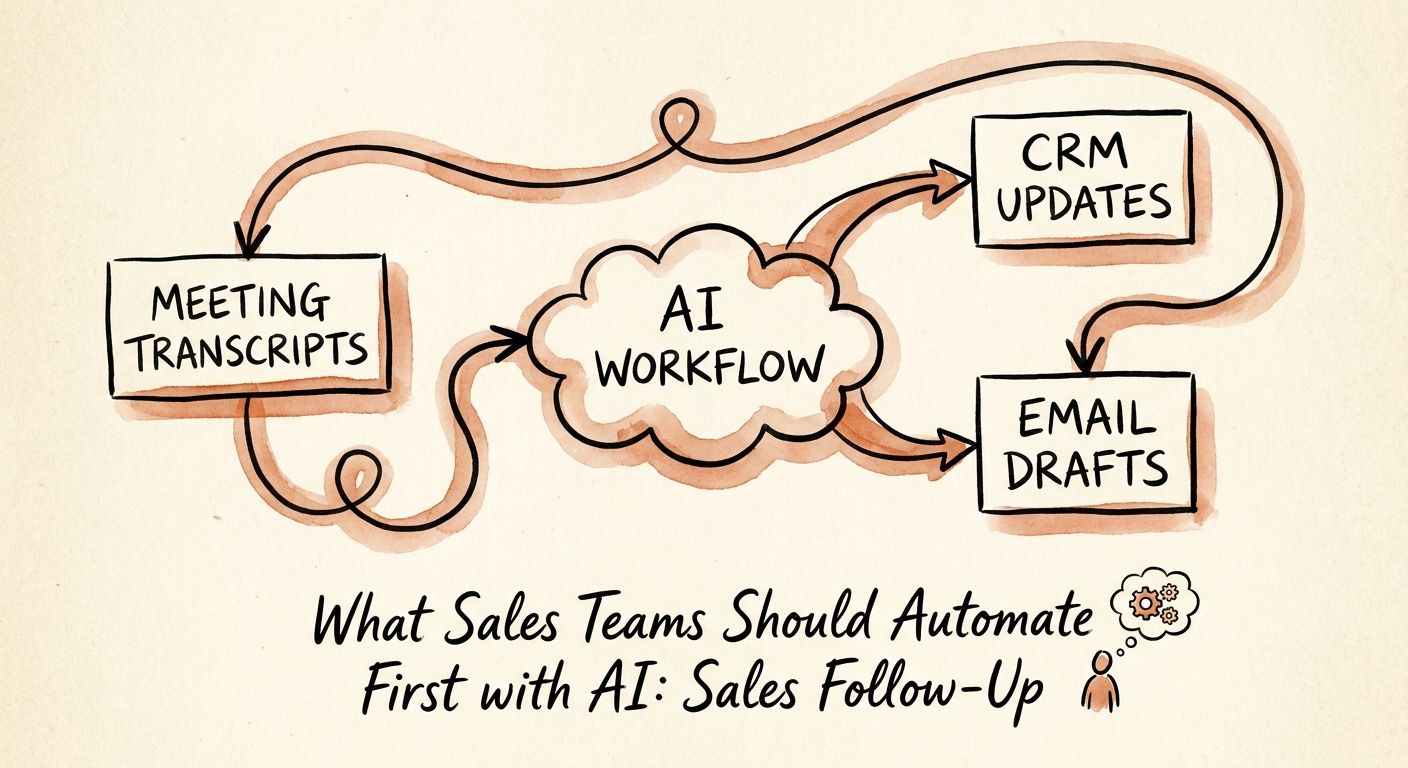
The deal you lose is the one you meant to follow up on Thursday
A senior consultant runs a strong discovery call with a prospect on Tuesday. Real chemistry, three clear next steps, a budget signal. Then Wednesday gets eaten by a delivery fire, Thursday by an internal review, and the recap email goes out Friday afternoon — generic, late, missing two of the three commitments. By Monday the prospect has cooled. The work was good. The follow-up was where it leaked.
This is why follow-up is the right first job for AI in a professional-services or B2B-tech-services sales team, and why it beats the more obvious candidates like cold outreach or lead scoring. The trigger is unambiguous — a meeting just happened, a proposal just landed, a demo just wrapped — and the raw material already exists in your notes and CRM. Salesforce State of Sales research describes how much of a seller's week disappears into administrative work instead of customer time. In a services shop, where the "product" is the relationship, that lost time is the cost of sale.
The job is narrow: turn what was said into a same-day recap that names the actual commitments. The AI drafts from your meeting notes, CRM history, and the next steps you logged — and stops there. It does not promise a delivery date you didn't agree to, soften a price you held firm on, or fire off automatically on a deal where one wrong sentence sets you back a week. For a high-stakes account, the draft is a head start, not a send button.
The hard part is sounding like the person who was in the room
Generic follow-up is worse than slow follow-up. A prospect who just spent forty minutes with your principal can smell a templated "Great connecting!" email instantly, and in a relationship-led sale that tells them exactly how the delivery will feel. So the rule that makes or breaks this workflow is provenance: every claim in the draft has to trace back to something real — a line in the notes, a CRM field, a documented scope point. If the model can't point to where a commitment came from, it doesn't belong in the email. Treat anything it can't source as a question for the account owner, not a sentence to send.
That also keeps you out of trouble with what the AI touches. Your meeting notes and account context are sensitive — they hold pricing posture, competitor mentions, and things said off the record. OpenAI's enterprise privacy commitments cover how business data is handled at the platform level, but platform terms don't decide which deals are safe to draft in bulk. You do. Draw the line explicitly: standard recaps and check-ins after a routine meeting can be drafted at volume; anything touching renewal risk, pricing concessions, contract terms, or a relationship with an economic buyer routes to the partner who owns the account before a word goes out.
A practical way to set this up: give the model your three best follow-ups from the last quarter as the voice reference, and one strict instruction — restate only what was agreed, in plain language, and flag anything ambiguous instead of papering over it. The goal isn't a clever email. It's a fast, accurate one that reads like the human who was actually in the meeting.
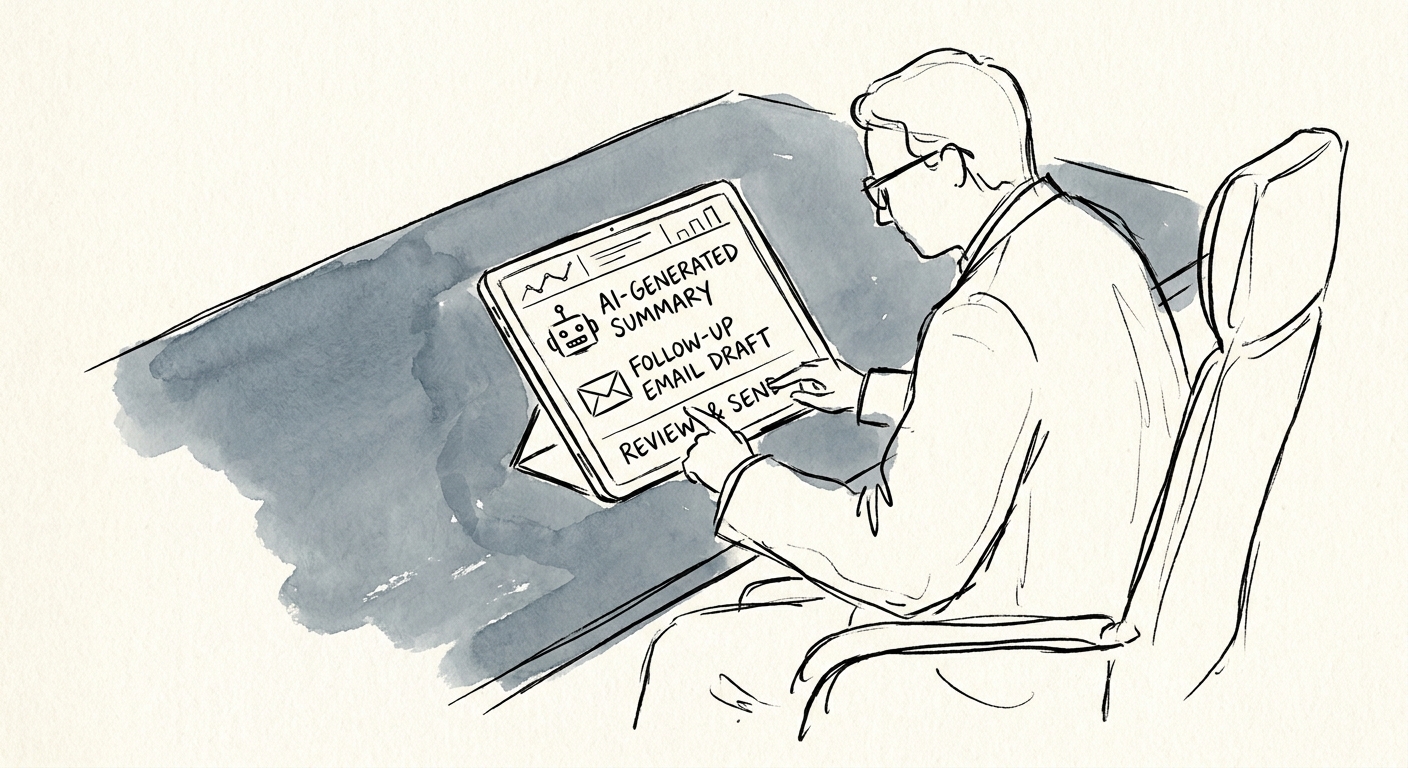
Run it for one motion, for 90 days, and watch the right numbers
Don't roll this across the whole pipeline. Pick one recurring follow-up motion — post-discovery recaps, or proposal nudges, or renewal check-ins — and run it for about 90 days before deciding anything. Both the RSM middle-market AI survey and the NIST AI Risk Management Framework point at the same discipline from different angles: tie the tool to one real workflow, then measure both the result and the risk it introduces.
The vanity metric is time-to-send, and it'll improve immediately — that's the easy part. The metrics that actually tell you something are downstream: reply rate on the recaps, how often a follow-up moves a stalled opportunity to the next stage, and the correction rate — how many drafts the account owner has to rewrite before sending. If sends get faster but reps are heavily editing every draft, the workflow isn't ready; it's just relocating the work. And watch the failure signals you'd never want from a services brand: a prospect replying "this doesn't sound like our conversation," or an unsubscribe from someone who was warm.
The bar for going wider is simple: faster and at least as accurate as what a good rep sent by hand, with the account owner still on the hook for the relationship. To pressure-test the economics before you expand, see how to measure AI ROI without fake savings, and for a deeper build specific to this sector, the professional-services follow-up implementation guide walks through the source-control and review setup step by step.
