Where the hour actually goes on Monday morning
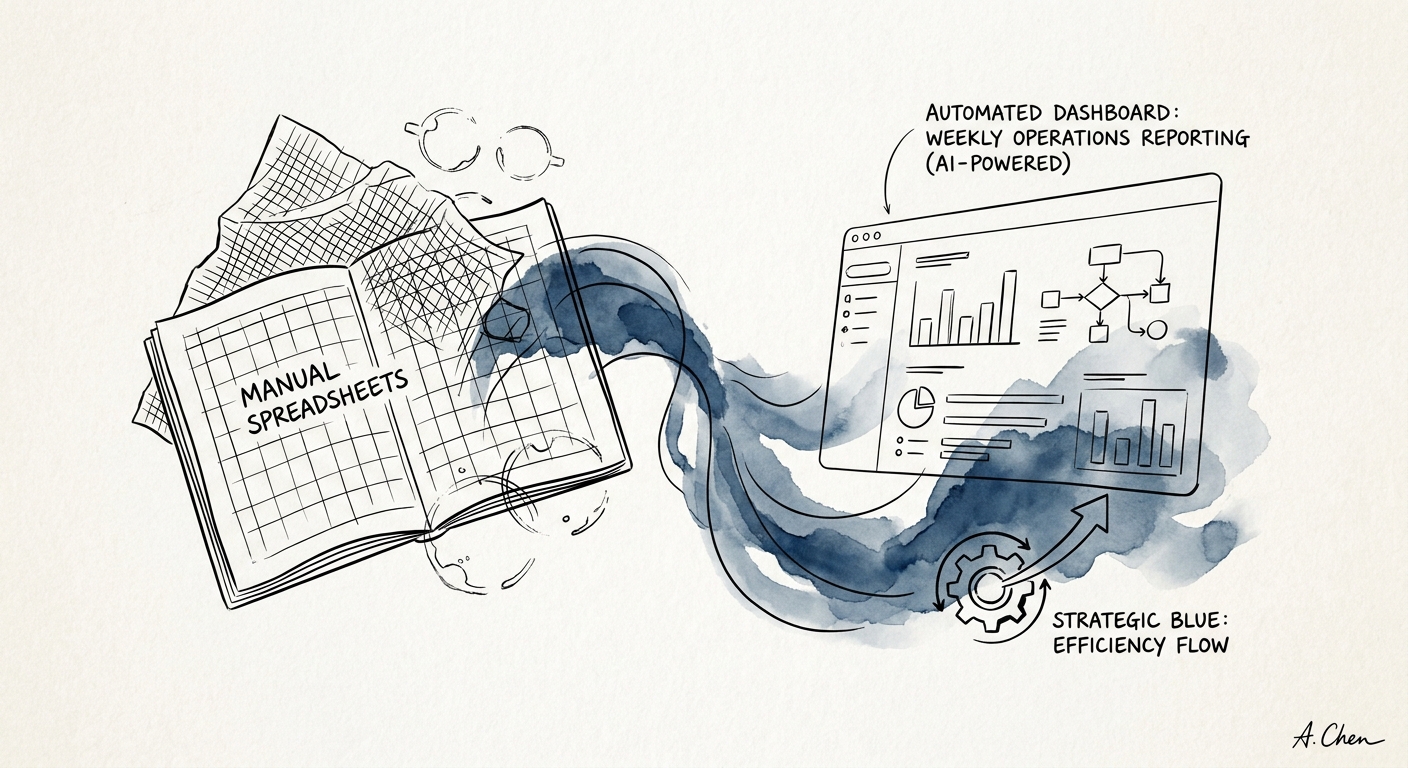
Picture a sales manager at a 60-person B2B services firm at 7:40 on Monday, twenty minutes before the team call. They're inside the CRM doing the same archaeology they did last week: which deals slipped a stage, which ones haven't moved in 18 days, whose "commit" forecast quietly turned into "best case," and which accounts went dark after the proposal went out. By the time the call starts, half the prep time is gone — spent reconstructing what changed, not deciding what to do about it.
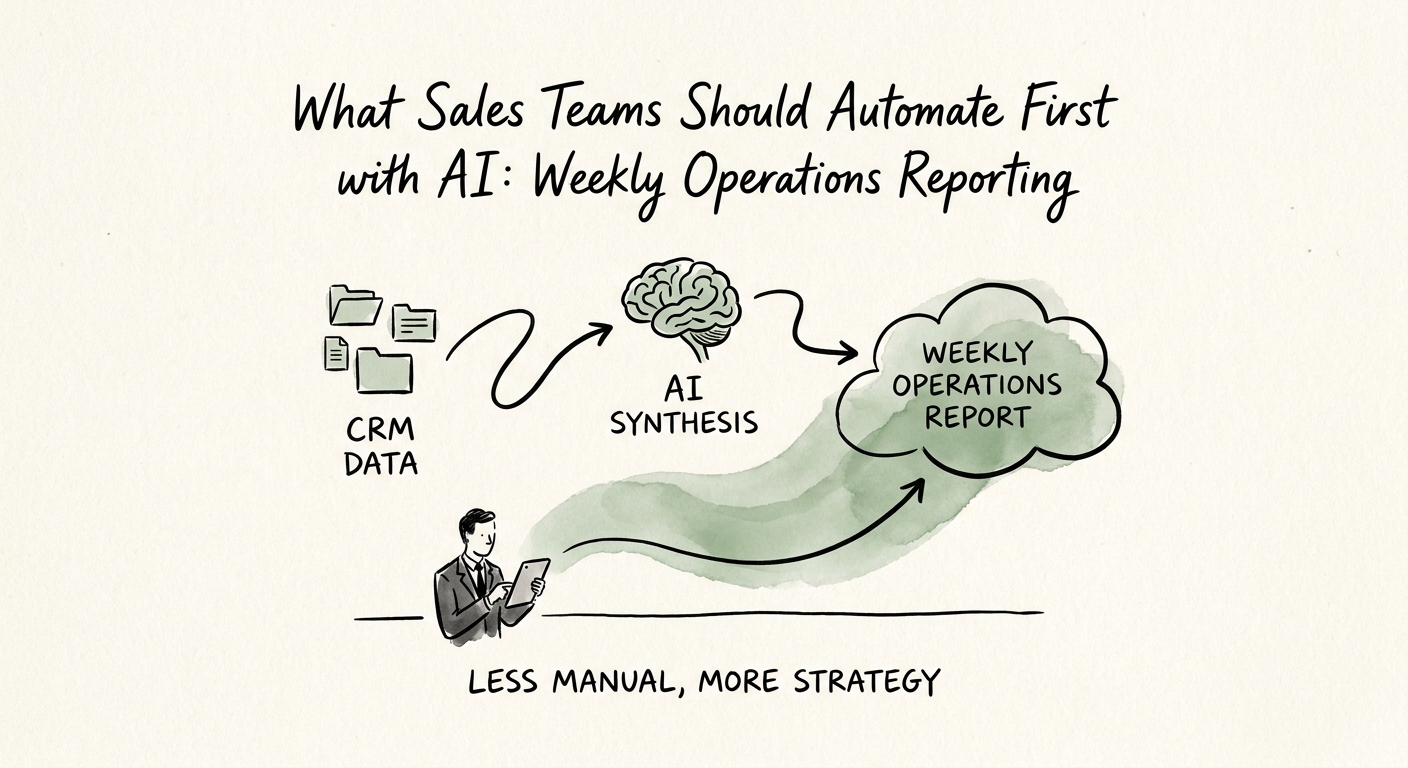
That reconstruction work is the thing to hand to AI first. Not the cold emails, not the call summaries — the assembly of the weekly pipeline packet. It's repetitive, it's structured, it happens on a fixed cadence, and it's mostly reading the CRM and noticing deltas. A model is good at "here are the seven things that changed since last Monday and the four that suspiciously didn't." That's exactly the part eating the manager's prep window.
The line that matters: AI assembles the packet, the manager owns the narrative before it reaches leadership. The Salesforce State of Sales research and Deloitte State of AI in the Enterprise 2026 both point at the same trap — teams adopt AI to produce more output, not better decisions. A summary that reads beautifully but launders bad CRM hygiene into confident prose is worse than no summary. Pilot it on exactly one weekly meeting and judge it by one question: did the manager walk in with sharper questions?
The packet can list what changed; it cannot tell you why
Here's the distinction that separates a useful sales packet from a dangerous one. AI can reliably report a fact: "Acme moved from Proposal to Negotiation; the close date pushed from May to July; no activity logged in 12 days." It cannot reliably report a reason: "Acme slipped because procurement got involved." The rep knows that. The CRM might not. The moment the model fills the why with a plausible-sounding guess, you've turned a forecast review into fiction with footnotes.
So structure the packet to keep facts and interpretation in separate columns. Each line item carries the CRM delta, the activity signal, the rep's own note if one exists, and — critically — a blank where the forecast explanation goes if no evidence supports one. An empty "why" routed to the manager is a feature, not a gap. The NIST AI Risk Management Framework frames this as reviewer accountability: someone named owns the call on what the numbers mean, and the system makes it obvious when no one has yet.
Measure two things over the pilot. First, the manager's edit rate — how often they correct or override the packet. Early on it'll be high; that's the model learning your pipeline. If a specific section gets rewritten every single week, the problem isn't the model, it's a CRM field nobody fills in honestly. Second, count the stale opportunities and missing next steps the packet surfaced that would otherwise have rolled into the forecast unnoticed. That number is the actual return — deals you stopped lying to yourself about, weeks earlier than usual.
What to wire up Monday, and what to refuse to expand into
Before the first run, draw a hard line around what the packet can read. Weekly sales data is laced with sensitive material: a rep's performance trajectory, a candid note that an account is at churn risk, the discount you're privately willing to give. The CISA AI data-security best practices are the right checklist here — decide which CRM fields the workflow may touch, where the output is stored, and who can open the leadership version. A coaching note about a struggling rep should never surface in a packet the whole leadership team reads.
For the first 90 days, run a dead-simple before/after. Two weeks of meetings the old way, then the AI-assembled packet, and compare the same three signals: how much manager prep time went to reconstruction versus decisions, how many at-risk accounts got flagged early, and whether reps left the call with clearer next steps. If the meeting feels identical, the packet is decoration and the pilot needs a sharper source set — not a wider rollout. Use the AI ROI Calculator to put a number on the prep hours you reclaim, and the AI Opportunity Score to check this against the other candidates competing for first place — finance variance notes, lead qualification, support triage.
The discipline that keeps this honest: do not expand reporting automation while your CRM is still full of stale stages and empty next-step fields. AI reporting amplifies whatever hygiene already exists. Fix the inputs first, prove the weekly review produces clearer owner actions, then — only then — let the same approach move outward into seller-facing workflows. The order is the whole point. Ready to map which workflow earns first place for your team? Build the AI roadmap.
