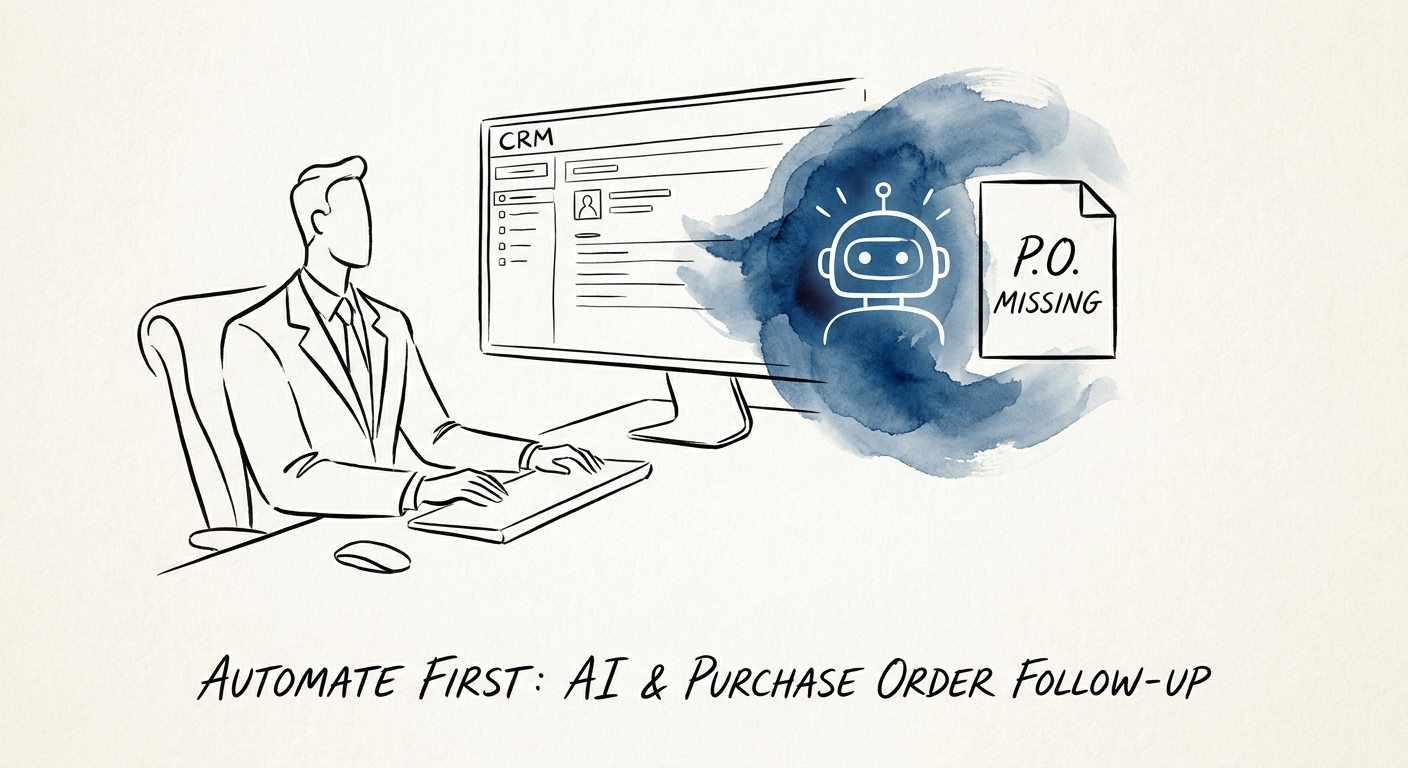
The deal closed three weeks ago. Where's the revenue?
Picture the Friday pipeline review at a 90-person B2B services firm. A deal marked closed-won on April 3rd is still showing zero recognized revenue on May 30th. Nobody on the call can say why in one sentence. The AE thinks it's "with their procurement." Finance never got a PO number. Deal desk has an unsigned amendment buried in an email thread. The customer's AP system is waiting on a billing entity that doesn't match the contract. The deal is sold. The money isn't moving.
This is the zone almost nobody automates first, and it's exactly where a first sales AI workflow earns its keep. Cold outreach gets the AI attention because it's glamorous, but it's also where a bad automated message does the most damage to a brand. Post-close PO follow-up is the opposite: the customer already said yes, the commercial terms are fixed, and the only thing left is dragging a half-dozen administrative facts across the finish line. There's nothing to renegotiate and nothing to oversell. There's just friction to make visible.
Salesforce State of Sales research tends to get cited to justify automating prospecting; the more useful read for a mid-market shop is to apply it to the handoff after agreement, where reps are quietly spending hours chasing fields instead of selling. Deloitte State of AI in the Enterprise 2026 makes the same point in a different key: the wins come from narrow, well-bounded workflows, not from pointing a model at your whole revenue motion and hoping. Closed-won-to-PO is about as narrow as it gets.
What the AI is allowed to touch, and the one line it can't cross
The discipline here is simple to state and easy to get wrong: the AI reads, summarizes, and drafts internally. It never sends a customer a number, a date, or a commitment. The moment a model tells a buyer "your order will ship Tuesday" or "your pricing is locked at the renewal rate," you've let an assistant make a commercial promise after the sale — and that's exactly the thing that costs you margin and trust.
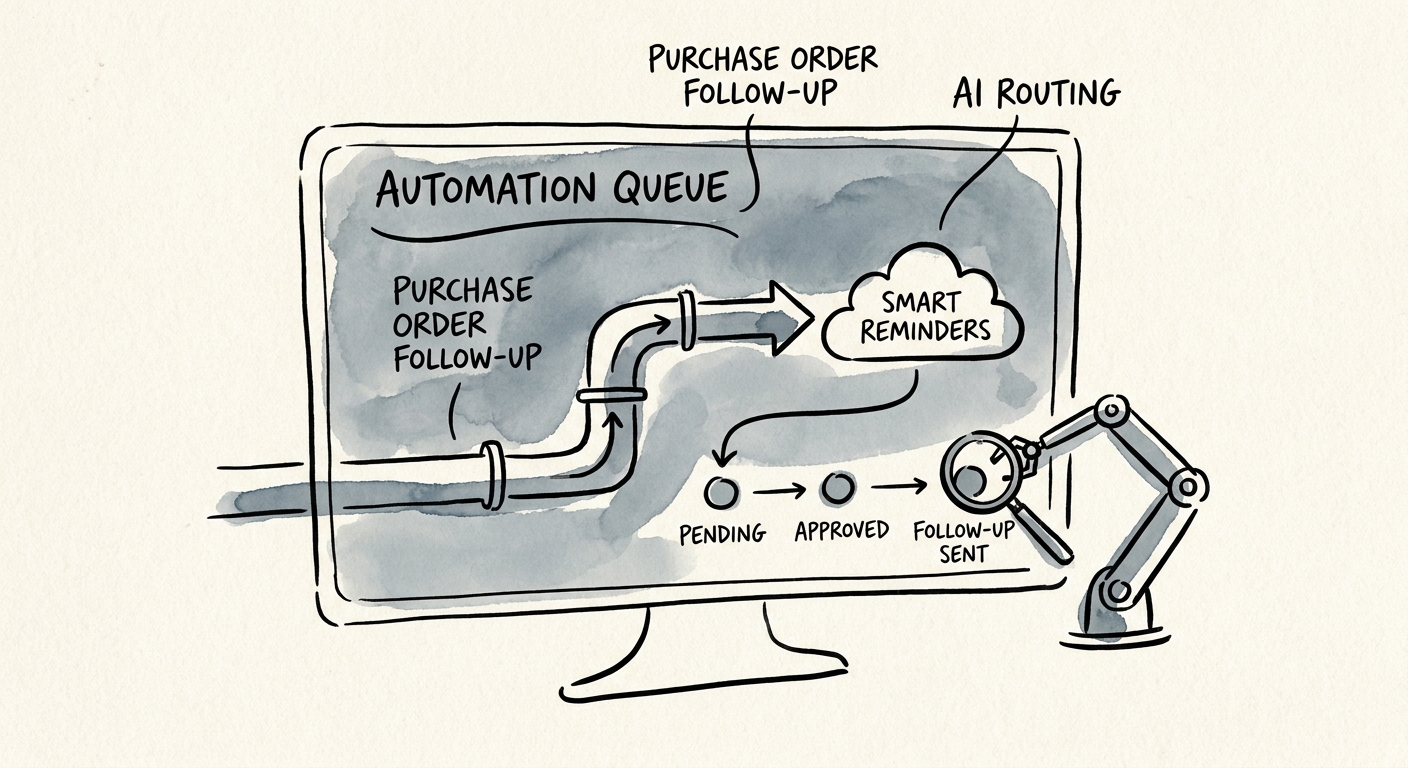
So build the packet, not the autopilot. For each stalled closed-won deal, the workflow assembles one structured view: opportunity ID, the actual procurement contact (not the champion who signed), which PO fields are missing, contract and amendment status, where it sits in the order queue, who owns the next action, and a flag for any commercial exception. Concretely, that means the AI surfaces the things that actually stall a services PO — a billing entity that doesn't match the signed legal name, a missing PO number, a tax-exemption code that AP keeps rejecting, an unsigned change order, a net-terms mismatch between contract and invoice. Those are facts to chase, not decisions to make.
The NIST AI Risk Management Framework earns its place here precisely because context flips meaning. The same line in a procurement email — "we need to revisit scope before issuing the PO" — is routine paperwork in one deal and a material re-trade in another. A model can't reliably tell which. So you measure what a human still has to fix: reviewer corrections on the drafts, how many stalled handoffs cleared, days from closed-won to a complete PO, and how often a draft customer message got suppressed before it went out. If the suppression rate is high, that's not a failure — that's the system catching exactly what it was built to catch. The pilot is working when "won" and "recognized" stop being three weeks apart and the gap stops being a mystery on the Friday call.
What you can run Monday — and what stays human
Start with one order path. Don't boil the ocean: pick enterprise POs, or signed-contract renewals, or procurement follow-up for new logos, and instrument just that lane. The output isn't a sent email. It's a daily list for whoever owns deal desk and customer operations: these six closed-won deals are missing a PO number, a billing entity, a procurement contact, a signature packet, a tax detail, or a delivery prerequisite — here's the owner of each next step. A human reads it, decides, and approves any words that reach the customer.
Two cautions worth taking seriously. First, treat what the workflow exposes as a signal about your quote-to-order process, not just a to-do list. If the AI keeps surfacing unclear contract status and missing procurement fields across deal after deal, the fix isn't more automation — it's repairing the handoff between sales, legal, and finance that's manufacturing the friction. The model is just making a broken seam visible. Second, mind the data. PO follow-up touches pricing, contract terms, customer approval status, and internal exception notes; the CISA AI data-security best practices should govern what the system can read, how long it retains it, what it logs, and the hard wall between internal follow-up and anything customer-facing.
When you're ready to decide whether to widen the lane, run the numbers honestly. Use the AI ROI Calculator to put a dollar figure on the sales-ops and finance hours you're currently burning on field-chasing, and the AI Opportunity Score to weigh PO follow-up against the next candidate — quote turnaround, scheduling coordination, renewal prep. If you want a sequenced view of where post-close automation fits in the broader plan, that's the starting point for an AI roadmap. The whole point is to recover revenue that's already yours without letting an assistant promise shipment, activation, or terms after the deal is done.