Why the proposal, of all documents, is the right place to start
Picture a Thursday afternoon at a 60-person managed-services firm. An account executive just got off a strong discovery call, the buyer wants something to circulate internally by Monday, and the AE now faces three hours of copy-paste: last quarter's similar proposal, the scope language legal blessed in March, the three case references that fit this vertical, the pricing table they have to half-remember. By the time it's drafted, it's late, it's stale, and the manager review gets skipped because the deal is hot.
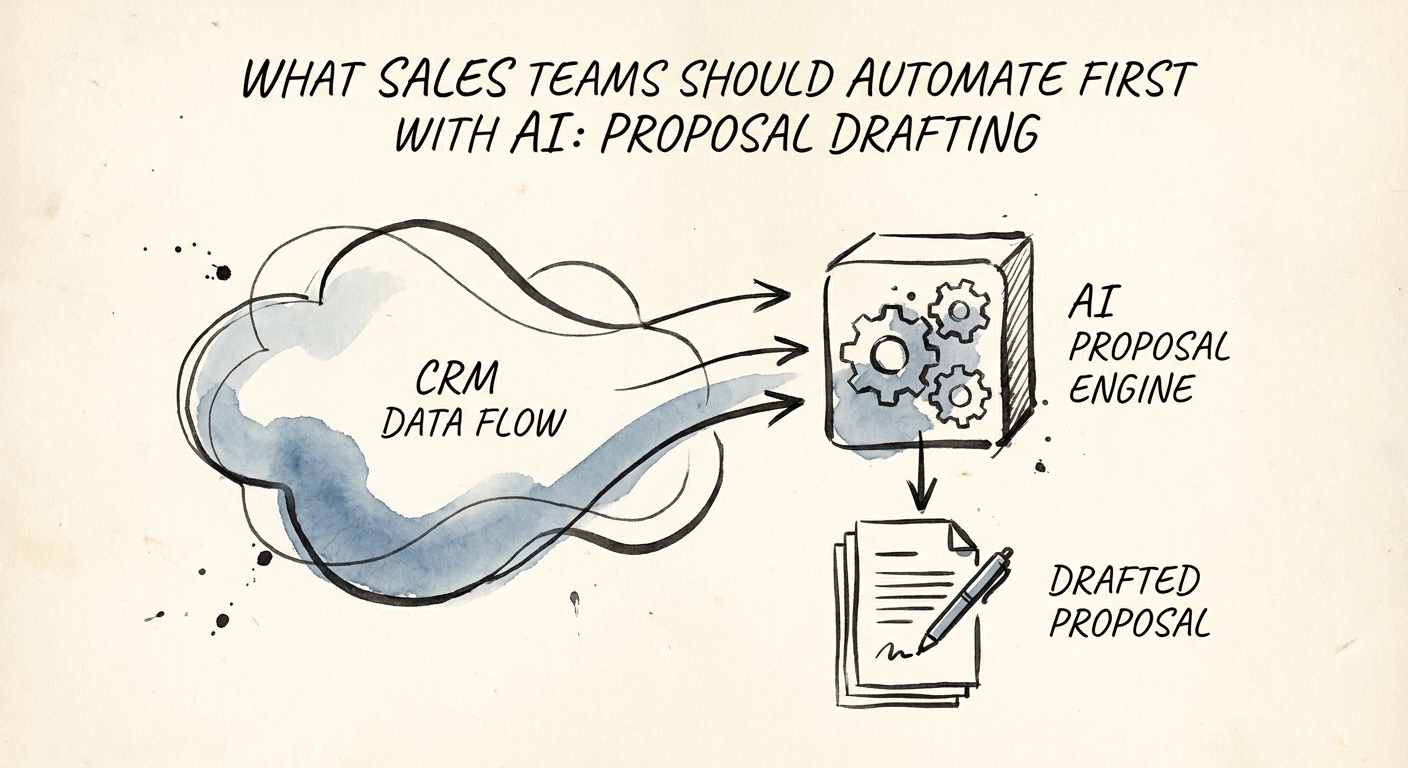
That is exactly the shape of work AI handles well — and it's why proposals beat the flashier sales use cases as a starting point. The inputs are repeatable, the team already reviews them, and the output is structured. The RSM middle-market AI survey, the San Francisco Fed's small-business AI analysis, and the OECD's SME AI adoption report all land on the same unglamorous condition for adoption that sticks: there's a clear owner, clean source material, and a way to see whether it worked. Proposals check all three boxes in a way that, say, "AI that prospects for us" does not.
The test before you pilot is volume and inputs, not enthusiasm. If your team writes four proposals a quarter off scratch every time, the juice isn't there. If they write twenty a month from a recognizable set of scope blocks and references, you have a real workflow. Run the workflow automation screen to confirm the volume, source cleanliness, and manager-review capacity are actually present before you build anything.
The line that separates a draft from a promise
Here's what most teams get wrong when they point AI at proposals: they treat the document as marketing copy. It isn't. A B2B services or tech proposal is a sales pitch and a half-signed contract stapled together. The "we'll migrate your environment with zero downtime" sentence is a delivery commitment. The pricing table is a number someone in finance has to defend. The reference you cite is a claim that has to be current and approved. When AI fabricates a confident-sounding scope line, you don't get a typo — you get a buyer expectation your delivery team never agreed to.
So you draw a bright line and let AI live on only one side of it. On the safe side: assembling approved positioning, pulling buyer-pain notes from the call, laying out scope options from a controlled block library, and proposing next-step language. On the governed side, behind a human gate every time: the specific claims you'll make, which case examples are still current, any pricing input, and any buyer-specific delivery promise. The NIST AI Risk Management Framework is a clean way to assign who owns each of those risks, and CISA's AI data security guidance covers the source-control, access, and logging discipline so the model only ever pulls from material someone signed off on.
Concretely for a services or tech sales org: build a small approved-claims library and an approved-references list the model is allowed to draw from, mark every pricing field as review-required, and require a named delivery owner to initial any custom commitment before the draft leaves the building. If you're weighing this against other revenue workflows competing for the same pilot budget, the AI use-case scoring model lets you rank them on impact, readiness, risk, and adoption effort instead of arguing by gut.
Measure it at the handoff, not at the send
The trap is celebrating speed. AI will cut your draft time, that part is easy, and it's also the least interesting number in the whole exercise. Deloitte's State of AI in the Enterprise 2026 keeps pulling attention back to process change over tool access, and for proposals the process you actually care about lives downstream of the send button.
Watch five things over a quarter: proposal turnaround time, how heavily managers still have to edit, how often scope changes after the buyer signs, what your win/loss reviews teach you, and — the one almost nobody tracks — whether the delivery team's handoff notes get better. That last metric is the tell. If AI drafting tightens the language so delivery inherits a cleaner picture of what was sold, you've improved the business. If proposals go out faster but delivery keeps getting surprised by commitments they didn't see, you've automated a problem.
So sequence it inside-out. Let AI draft for the AE and sales manager first, with humans rewriting before anything reaches a buyer, and only widen its reach once the edit burden drops and the handoff metric moves. The 90-day AI implementation plan walks the order: clean the source blocks, set the reviewer rules, run a measured pilot, then expand. Do it in that sequence and the proposal stops being a Thursday-afternoon fire drill and starts being the most reliable document your sales team produces.
