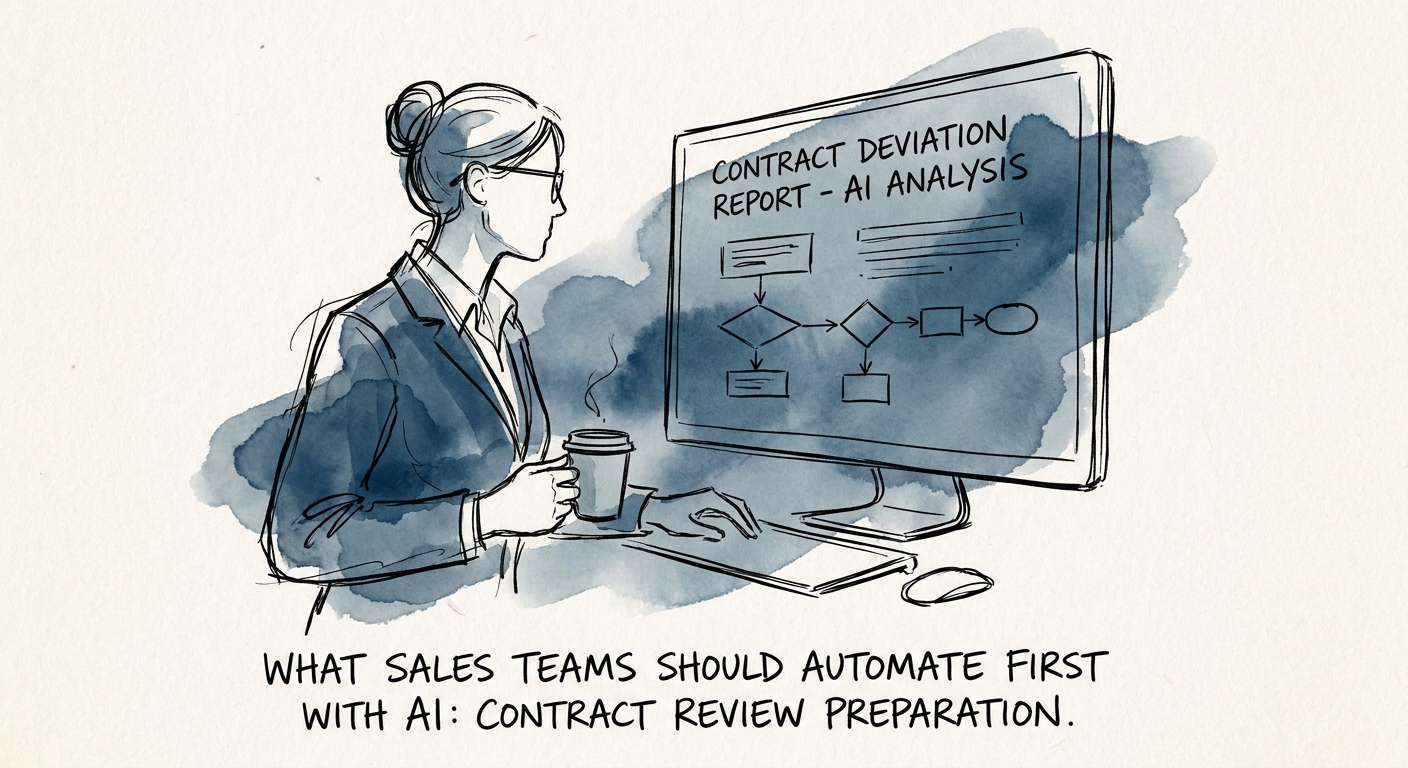
The deal that stalls in the gap between sales and legal
Picture a 90-person B2B software company. A rep closes verbally on a Thursday, then emails legal: "Customer wants to move fast, can we get the contract reviewed?" Legal opens the folder. The order form is there. The redlined MSA is not. The security questionnaire the customer attached lives in someone's inbox. The "fast" deal now sits for six days while three people chase the missing pieces — and the rep tells the prospect it's "with legal," which is technically true and completely useless.
That gap is the highest-leverage place to put AI first. Not because AI should review the contract — it absolutely should not — but because the most expensive part of contract review isn't the reviewing. It's the prep: assembling the packet, classifying the request, spotting what's missing before a $200/hour reviewer wastes an hour discovering it themselves. RSM's middle-market AI survey, the San Francisco Fed's analysis of AI and small businesses, and Deloitte's State of AI in the Enterprise 2026 all point the same direction: the durable early wins are narrow, governable workflows with a clear owner — not the dramatic ones.
Contract review prep qualifies only if your team can answer four questions out loud: what's the current workflow, what systems hold the documents, what kinds of requests come in (standard order form, heavily redlined enterprise MSA, renewal, custom terms), and who owns the actual review. If you can't name those four, you don't have an AI problem yet — you have a process problem. Score the manual work first before you automate anything.
Draw the boundary in permanent ink: prep, not judgment
Here is the line that keeps this safe, and it is not negotiable. The AI assembles and classifies. A human decides. For our 90-person company, the first release should do exactly four things and nothing more: pull the right documents into one packet, classify the request type, flag what's missing or unusual ("no signed NDA on file," "redline touches the limitation-of-liability clause"), and route to the named reviewer with that flag attached. It does not opine on whether the indemnification cap is acceptable. It does not green-light terms. The moment a sales tool starts interpreting contract language, you've turned a prep assistant into an unsupervised paralegal — and that's how a rep "closes" a deal on terms legal never actually approved.
This is where the NIST AI Risk Management Framework and CISA's AI Data Security Best Practices earn their keep. Contracts carry pricing, customer PII, and security commitments — exactly the data you don't spray across an ungoverned model. So the build needs approved inputs (which document repositories the tool may read), hard permission boundaries (a rep can't pull another rep's deal folder), retained outputs (every packet the AI assembled is logged), a quality check, and a forced escalation when the request touches sensitive data or terms the model isn't confident about.
In a mid-market company, the winning first release is deliberately small: one queue, one source library, one exception path, one owner who is accountable for source quality and the review handoff. That narrowness is the feature. It keeps adoption visible and stops "the AI thing" from quietly becoming another tool nobody governs. A 90-day implementation plan keeps governance and adoption moving on the same timeline instead of letting one outrun the other.
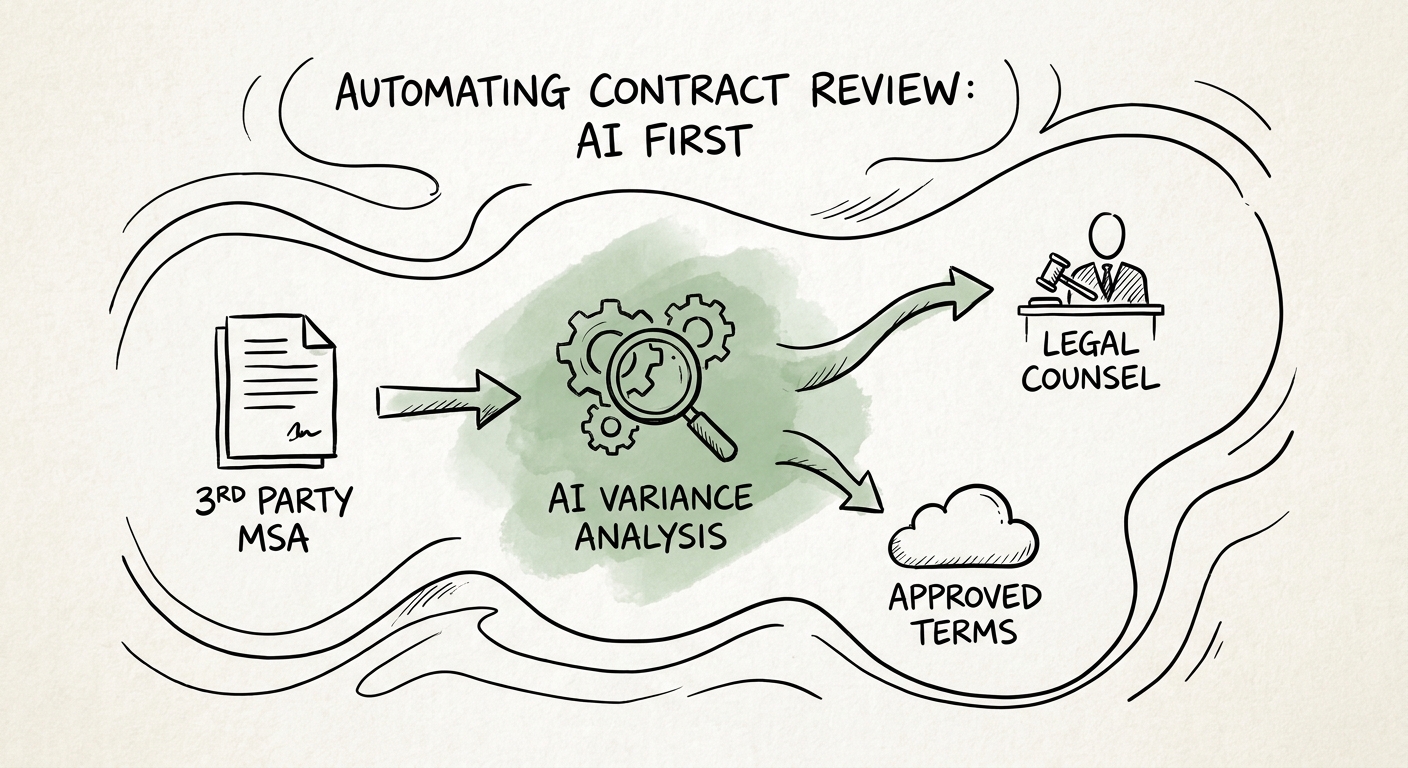
One number decides if it worked: does the deal reach legal review-ready on the first pass?
Forget "hours saved" — that metric is too easy to fake. The honest question is whether the contract reaches the reviewer's desk complete and correctly routed the first time, instead of bouncing back twice for missing pieces. Track five things you can actually see: intake completeness (did the packet arrive whole?), routing accuracy (did it reach the right reviewer?), reviewer effort (how much hunting-for-documents time disappeared?), exception rate (how often does it hit the escalation path?), and adoption (are reps using it, or quietly emailing legal the old way?).
Watch those last two together. A near-zero exception rate isn't a victory — it usually means the tool is waving through requests it should be flagging, and a hard edge case is about to land on legal's desk dressed as routine. A high exception rate that reps trust is far healthier than a low one they've learned to ignore.
Once the contract-prep workflow earns that trust, you've also built the template for the next one — sales order intake, renewal packets, vendor onboarding. The second workflow should inherit this exact governance pattern (approved inputs, logged outputs, named owner, forced escalation), not start from scratch with a different tool and a different blind spot. Run the numbers honestly before you greenlight it: measure AI ROI without the fake savings, then decide. When you're ready to sequence the whole rollout, the AI roadmap is where the next workflow gets planned.
