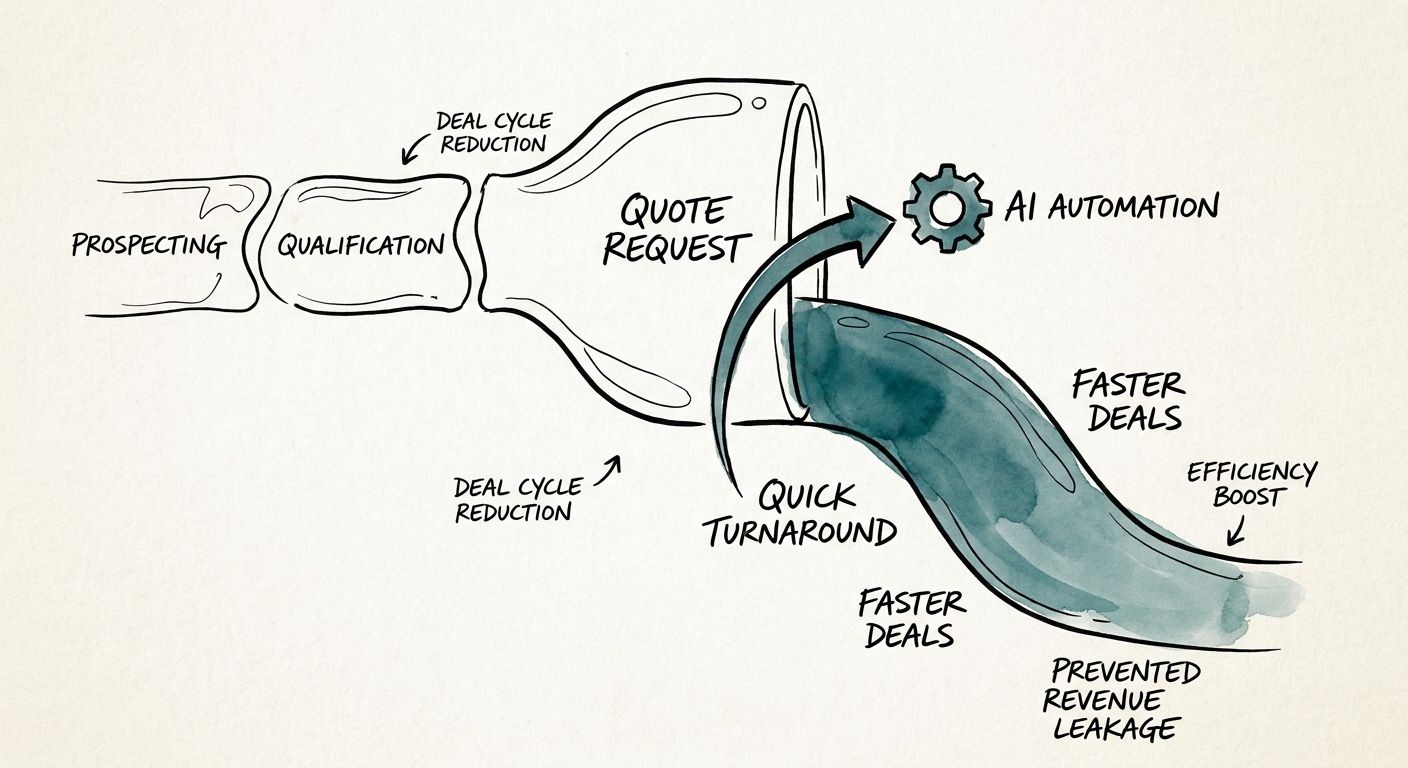
The deal cools while the quote sits in a queue
A rep gets verbal yes on Tuesday. The buyer wants pricing for three seats, a migration add-on, and a discount they were "promised on the call." The rep pings the deal desk. The deal desk asks finance about the discount. Finance asks whether the migration scope is fixed. By the time a clean quote lands Thursday afternoon, the buyer has gone quiet and a competitor has sent something over. Nothing was technically wrong with the process. It was just slow, and slow is how you lose deals you already won.
That two-day gap is the thing to automate first in a B2B services or technology sales org. Not lead scoring, not email drafting, not forecasting. The quote, because it sits at the exact point where a warm buyer is most likely to cool, and because most of the delay is assembly work, not judgment. Pulling the current price book, checking which bundle the customer already owns, confirming the discount tier, attaching the right service-scope language, and routing it to the correct approver is mechanical. Salesforce's State of Sales research consistently finds reps spending the minority of their week actually selling; quoting friction is a large slice of the rest.
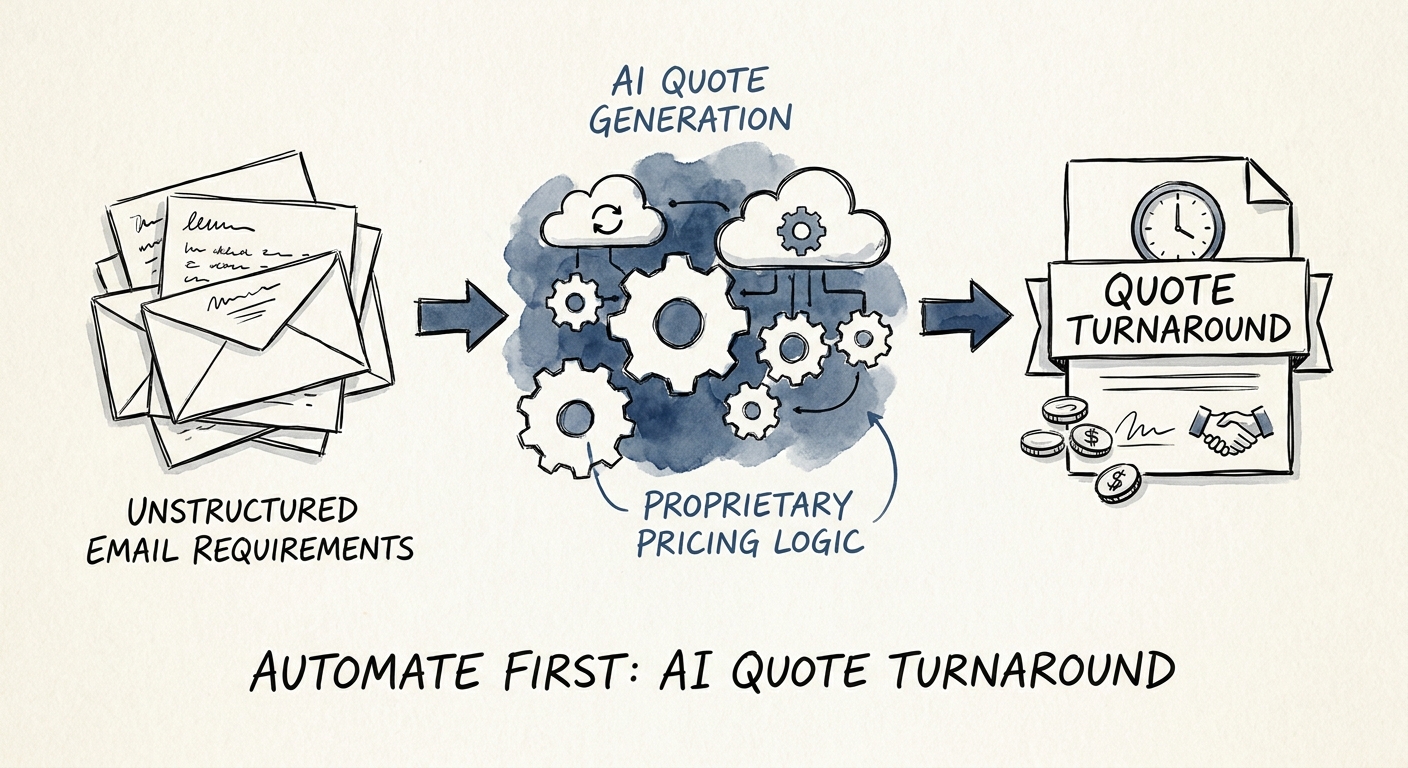
Here is the line that decides whether this works: AI assembles the packet. AI never sets the number. The system can find that this customer is on the standard MSP tier, that a 12% renewal discount is pre-approved at their volume, and that the migration SKU requires a scoping note. It surfaces all of that in seconds. The moment the buyer wants 18% instead of 12%, or the scope is fuzzy, the workflow stops and routes to a human with authority. RSM's middle-market AI survey shows adoption climbing fastest exactly where the task is repetitive and the guardrails are clear, which is what a well-defined quote pattern gives you.
Pick one quote shape, then defend the margin lineage
Do not start with your hardest deal. Start with the quote you generate most often and argue about least: renewals, or a standard service bundle with one or two optional add-ons. Write down the four things the AI needs before it drafts anything. Which price book is current. What discount is pre-approved at this customer's tier and volume. What service scope language attaches to each line. Who approves an exception, and what counts as one. If your team cannot answer those four for the renewal quote, the problem was never speed. It was that your pricing rules live in three spreadsheets and one sales director's head, and the AI just made that visible.
Quote workflows touch your most sensitive data: customer contract history, what each account actually pays, your discount floors, and the margin notes behind them. That is competitive intelligence about your own pricing. The CISA AI data-security guidance is directly relevant here: restrict which pricing sources the tool can read, and decide deliberately where generated quote context is stored and who can retrieve it. A leaked discount floor is a problem you carry into every future negotiation.
The control that matters most is lineage. A generated quote should never present a confident number with no trail behind it. Each line should show the source price, the discount rule applied, any margin exception triggered, the approval status, and any assumption the AI could not resolve, such as "migration hours not specified." Use the NIST AI Risk Management Framework to decide which of those need a hard stop versus a flag. A quote that says "$48,200, 12% discount applied per renewal tier B, margin within guardrail, scope assumption flagged" is one a sales leader can sign. A quote that just says "$48,200" is one they have to rebuild from scratch, which means you automated nothing.
What you watch in the first 90 days
Speed is not the scoreboard. A quote that comes back in four minutes and erodes three points of margin is worse than the two-day version. So track both sides at once: quote cycle time and missing-source flags on the velocity side, finance corrections, discount exceptions, and margin leakage on the discipline side. Then watch the two signals that tell you the truth: seller adoption, because reps route around tools they do not trust, and win-rate on the quote pattern you automated. If cycle time drops but reps are still quoting deals by hand in a side document, the workflow failed regardless of how fast it is.
Run a standing finance review of rejected drafts in those first 90 days. The pattern in the rejects diagnoses your real problem. If finance keeps fixing prices, your price book data is stale. If they keep overriding discounts, your approval policy is undocumented or wrong. If reps keep bypassing the system, the workflow is slower or clunkier than their workaround. Each failure mode has a different fix, and the reject pile tells you which one you have.
Hold one line firmly: do not let AI release a final quote when the product mix is nonstandard, the implementation scope is unclear, or discount authority is in dispute. In those cases the AI assembles the sources and surfaces the exception, and a human owns the commercial call. When you report results, tie the time saved to cleaner approvals and fewer margin surprises, not just a faster clock. Measuring AI ROI without fake savings is the difference between a quote engine your CFO trusts and a stopwatch nobody believes.