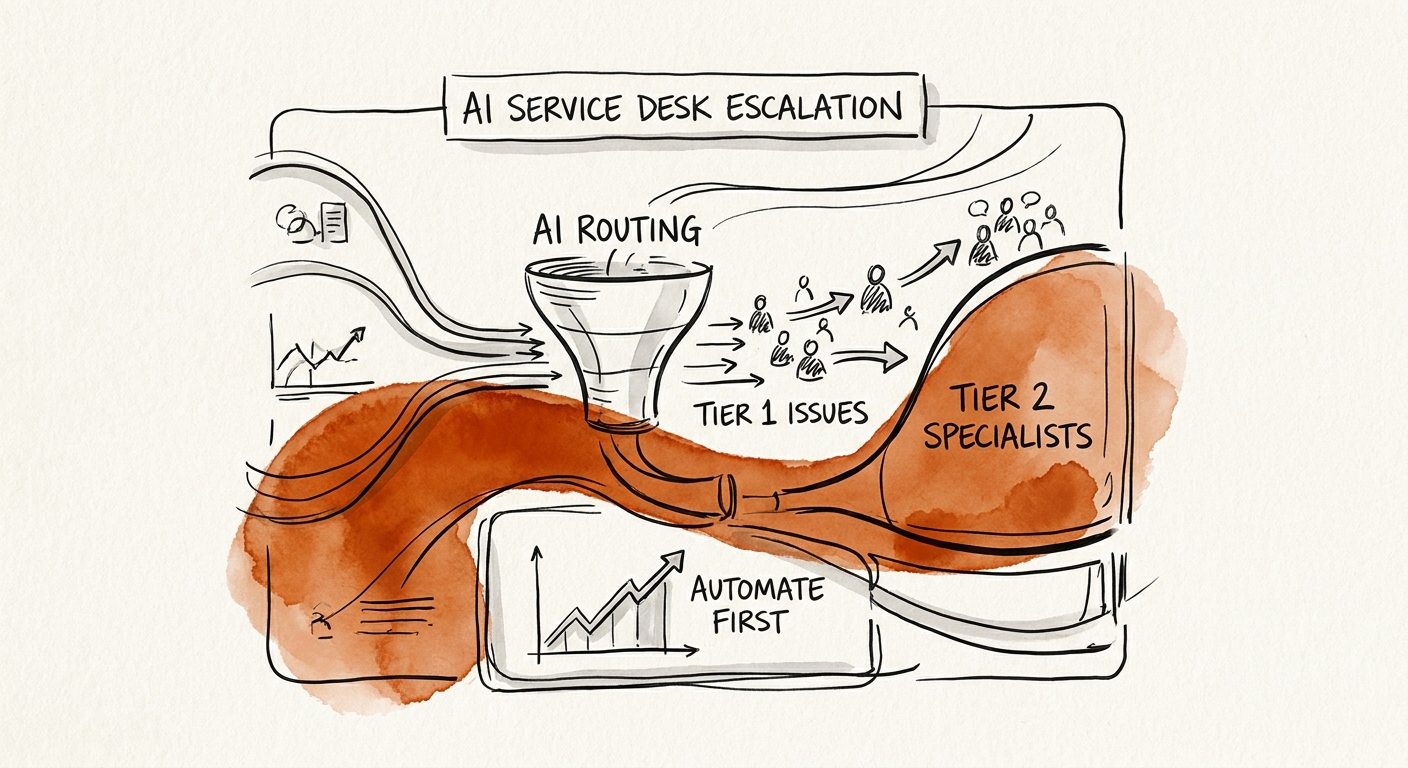
The expensive failure isn't a slow answer — it's a ticket in the wrong queue
Picture a support desk at a 120-person B2B software vendor on a Tuesday afternoon. A ticket comes in: "API returning 500s, our checkout is down." It lands in the general queue, an agent tags it "integration question," and it sits with the wrong team for three hours before someone realizes it's a production outage hitting a top-20 account. Nobody answered the ticket slowly. They answered it to the wrong person, twice, and the clock ran the whole time.
That is why escalation is the smartest first AI workflow for a customer service or IT service team — not the first-line reply, not the knowledge-base summary. You already own the raw material the decision needs: severity definitions, account tiers, product-area ownership, and a history of how similar tickets resolved. The Salesforce State of Service report is worth reading here because it treats service AI as a way to compress resolution time and protect the customer relationship, not as a novelty bolt-on. Routing is exactly that lever: it decides who touches the issue and how fast, before a single word of response gets written.
So the first release should not "auto-resolve" anything. It should output one thing well: a routing recommendation — proposed owner, severity, and the specific signals behind it. A senior issue with thin evidence stays in front of a human; it does not slip silently into a lower queue because the model felt confident.
Five facts ride with every ticket — or the handoff is still a guess
The difference between a routing recommendation a lead trusts and one they re-litigate is whether the reasoning travels with the ticket. Make the system attach five facts to every recommendation: severity (and why — which rule fired), customer context (tier, contract, open incidents), product area, prior-incident history (has this signature paged before?), and the proposed owner. Strip any of those out and you've rebuilt the original problem one layer down: the next person still has to reconstruct the context from scratch.
Two facts in that list deserve a hard gate. Because escalation routing brushes against security and availability incidents, the CISA artificial intelligence guidance and the NIST AI Risk Management Framework both point to the same discipline: define, before launch, the patterns where the model must stop and hand to a named human rather than route on its own. A ticket that matches a security-sensitive signature, or one where the evidence is thin, is not a confidence call — it's a stop-and-escalate-to-an-owner rule you write down in advance.
The fifth requirement is the receipt. When a service lead asks six weeks later why a P2 got routed as a P3, you need to show the exact ticket fields, knowledge articles, and account signals that drove it. The Microsoft 365 Copilot architecture and data protection documentation is a useful model for what that audit trail looks like in practice — what was retrieved, what was used, and who could see it. An escalation engine you can't audit is one you'll quietly stop trusting the first time it's wrong on a big account.
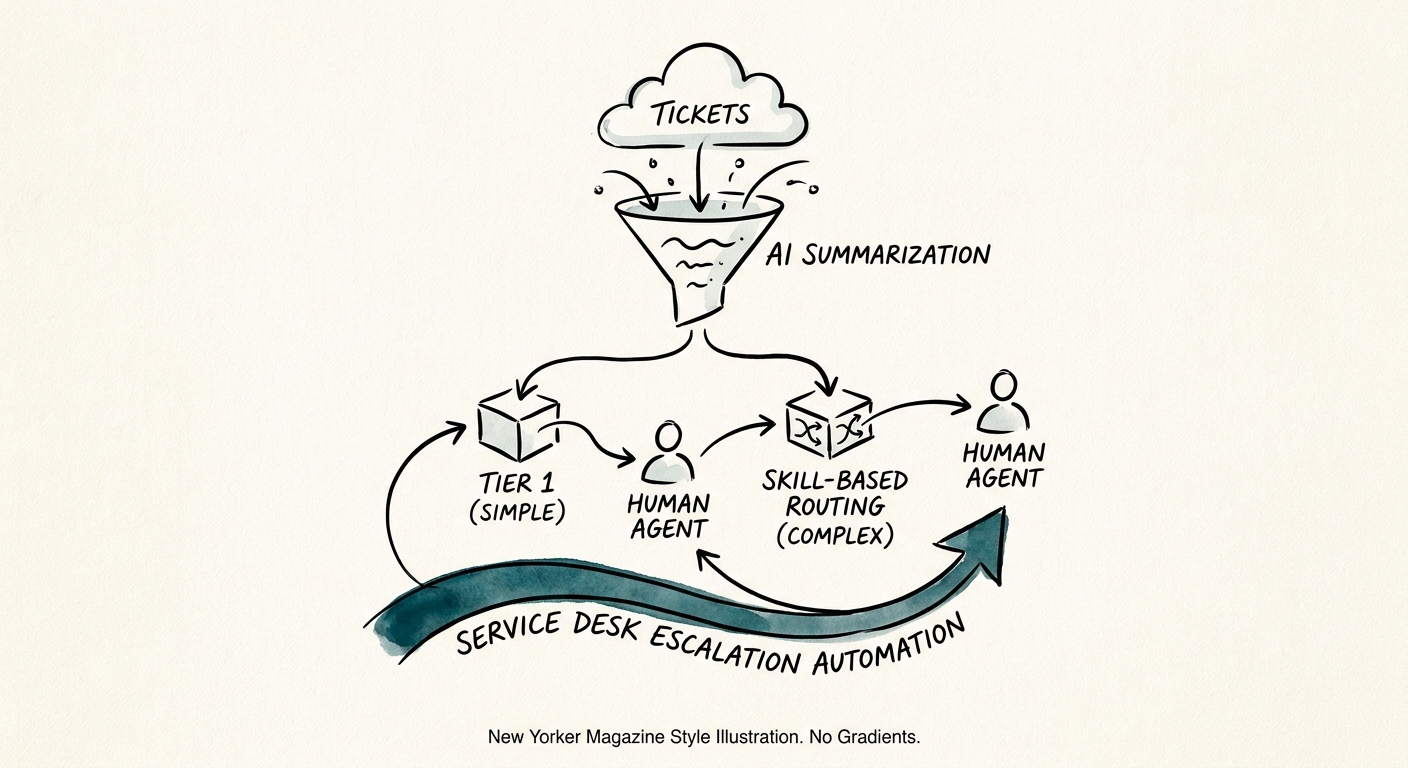
What to do Monday: instrument the bounce, not the speed
The trap is grading this pilot on speed. A workflow that routes fast and wrong just relocates the cleanup. Track five things instead: correct-routing rate (did the first owner keep it?), reopen and re-route rate (how often did the ticket bounce?), time to owner assignment, exception volume (how many hit your stop-and-escalate rules), and reviewer trust — do leads accept the recommendation or override it. Bounce rate is the one to watch; it's the truest signal that the routing is actually landing.
Before you build anything, run the harder test: pull your last 50 escalated tickets and ask whether two experienced agents would have routed them the same way. If they wouldn't, the rules are ambiguous and no model will fix that — it will just automate the disagreement. That's where a QuickStart AI Audit earns its keep: tightening the severity and ownership definitions first. Once your desk can name its first governed escalation lane cleanly, use the AI Opportunity Score to size whether it's the right place to start.