The question that breaks your team isn't from a customer
Picture a Tuesday in a 60-person B2B software company's support queue. A customer on an annual plan cancels in month four and wants a prorated refund. One agent reads the contract and says no. A newer agent, three desks over, reads the same contract and issues the refund to avoid a bad review. Now you have two customers in identical situations who got opposite answers — and the one who got "no" is forwarding screenshots from a forum where someone got "yes."
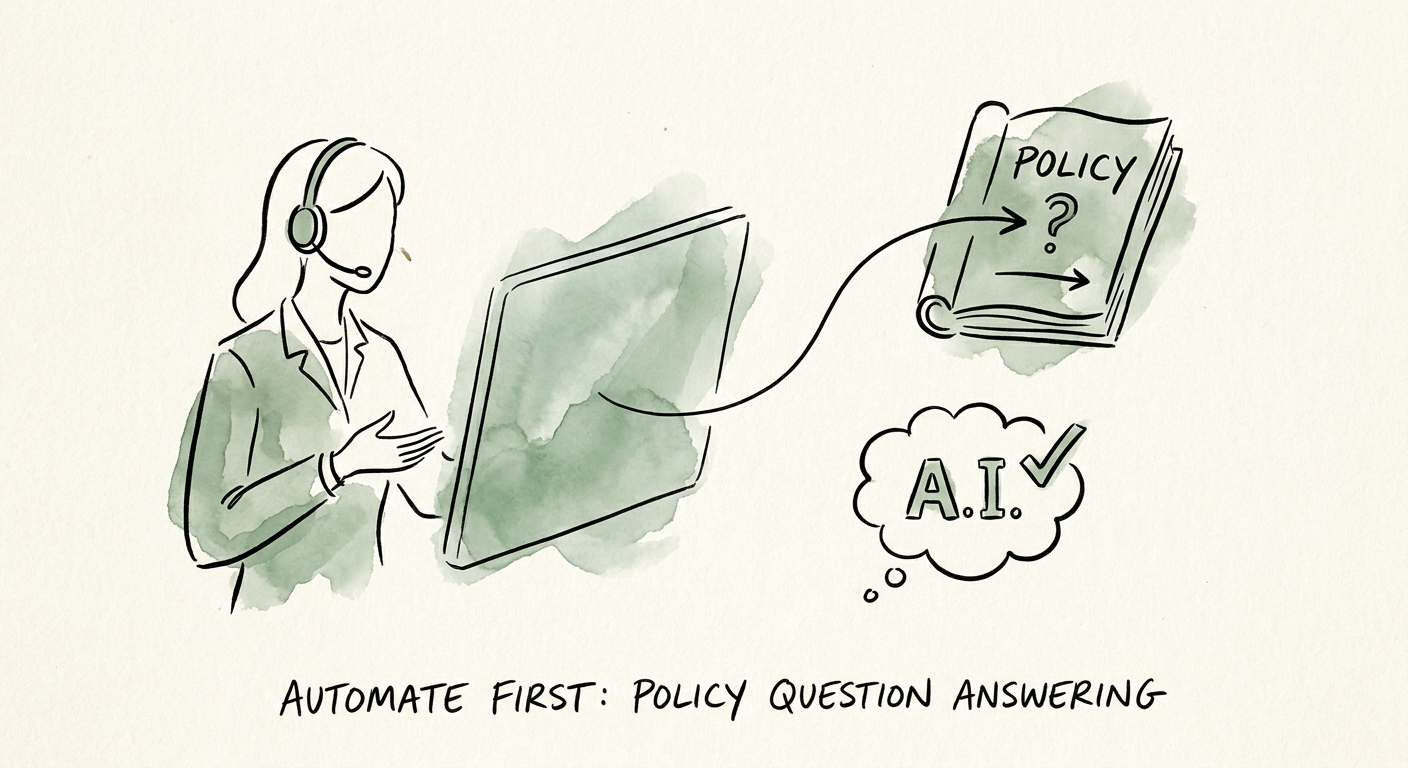
That inconsistency is the real cost, and it's why the first thing customer service should hand to AI is not a customer-facing chatbot. It's a tool that answers your agents' policy questions: refund eligibility, SLA wording, account exceptions, warranty boundaries, how to handle a data-deletion request, when something has to go to a supervisor. The same conditions that make any automation worth doing — a clear owner, a single source of truth, a value you can measure — point straight at internal policy guidance. The RSM middle-market AI survey, the San Francisco Fed small-business AI analysis, and the OECD SME AI adoption report all converge on the same advice for teams your size: start narrow, where the work repeats and the answer can be checked.
The win here is structural. When an agent asks the assistant instead of guessing — or instead of pinging a senior rep on Slack for the fortieth time that week — you get one answer, traceable to one document, that everyone gives. Before you build anything, run the workflow through the workflow automation screen to confirm the volume is real and the source policies are actually approved and current. Stale source documents are how you automate a wrong answer at scale.
Build it so it would rather say "ask a supervisor" than make something up
The hard part of policy Q&A in B2B service isn't the common case — it's the exception that looks like the common case. A reseller agreement with custom terms. An enterprise account with a negotiated SLA that overrides the standard one. A privacy request that's routine in one jurisdiction and a legal escalation in another. An AI that answers all of these with equal confidence is more dangerous than no AI, because your agents will trust it precisely when they shouldn't.
So design the boundaries before you design the answers. Every response should cite the exact policy section it came from, so the agent can read the source in two seconds rather than take the bot's word. Set a confidence threshold below which the assistant stops and routes to a supervisor instead of guessing. Lock down access to customer data so the tool answers policy questions, not "what's this specific account allowed to do." And keep a supervisor queue where every exception lands with its context attached. The NIST AI Risk Management Framework is useful here for mapping who owns what when an answer is wrong, and the CISA AI Data Security Best Practices cover the controls for the sensitive contract and customer data these policies touch.
Treat "I'm not sure — escalate this" as a successful answer, not a failure. A tool that knows the edge of its own knowledge is the one your senior reps will actually let near a contract dispute. To pressure-test whether this specific workflow is worth the build versus the escalation risk, source quality, and adoption effort, put it through the AI use-case scoring model.
The metric isn't deflection — it's whether your senior reps get their week back
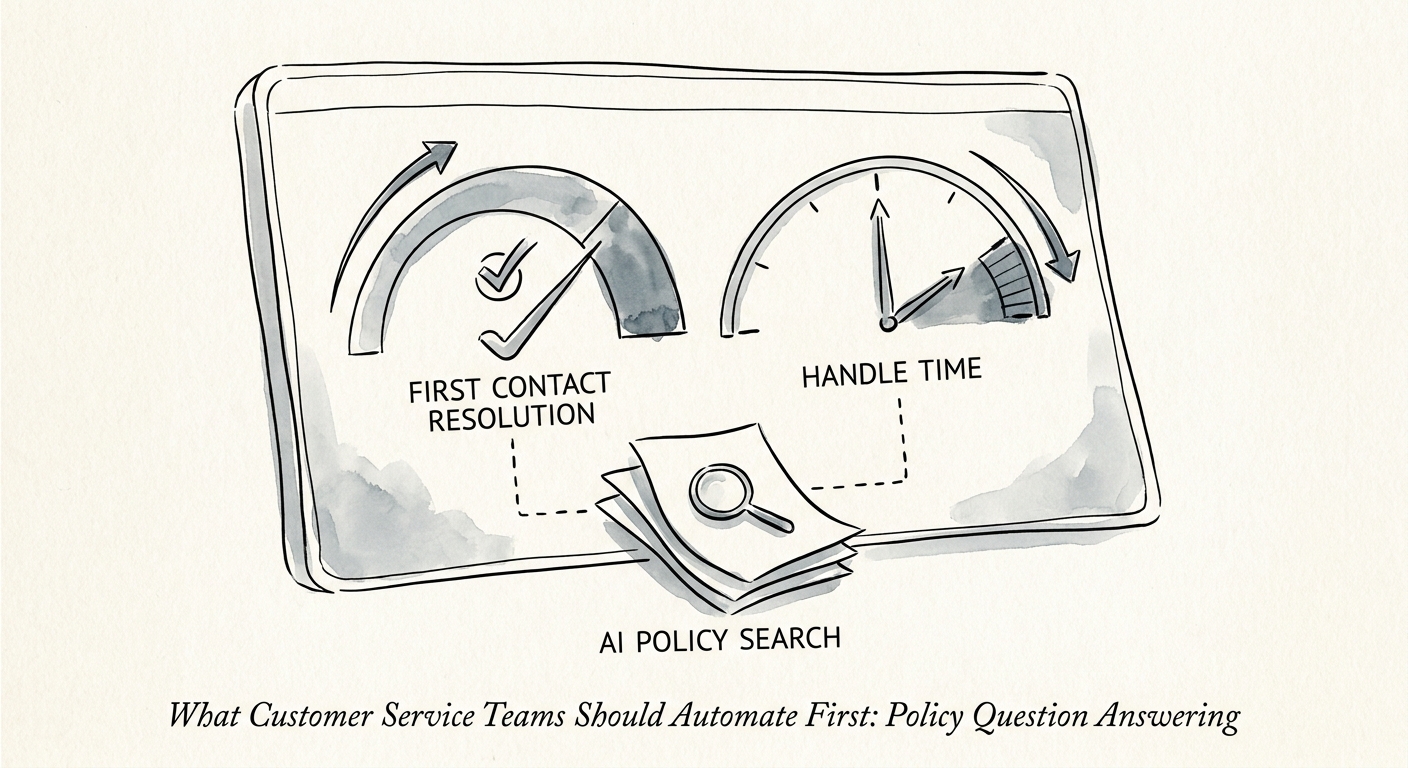
Most customer service AI gets measured by ticket deflection, which is the wrong number for an internal tool nobody outside the company sees. The value of agent-facing policy Q&A shows up somewhere quieter: in your two or three most experienced reps no longer answering the same "can we refund this?" question fifteen times a day in DMs. If those people get even an hour back daily to handle the genuinely hard cases, that's the return — and it's why the Deloitte State of AI in the Enterprise 2026 is worth reading: it separates real process value from AI that's merely busy.
Track the things that prove the answers are getting better, not just faster: how often an agent corrects or overrides the assistant, how clean the escalations are when they reach a supervisor, and whether the same policy interpretation stops getting re-litigated across the team. If correction rates are climbing, your source documents are wrong or out of date — fix the source, not the model. Watch adoption too; an internal tool agents quietly route around is telling you it isn't trustworthy yet.
The discipline that keeps this safe: do not let a customer see a single auto-generated policy answer until the internal version has been accurate and reviewable for long enough that your agents stop double-checking it. They are your free, expert QA layer — and they will catch the embarrassing mistakes a customer would simply screenshot. To sequence the internal rollout, supervisor review, exception tracking, and a later customer-facing pilot, use the 90-day AI implementation plan.
