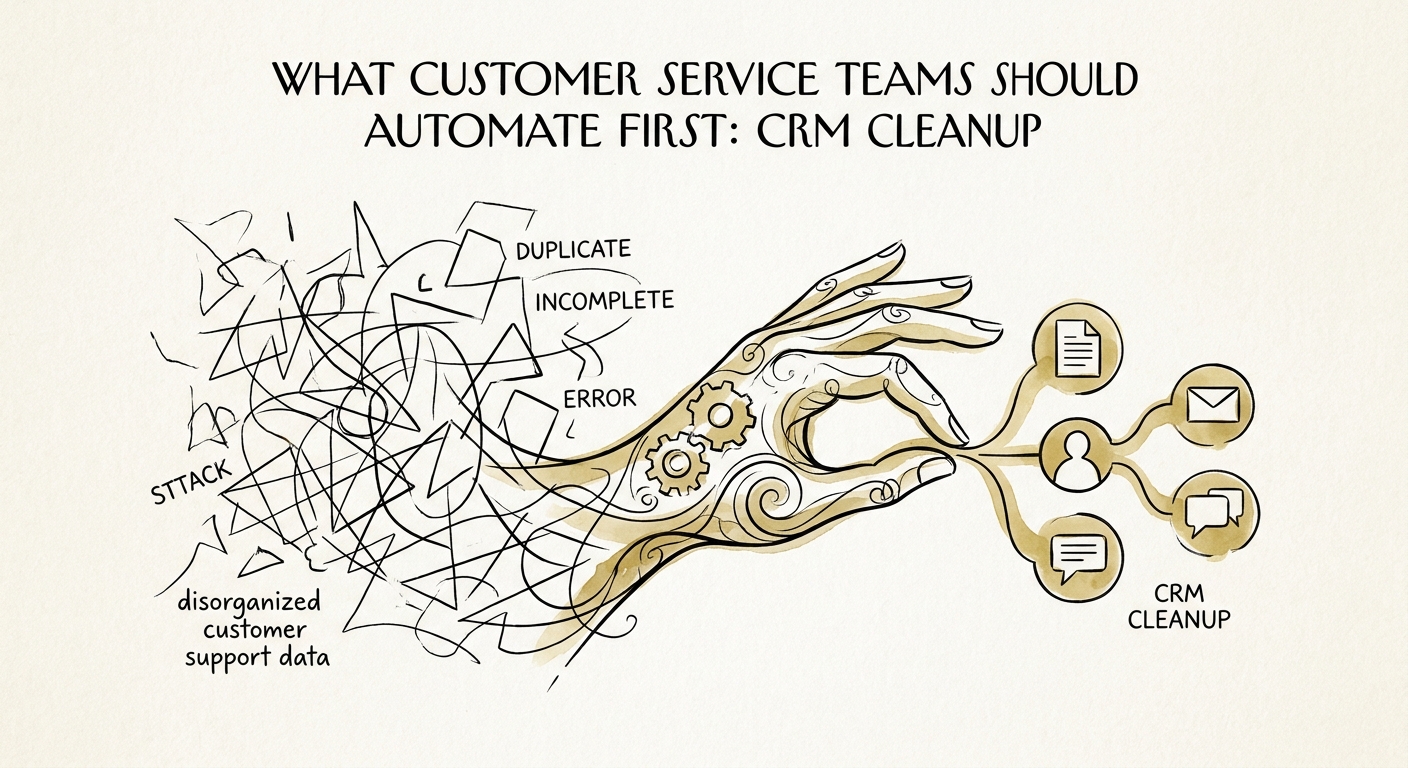
The bot quoted the wrong contract — and it was right to
Picture a B2B support team that just turned on an AI assistant to draft agent replies. A customer writes in about a feature their plan supposedly includes. The assistant pulls the account, reads the entitlements, and confidently tells the agent the customer is on the legacy tier with no access. The agent relays it. The customer escalates, furious, because they upgraded four months ago — on a different CRM record that nobody merged.
The AI did exactly what it was told. The problem was never the model. It was that the account existed three times: one from the original signup, one from a renewal logged by sales, one created by a webform typo. Whichever record the assistant grabbed first became the truth it acted on.
This is why, for most B2B support organizations, the first AI workflow worth building isn't a chatbot or a triage router. It's CRM cleanup. Stale notes, conflicting entitlements, duplicate accounts, and orphaned contacts don't just sit there quietly — every downstream automation inherits them and amplifies them. IBM's Institute for Business Value and McKinsey's State of AI research both keep landing on the same unglamorous prerequisite: data readiness, not model selection, separates the teams that get value from the ones that get incidents.
Detection is AI's job. Deciding is the human's.
The cleanup workflow that survives contact with a real support org has a hard wall in the middle of it: AI finds, a human approves. Never let the model rewrite the CRM on its own. The moment it can silently merge accounts or overwrite a status, you've handed it the authority to corrupt the exact records support, sales, finance, and delivery all read from.
So build a review queue, sorted by failure pattern, not by record. For a B2B support CRM the patterns are specific: duplicate accounts (same domain, fuzzy-matched company name, overlapping contacts), entitlement conflicts (the renewal record says Pro, the original says legacy), stale ownership (the assigned CSM left eight months ago), contradicted status (account marked churned but with three open tickets this week), and missing context (no plan, no renewal date, no primary contact). Three of those — duplicate, missing, stale — are usually where the volume sits and where you should start.
The part teams skip, and the part that actually makes the queue trustworthy: every flag has to show its work. Why was this a likely duplicate? Which two fields matched, and at what confidence? Which support tickets contradict the "churned" label? A reviewer clearing fifty merges an hour will rubber-stamp a blind queue and approve a bad merge by lunch. A queue that says "matched on domain + 91% company-name similarity, but billing IDs differ — review" earns a real decision. PwC's work on responsible AI frames this as keeping a human meaningfully in the loop, which in practice means giving the human enough evidence to actually overrule the machine. If you want a structured way to scope where the repair happens before any customer-facing automation expands, the CRM cleanup guide walks the boundary.
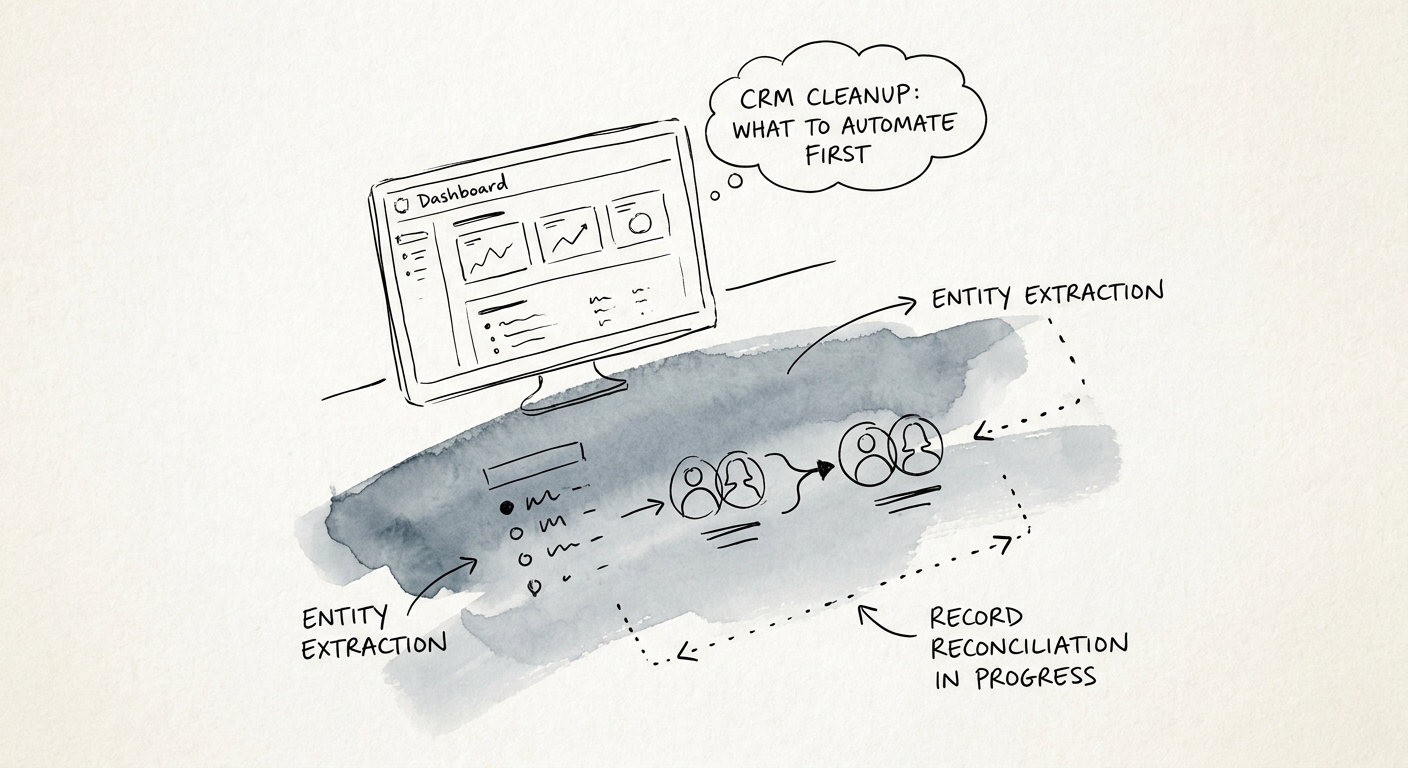
What to ship Monday — and how to know it worked
Don't boil the CRM. Pick one pattern and one slice: say, duplicate detection across your top 200 active B2B accounts, or entitlement-conflict flagging for everything with an open ticket. Run AI over that slice, route the hits into a review queue, and have one operations owner clear it for two weeks. You're not measuring "accuracy" in the abstract — you're measuring whether the queue makes a human faster and the data cleaner without creating new errors.
Track four numbers, not vanity ones: review time per record, percentage of AI recommendations accepted as-is, duplicate reduction in the slice, and — the one that matters most — downstream rework, meaning how often agents still pull the wrong account after cleanup versus before. If accepted-rate is high and rework drops, the detection logic is sound and you expand the slice. If reviewers are rejecting half the flags, your matching is too loose; tighten it before you scale, because Bain and MIT Sloan Management Review both document that the failures here are almost always rollout discipline, not raw capability.
Once the records under your assistant are clean and the queue is humming, the rest of the support stack — routing, reply drafting, renewal context, escalation handling — stops inheriting garbage and starts compounding. If CRM cleanup is one piece of a larger support operating model, Customer Service AI covers the broader build. If you're still deciding whether cleanup beats your other candidate first workflows, run it through the AI Opportunity Score and compare.