The pitch your reps use was never written down
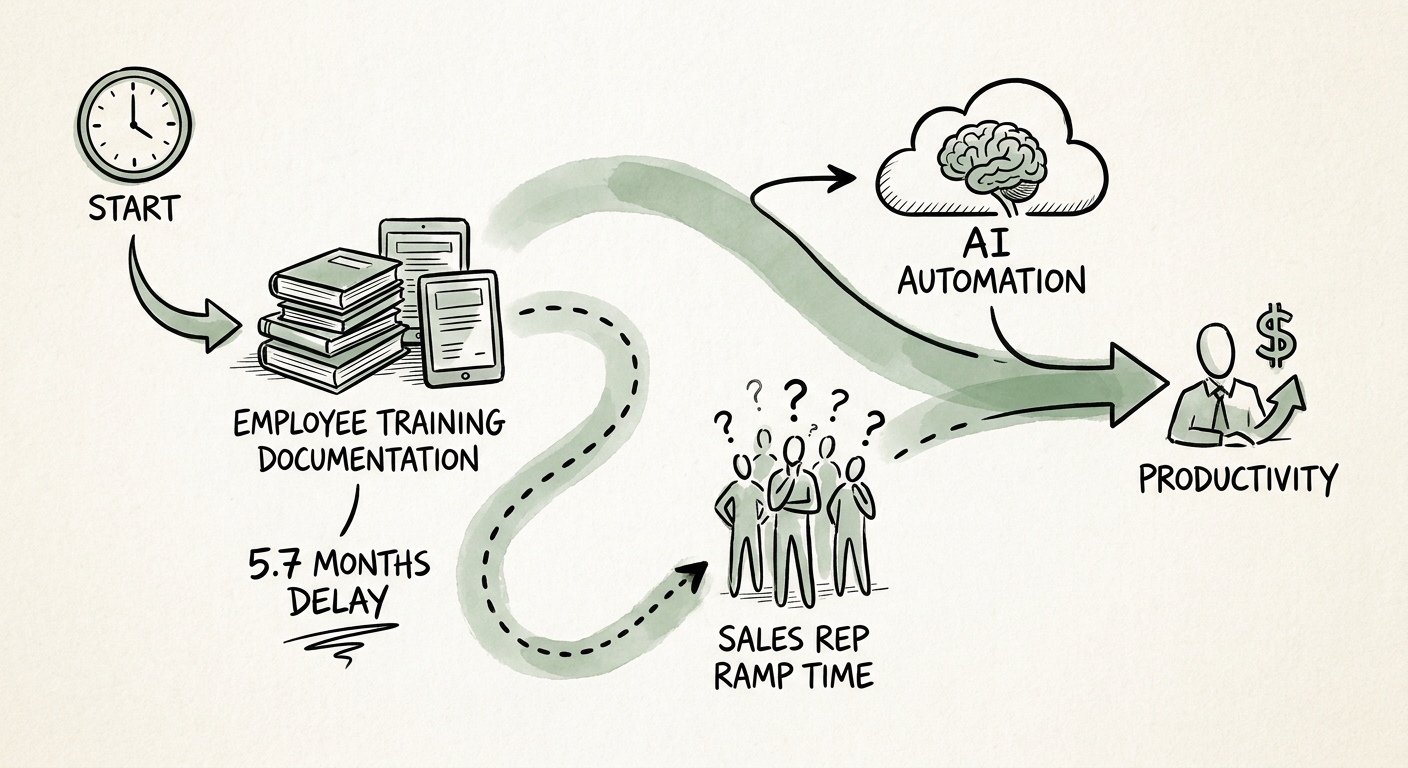
Ask any sales manager where the real onboarding playbook lives and the honest answer is: in the head of the rep who closes the most. New hires don't learn from the enablement folder. They shadow that person, copy their objection handling, and absorb a version of the pitch that no one approved and no one wrote down. Six months later the "official" training doc and the field reality have quietly diverged, and the gap is invisible until a new rep ramps slowly or repeats positioning the product team killed two quarters ago.
This is exactly why training documentation — not forecasting, not lead scoring — is the first thing a sales team should hand to AI. The work is bounded, the source material already exists (call recordings, the current pitch deck, win/loss notes, manager-approved messaging), and a wrong answer gets caught by a human before a customer ever hears it. Salesforce's State of Sales research and Deloitte's State of AI in the Enterprise 2026 both show adoption pressure landing hardest on revenue teams, but the same reports make clear that the question worth answering is which workflow goes first — and training docs are the one with the most upside and the least blast radius if it misfires.
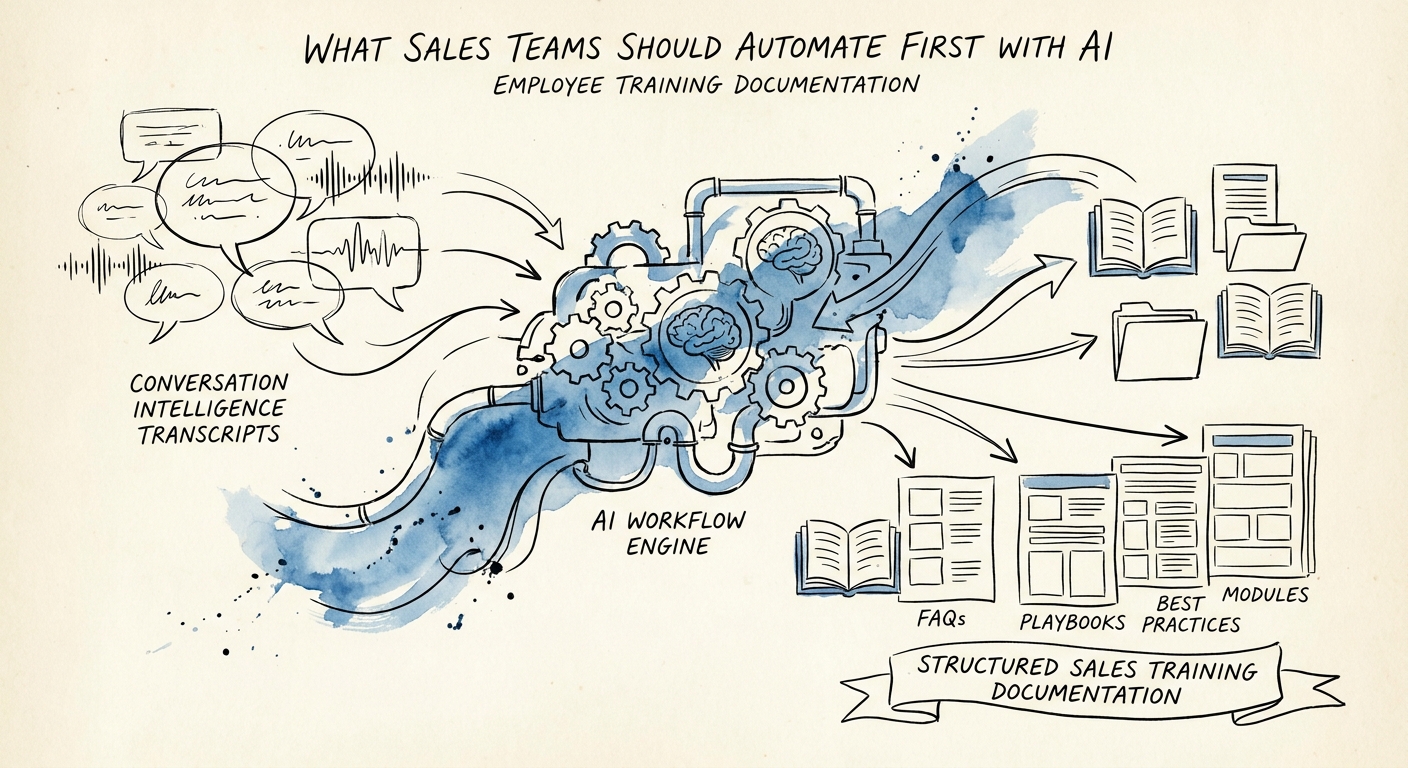
Say you run a 30-person sales org with three pods. The AI's job in the pilot isn't to invent a new playbook. It's to take last quarter's top-recorded calls and flag where the live pitch has drifted from the approved talk track — where reps are quoting a discount tier that expired, naming a competitor feature that shipped, or improvising a claim no one can support. That drift report, reviewed by the enablement owner, is the deliverable. The refreshed doc is what comes out the other side.
Baseline the drift before you measure the doc
The mistake teams make is measuring AI output by volume — "we generated 40 new training assets." That's the wrong scoreboard for sales. The thing that actually costs money is the lag between when the motion changes and when the docs catch up, plus the manager hours burned correcting reps who learned the old version. Baseline those first.
Pick four numbers and capture them before the pilot touches anything: days from a product or pricing change to an updated talk track, ramp time to first closed deal for the last cohort of new hires, the rate at which managers have to correct enablement material live on calls or in pipeline reviews, and the count of stale assets still sitting in the library that reps could find and use. Then run the weekly review against those — not against draft counts. You want to see whether the AI shortened the drift window and freed manager time, or just produced more documents for someone to ignore.
One concrete guardrail for a sales org specifically: tie every AI-suggested talk-track change back to a real artifact — a recorded call, a release note, an approved messaging doc. If the suggestion can't cite where it came from, it doesn't go to reps. Once those measures have a named owner on the enablement team, the AI Opportunity Score and the AI ROI Calculator are useful for sizing the next workflow — but only after this one is producing trusted, attributable material.
Version the pitch like you version code
Sales enablement content has a problem most document workflows don't: the same claim, said by 30 reps to hundreds of prospects, is a compliance and competitive exposure if it's wrong. So the governance here is sharper than "have a human review it." You version every approved talk track, you log who changed what and when, and you make sure a rep can always tell which version is live. When a rep flags from the field that "this objection rebuttal doesn't land anymore," that correction goes back into the source library — it doesn't die in a Slack thread.
The NIST AI Risk Management Framework gives you a clean way to write down intended use, risk, and accountability for this specific workflow — who owns the content, what the AI is and isn't allowed to assert, how you measure that it's working. And because the source material is your call recordings and competitive notes, CISA's AI data-security guidance should shape who can feed customer conversations into the system and where those inputs are retained. Restrict unsupported external claims hard — a rep repeating an AI-fabricated stat to a prospect is the failure mode that ends the program.
Start with one pod and one document type: the objection-handling guide or the new-hire ramp sequence, not both. Expand to adjacent material only when you can point to two things — managers accepting the updates without rewriting them, and reps actually using the current version on live calls. When you're ready to map which sales workflow earns the next pilot, build the AI roadmap so the sequence is deliberate instead of opportunistic.
