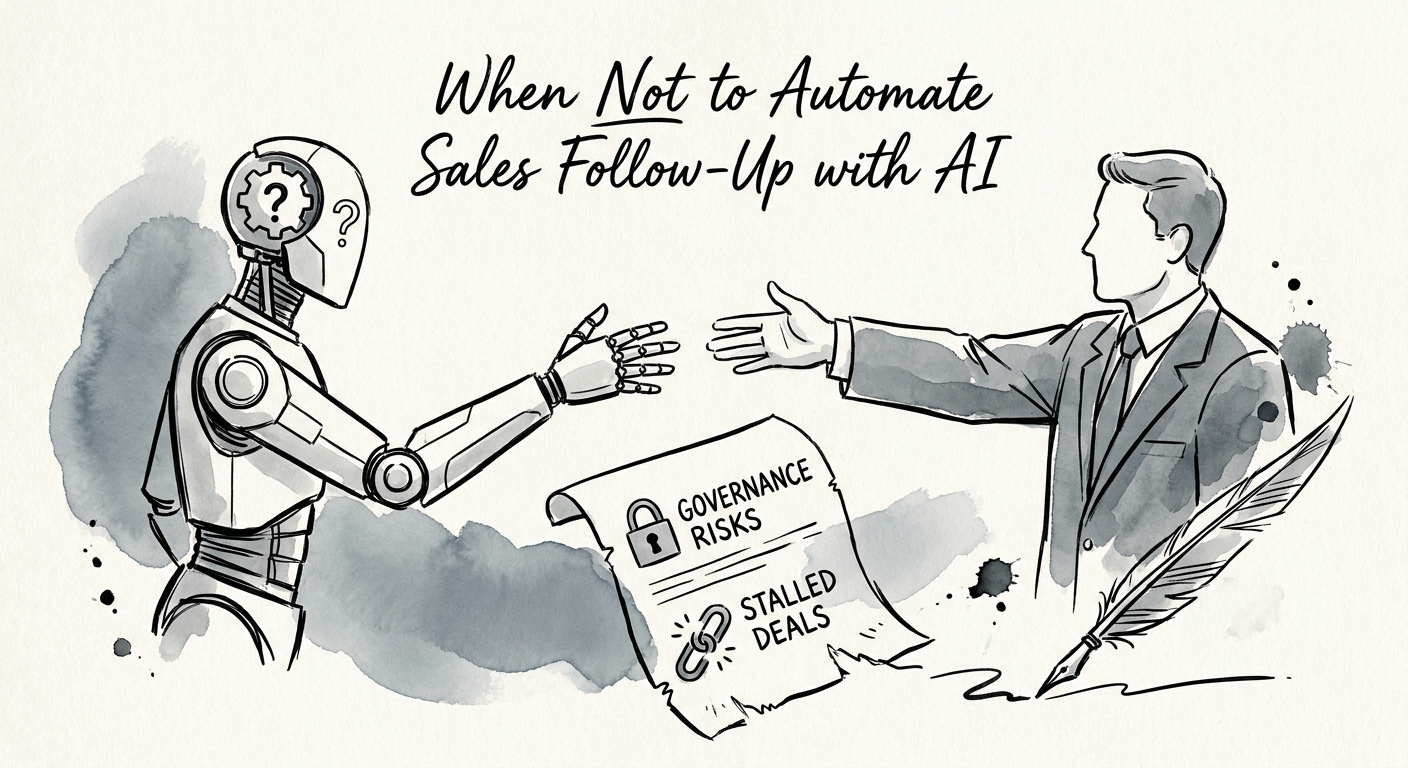
The follow-up that costs you the deal looks identical to the one that wins it
Picture a 90-person B2B software company that just turned on AI follow-up across the pipeline. On a Tuesday, a security engineer at a prospect replies to a stalled thread: "Where does our customer data physically reside, and are you SOC 2 Type II?" The AI, trained on cheerful marketing copy and a stale FAQ, fires back a confident "Yes, fully compliant, data stays in-region" in under four minutes. Fast. Polished. Wrong. The real answer was "Type II is in progress, and EU residency is roadmap, not GA." Three weeks later the deal dies in security review, and nobody can explain why the buyer went cold.
That is the trap. The reminder nudge after a no-show and the answer to a data-residency question travel through the exact same channel, in the exact same tone. To the seller they feel like one workflow. To the buyer, one is housekeeping and the other is a contractual representation. AI is excellent at the first and dangerous at the second, and the interface gives you no warning when you've crossed from one to the other.
This matters more in technical B2B than almost anywhere else, because your buyer is rarely one person. A mid-market deal threads through a champion, a procurement lead, a security reviewer, a finance approver, and an executive sponsor — each reading the same email with different stakes. Gartner expects over 40% of agentic AI projects to be canceled by 2027, and unsupervised buyer-facing messaging is precisely the kind of project that gets killed after one expensive miss. The question was never "can AI write this." It's "should AI decide which message a security engineer gets to read."
The three replies your AI should draft but never send alone
There are exactly three follow-up moments in a technical sale where letting the model hit "send" trades a small efficiency gain for an outsized risk. Memorize them, because they all start as a routine inbound reply.
1. Post-demo technical objections. Anything touching security posture, data residency, integration scope, SLAs, or implementation risk demands source-backed precision. The AI's failure mode here isn't a typo — it's manufactured confidence. It will assert an integration exists or a certification is held because the pattern of the sentence "sounds right," and it has no concept of the legal weight a buyer's procurement team places on that sentence. Salesforce's State of Sales research keeps surfacing the same theme: reps already struggle to keep technical answers accurate, and an autonomous agent multiplies the wrong ones at machine speed. Let the model assemble the account context and a draft. Make a human verify every claim against the source of truth.
2. Pricing, redlines, and procurement. An AI should never waive a fee, accept non-standard terms, interpret a redline, or imply agreement to a clause. Each of those moves margin, legal exposure, or delivery capacity — and an agent optimizing for "advance the deal" will discount or concede to do it. Forrester's B2B buyer research shows how much of modern buying happens in self-serve, document-heavy negotiation, which is exactly where a too-eager auto-reply does damage you only discover at renewal. This belongs with the account owner and an approved deal-desk path, full stop.
3. Executive sponsor communication. When a VP or CFO re-engages, the variables are timing, political context, and how hard to push — none of which live in your CRM. Bain's work on AI adoption is blunt that relationship equity is the asset automation most easily burns. The model can hand your rep three framed options and the full history in fifteen seconds. It should not choose which option lands in a sponsor's inbox.
None of this slows the team down. In every case AI still does the heavy lifting — research, summarization, drafting. It just stops short of the one keystroke that turns a draft into a commitment.
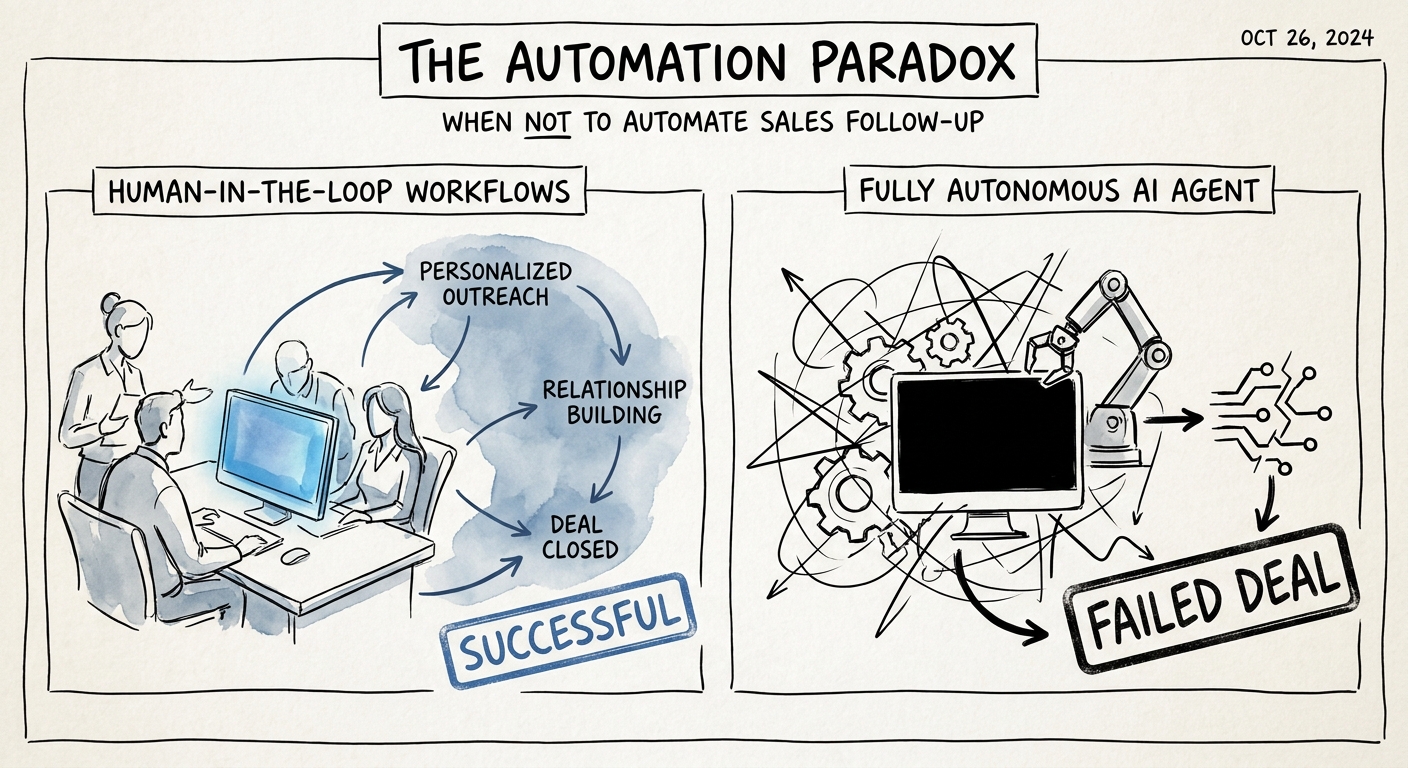
Tag every follow-up action before you turn the system loose
The fix isn't a policy memo nobody reads. It's a one-time classification pass over your actual sales actions, sorted into four tiers your tooling can enforce:
- Automation-safe: internal Slack pings, "you have a meeting tomorrow" reminders, no buyer-facing claims. Let it run.
- Draft-only: the AI writes the reply and parks it in the rep's drafts. A human reads and sends. This is where most "objection handling" should live.
- Manager-approved: deal-stage changes, discount mentions, anything that touches the contract. Routed to a person with authority before it moves.
- Read-only: the AI analyzes the account and suggests next steps but writes nothing outbound — the right starting point for any team that isn't sure yet.
Then close the technical gaps, because classification means nothing if reps route around it. Lock down write access to the CRM, gate deal-stage edits behind approval, keep your MSA and security questionnaires out of unsanctioned tools, and log the source material behind every generated draft so you can answer "where did that claim come from" after the fact. If your team is pasting buyer threads into a personal browser extension, that is the first fire to put out — not the next sequence to build. McKinsey's B2B sales research finds the teams getting real lift are the ones that scoped AI tightly, not the ones that pointed it at everything.
Use the AI assistant governance framework to write those review rules down, and run the AI Opportunity Score before you assume follow-up is even the right first workflow — for plenty of teams, CRM cleanup or account research delivers more upside with none of the trust risk. And if outbound is the goal, start where the stakes are lowest: faster, cleaner follow-up that improves response without spam. The win on Monday is simple: open a shared doc, list your last 20 follow-up actions, and put one of the four tags next to each. The drafts you'd never let a model send alone will be obvious in ten minutes.