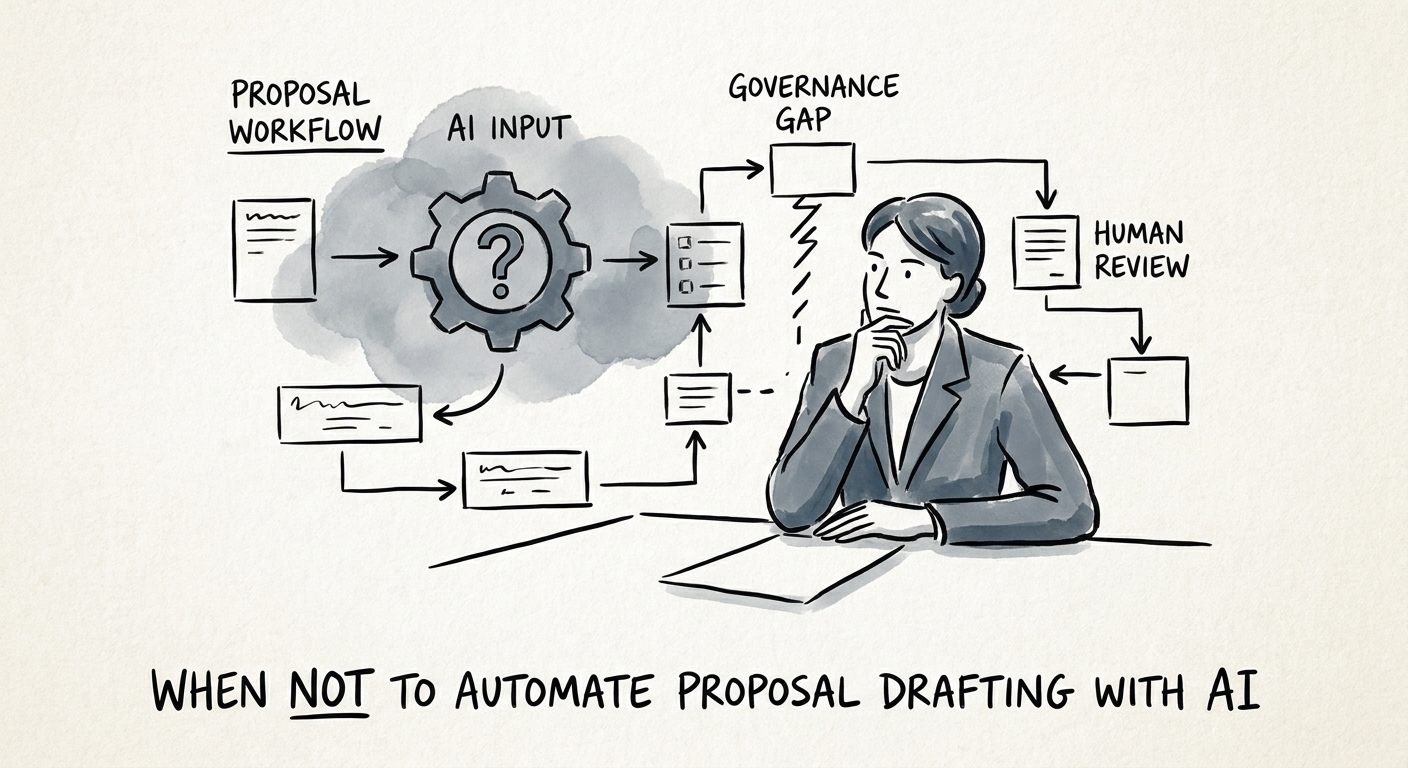
The line item nobody asked AI to invent
Say a 60-person B2B services firm points its new drafting assistant at a discovery call transcript and asks for a first-pass proposal. Ninety seconds later it has a clean three-page document — scope, timeline, a pricing table, and a confident paragraph that reads: "Our team has delivered this exact migration for comparable clients in under six weeks." Nobody wrote that sentence. Nobody can point to the project it refers to. And the prospect's procurement team is going to hold you to all of it.
That is the trap with proposal drafting specifically. It looks like the perfect automation candidate because the format repeats — cover, scope, approach, pricing, terms — but unlike a blog post or an internal summary, every section is a commercial promise. Scope you'll be measured against. Timing you'll be invoiced against if you miss it. Pricing that signals your authority to discount. A proposal is the one sales document where polished and wrong is more dangerous than rough and honest, because the prospect can't tell the difference and the contract inherits whatever you sent.
The Salesforce State of Sales report is blunt about where deals are actually won: not on output volume, but on the quality of information and execution behind the pitch. Faster proposals that draw from a weak, unapproved source library don't improve execution — they industrialize the gap between what you said and what you can prove.
Four commitments to keep on a human's desk
The useful question is not "should we automate proposals" but "which sections is a model allowed to author unsupervised." For a services firm, four sections should never ship straight from a generated draft, and they map cleanly onto a risk framework. The NIST AI Risk Management Framework — map context, measure risk, manage controls, govern the system — gives you the discipline to draw those lines deliberately instead of after a deal goes sideways.
The four: evidence claims ("we've done this before," win rates, named outcomes) must trace to an approved case study, not a plausible reconstruction. Pricing and discount language carries authority — a model shouldn't decide your floor or imply terms a partner hasn't blessed. Differentiation against named competitors is where confident hallucination does brand damage. And scope and timing commitments become deliverables the second the prospect signs. For each, define who owns sign-off, what counts as an approved source, and the exception path when reality doesn't fit the template.
The PwC Responsible AI survey frames responsible AI as an operating discipline rather than a one-time policy, and proposals are the clearest place to feel that. The controls that matter here are concrete: a red-team pass that flags any claim without a source citation, a disclosure rule for AI-assisted drafts, mandatory human review before a proposal leaves the building, and an audit trail so you can answer "where did this number come from" three months into delivery.
Automate the 80% that isn't a promise
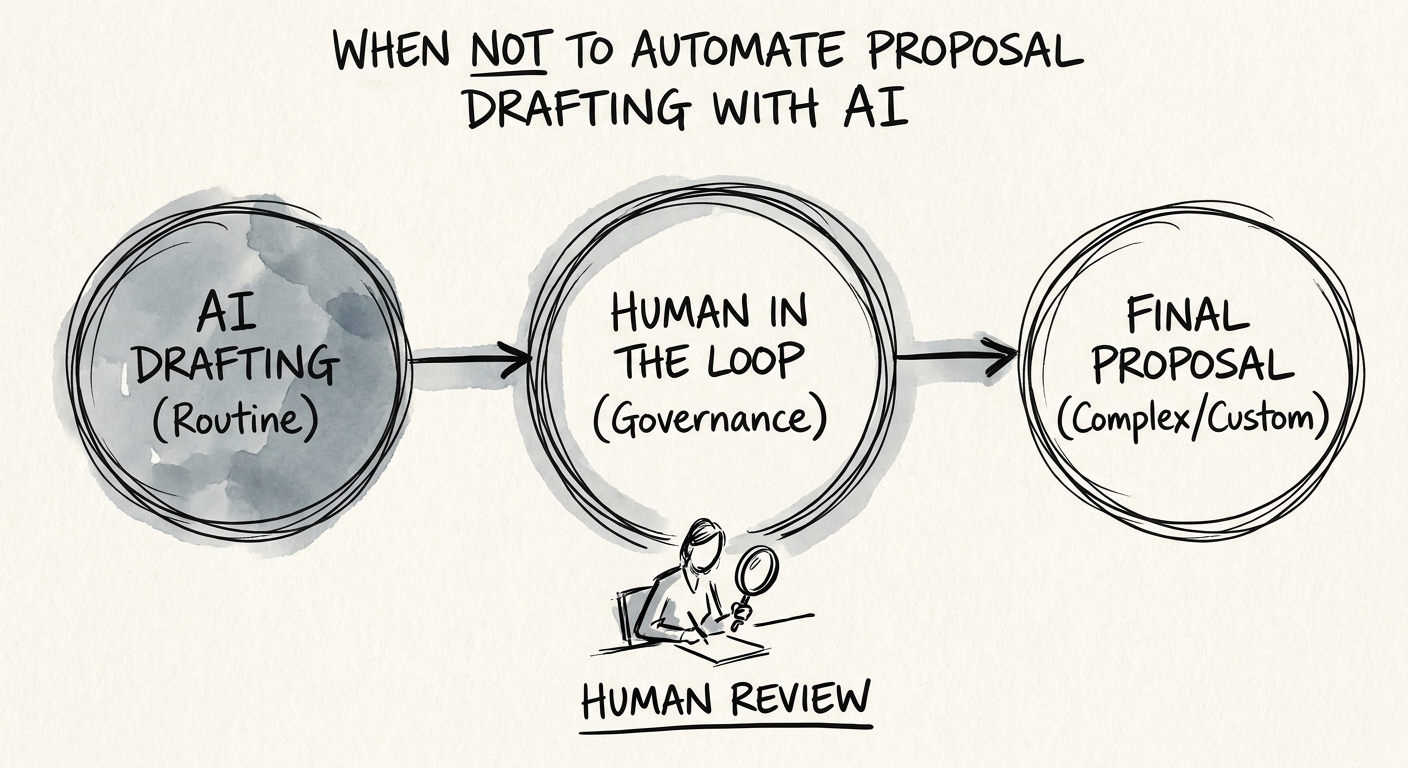
Here's the part that gets lost in the "automate or don't" framing: the bulk of proposal work isn't the four risky sections — it's the prep that surrounds them, and that prep is where AI earns its keep safely. The IBM Institute for Business Value AI capabilities research ties real AI ROI to building durable capabilities, not to producing finished artifacts faster. For proposals, the capability is a clean, retrieval-driven workflow that hands a human a strong starting point — not a send-ready document.
Concretely, by Monday: point the model at retrieval, not authorship. Let it pull the closest matching past engagements from an approved library, draft the structural scaffold and the non-committal sections (background, methodology overview, boilerplate terms), compare this opportunity to similar won deals, and — most valuable of all — produce a "missing evidence" list that tells the seller which claims they want to make but can't yet support. That last output flips the risk: instead of generating an unsupported claim, the system surfaces the gap before anyone writes around it.
Stand up those guardrails before you widen the model's authority. Our AI Governance and Training work exists to define exactly this — the source-of-truth library, the claim categories, the reviewer roles — so proposal automation accelerates the prep and never quietly authors the commitment.