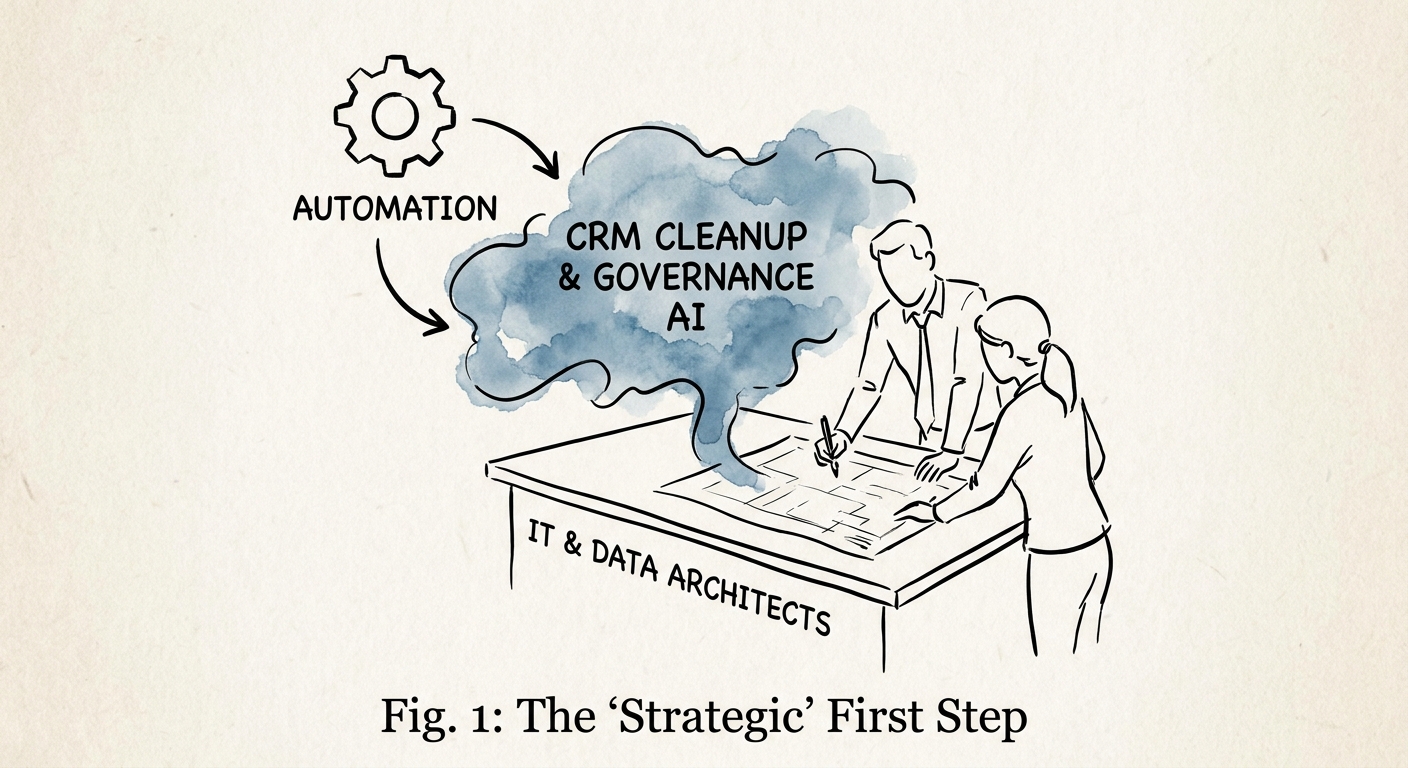
The "ACME Corp" Problem Every Data Team Already Knows
Open any aging B2B CRM and search for one of your bigger accounts. You will probably find it four times: "ACME Corp," "Acme Corporation," "ACME Corp." with a trailing space, and "Acme (West)" that someone created during a regional reorg in 2022. Three of them have an owner. Two have open opportunities. One has the renewal date that's actually correct. A salesperson logs a call against whichever one autocomplete surfaces first, and now your pipeline report is quietly wrong.
This is why CRM cleanup is the smartest first AI workflow for an IT or data team — not because it's exciting, but because it's bounded, measurable, and the failure modes are visible the moment you get them wrong. You are not asking a model to write to customers. You are asking it to propose record merges that a human approves. The OECD SME AI adoption report describes exactly the constraint smaller firms run into — limited internal AI skills and thin tolerance for unexplained automation — and a human-in-the-loop dedup workflow fits inside that constraint instead of fighting it.
It also pays for itself in a place the business can see. Salesforce State of Sales research keeps landing on the same point: reps lose real selling hours to manual admin and bad data. When you collapse four ACME records into one trustworthy account, forecast accuracy and territory routing improve at the same time — and that's a win sales ops can feel, not just a tidier database.
The Merge Conflict Is Where the Real Design Happens
Anyone can write a script that flags two records with the same domain. The hard part — and the part that decides whether your pilot survives contact with the sales team — is the conflict resolution rules. So design those first, on paper, before you touch a model.
Take two duplicate contacts. One says "Director of IT," the other says "VP, Infrastructure." One has a phone number, the other has a mobile. One was last touched 14 months ago, the other last week. Your merge logic needs an explicit answer for each field: most-recently-modified wins for title and phone, never-overwrite-a-non-null-with-a-null for contact details, and keep both activity histories, always. Write that table down. The AI's job is to apply it and surface the cases the table doesn't cover — not to invent a winner.
For every proposed merge, your workflow should log five things: which source records it touched, the change it wants to make, the rule (or model confidence) that justified it, the human who reviewed it, and the approval status. And it must support an un-merge. This isn't paperwork — it's the operating model. The NIST AI Risk Management Framework treats explainability and human oversight as live controls, and a CRM merge is the perfect place to practice them, because a bad merge is fully reversible if — and only if — you kept the lineage to reverse it.
One trap worth naming: the dangerous duplicate isn't the one where the records disagree. Disagreement gets flagged and reviewed. The dangerous one is where two records agree on a stale value — both say the account is owned by a rep who left — and the model merges them with high confidence into a confidently wrong single record. Route high-confidence merges through a sample audit anyway. Confidence is not correctness.
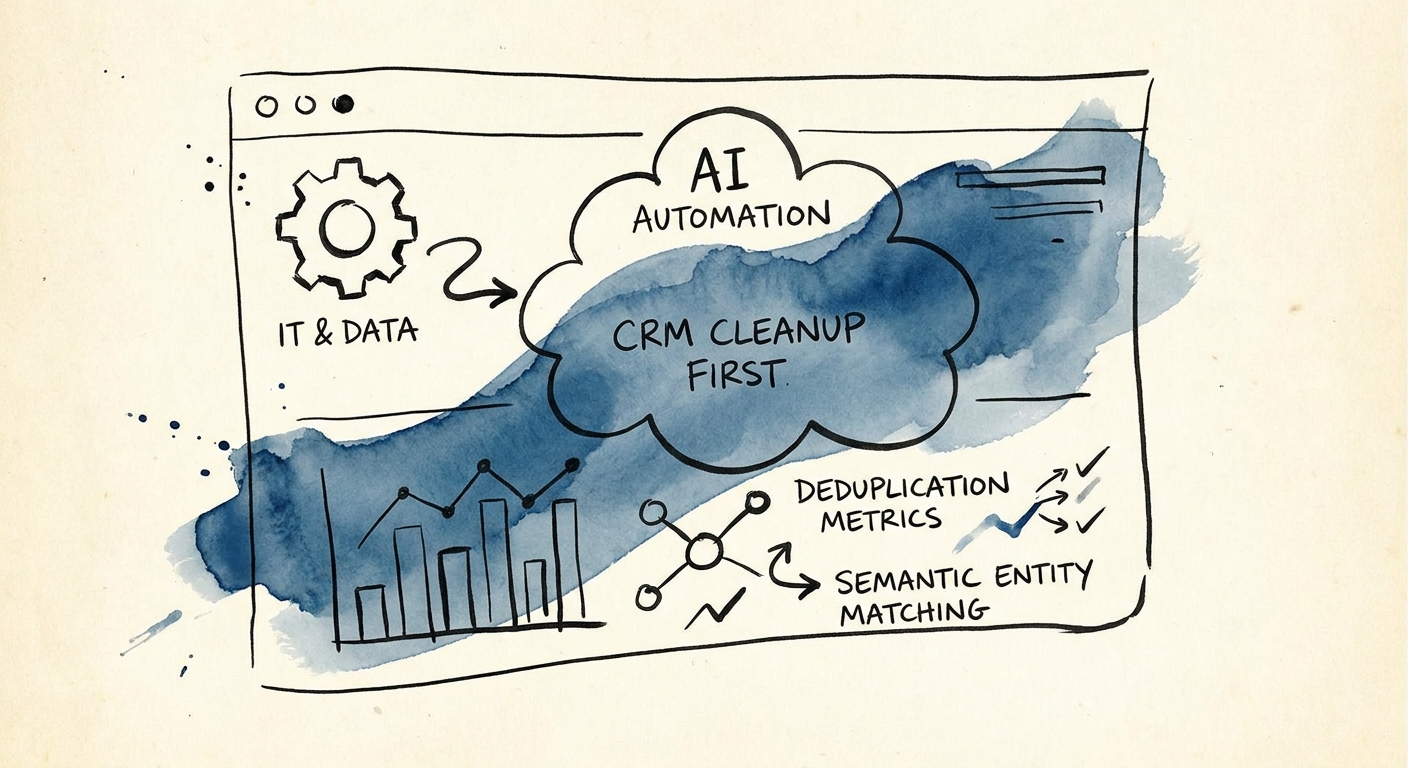
Scope It So You Can Ship It Monday
Don't try to clean the whole CRM. Pick one bounded slice — say, duplicate accounts in your top revenue segment — and run the workflow in propose-only mode for two weeks. Nothing auto-commits. A data analyst clicks approve or reject, and every decision feeds back as a labeled example. You'll learn your own data's quirks (the regional-suffix accounts, the personal Gmail addresses on enterprise contacts) far faster than any vendor demo would teach you.
Before any of that runs, settle the access question. A CRM holds personal contact data, contract terms, deal notes, and account strategy — the kind of data you do not want flowing into an unvetted model endpoint. The CISA AI data-security best practices should shape that decision: what the workflow can read, where it processes, what it's allowed to retain. Decide it now, while the blast radius is one data slice and not the entire customer base.
Then make the output speak business, not engineering. Instead of reporting that a data-quality score went from 71 to 84, publish a weekly exception report to sales ops: "We merged 312 duplicate accounts, flagged 47 with conflicting owners for you to resolve, and found 19 active opportunities sitting on orphaned records." That report is what earns IT the mandate to take on the higher-value work next — account research, renewal-risk scoring, lead routing. Cleanup is the unglamorous proof that your team can run AI safely, and proof is what unlocks the budget for everything after it. Map the sequence here.