Pick the queue, not the press release
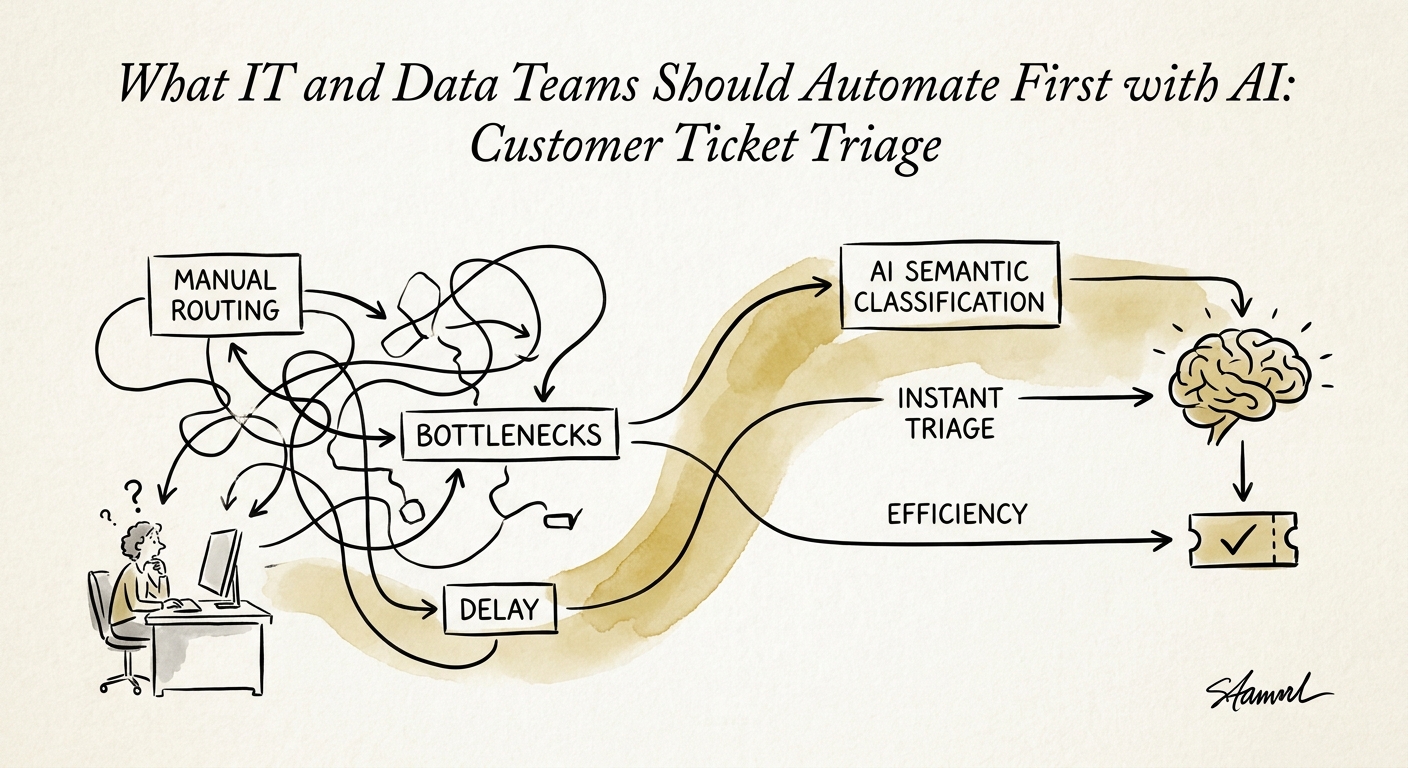
Walk past any service desk on a Tuesday and you'll find the same thing: a senior analyst manually reading the top of the queue, deciding what's a password reset versus a sev-1, what's "billing" versus "billing that's actually a contract dispute," and who owns it. That five-second human judgment, repeated a few hundred times a day, is the workflow most teams should hand an AI model first — and the reason isn't that it's flashy. It's that the queue is already instrumented.
Every ticket has a timestamp, a category, a routing history, a resolution code, and a customer. You don't have to build a measurement system to prove whether triage AI works; your ITSM tool has been logging the ground truth for years. Salesforce's State of Service research documents the squeeze service teams are under — faster responses demanded without a drop in quality — and triage is exactly where that pressure concentrates. Most AI pilots fail on attribution. This one starts with a labeled dataset you didn't have to create.
Define the boundary narrowly. Version one classifies the incoming ticket, flags missing information, suggests a route, and scores escalation risk. It does not close tickets, promise a customer anything, or jump the priority rules a human would have followed. Treat the model as the analyst who reads the queue and tags it — never the one who replies. The release boundary in the ticket triage use-case guide is the line you don't cross in the first 90 days.
Tickets are a data-exposure problem wearing a productivity costume
Here's what makes triage different from automating, say, an internal FAQ: the queue is one of the dirtiest data stores in the company. A single ticket body can contain a customer's account credentials pasted in frustration, a screenshot with PII, an incident description that names an unannounced outage, or contract terms a salesperson dropped in for context. The moment you point a model at that queue, you've made a data-governance decision whether you meant to or not.
So make it on purpose. CISA's AI Data Security Best Practices is the right frame here because it forces three questions before a single ticket flows to the model: what can the workflow read, where do its summaries get stored, and which downstream teams can see its outputs. A triage assistant that surfaces a customer name to a tier-1 queue that shouldn't have it isn't a feature — it's an incident you built yourself.
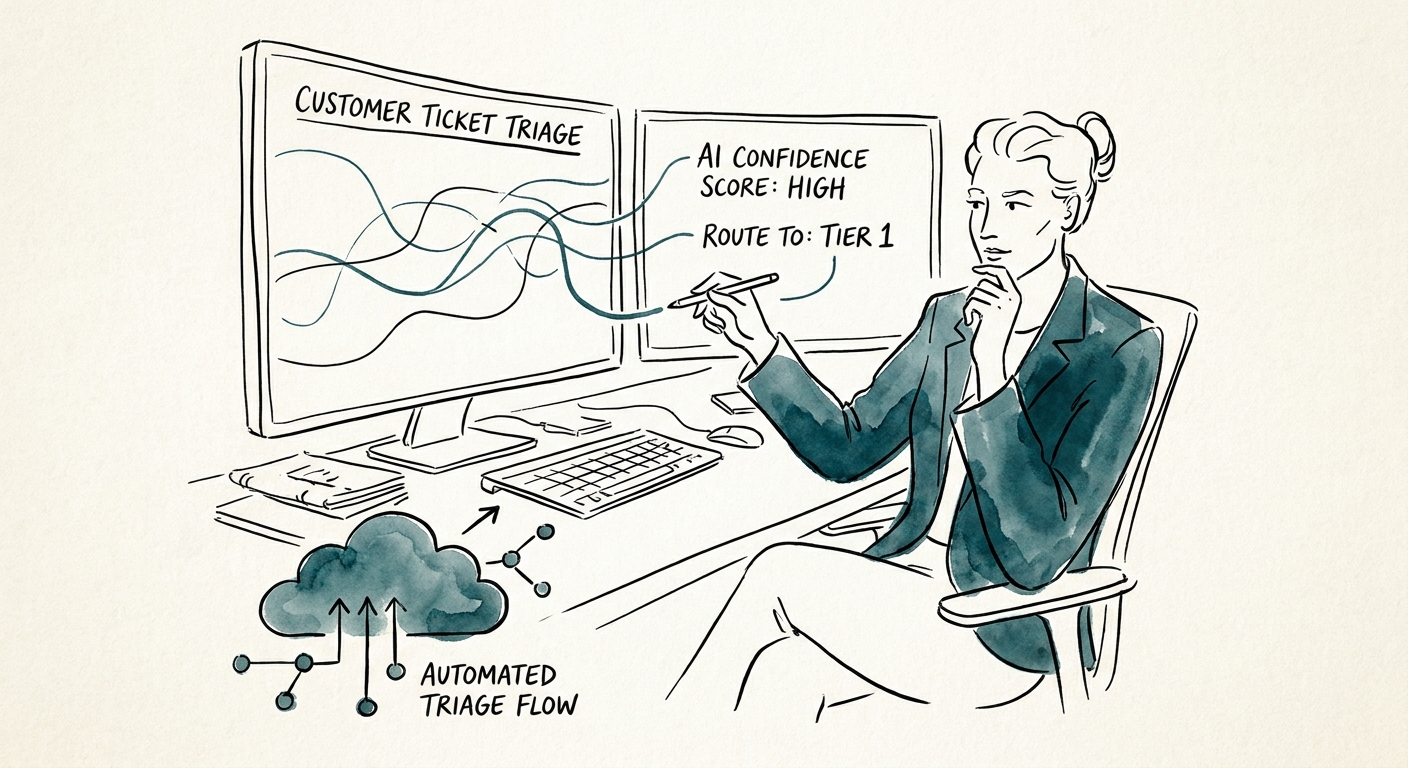
Then make the routing logic explicit and auditable. The model should be choosing along named dimensions — category, urgency, affected product, account tier, the specialist required, and the escalation trigger — not producing a vibe. And wire in the abstention path early: if confidence is low, or the ticket trips a sensitive-content rule, it goes to a human, untouched. The goal is a queue that behaves more consistently than your best analyst on their worst afternoon, with zero decisions hiding inside the model.
The reroute rate tells you everything
Set up the production guardrails the way you would for any system that touches customer outcomes — the NIST AI Risk Management Framework gives you the map-measure-manage structure to do that without inventing your own. But the metric that actually decides whether triage AI earned its keep is the reroute rate: how often a ticket the model routed has to be picked up and re-assigned by a human. Track it against the baseline you already have from the months before you shipped. If reroutes climb, the model is generating cleanup work and disguising it as throughput. If they fall while first-response time tightens and escalations land with the right owner faster, the queue is genuinely getting smarter.
Pair that with three secondary reads: escalation accuracy (did the sev-1 risk flags match reality?), missing-information request rate (is the model catching the gaps that used to cause a second round-trip?), and customer-impact resolution. None of these require a new dashboard — they're columns in data you already own. That's the whole argument for keeping the business case honest, which measuring AI ROI without fake savings walks through, and why RSM's middle-market AI survey keeps surfacing the same gap between teams that measured and teams that assumed.
What you can do Monday: pull last quarter's tickets, count how many were rerouted at least once, and write that number on a whiteboard. That single figure is your before. Ship a triage model that has to beat it — and nothing else — and you'll have the cleanest first AI win your operation has seen, with a path to the next workflow already proven.