The ticket that sat in the wrong queue for three days
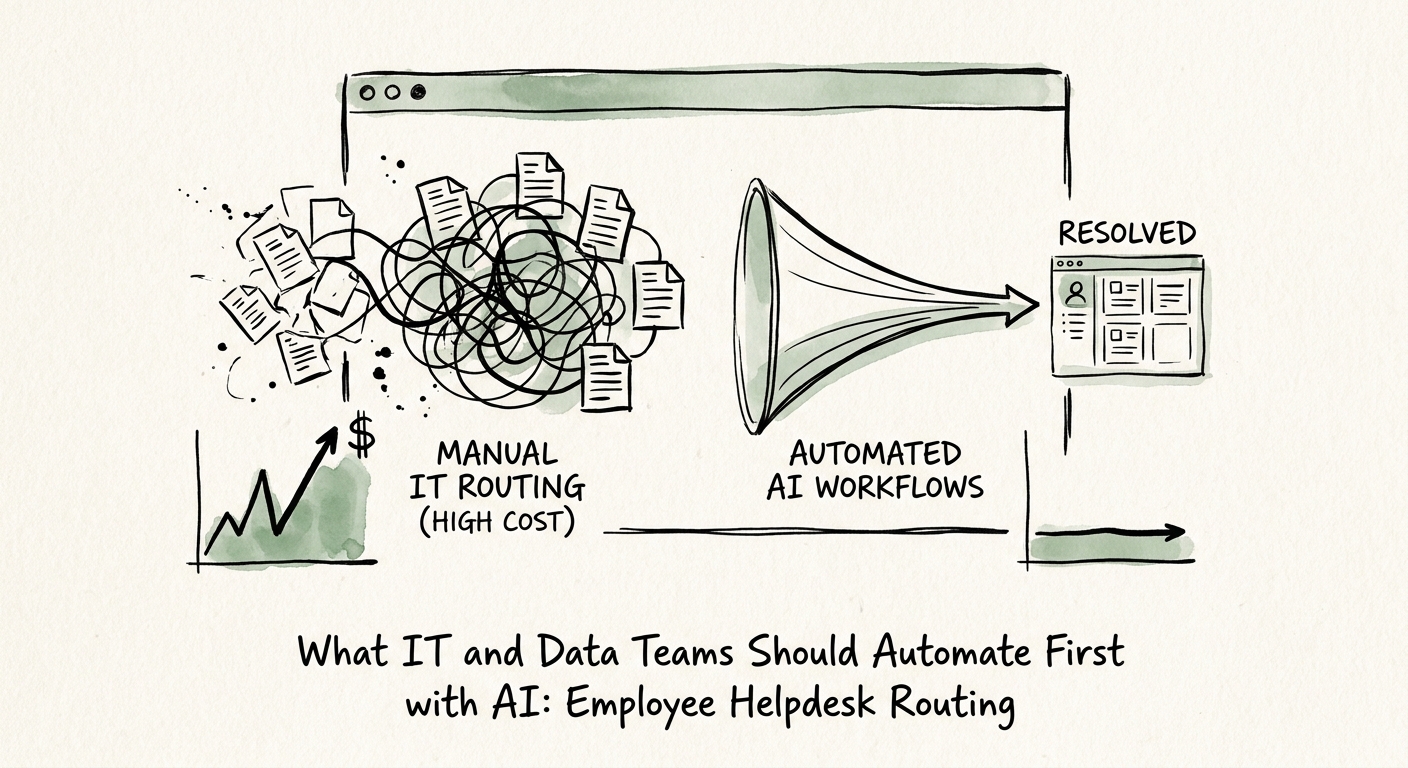
A "VPN won't connect" ticket lands in the general inbox. A network tech reads it, decides it's an identity problem, and bounces it to the access team. The access team reads it, decides it's a device problem, and bounces it back. Three handoffs, two days, and the actual issue — an expired certificate — was knowable from the first sentence. Every IT team has a version of this story, and it's why helpdesk routing is the workflow to automate first: the input repeats constantly, the cost of a wrong guess is one reassignment instead of one outage, and you already have the answer key sitting in your ticketing system.
That last point is what makes routing different from a flashy "AI agent that resolves tickets." You have thousands of closed tickets, each tagged with the team that finally fixed it. That is a labeled dataset handed to you for free. The reason to start here over something splashier is timing: the Census Bureau found in May 2026 that 32% of firms with 100 to 249 employees are already using AI, and the ones building durable confidence are the ones who picked a workflow they could measure on day one. Routing is that workflow. Resolution can come later, once you trust the classifier.
Score it against your own backlog before you trust it
Here is the trap that kills these projects: a vendor demos the model on a clean ticket, it nails the category, everyone nods, and it ships. Then it meets the ticket that says "it's broken again" with a screenshot and no other words. The gap between that demo and production is the difference Deloitte measured when its 2026 State of AI research found only 25% of leaders moved 40% or more of their pilots into production. The fix is unglamorous and decisive: pull 300 of your last closed tickets, hide the resolution team, let the model route them, and compare its calls to where each ticket actually got solved. Now you have a routing accuracy number for your environment, not a slide.
Then look at the misses, because they tell you the real design. If the model confidently routes ambiguous "it's slow" tickets wrong, the answer isn't a better model — it's a confidence threshold. Above 85% certainty, auto-route. Below it, hand the human a ranked shortlist and a one-line rationale instead of forcing a blind guess. For an IT function specifically, this is also where data handling stops being abstract: tickets carry hostnames, account names, and sometimes credentials pasted in by panicked users. Use the NIST AI Risk Management Framework to map who can see what at each step, and CISA's AI data security guidance to keep that ticket content out of any model context that doesn't honor your existing permission boundaries. If a commercial assistant is in the loop, pin down retention and data-use terms in procurement — a routing tool should never become a side-channel copy of your incident history.
A 90-day path that ends in a real decision
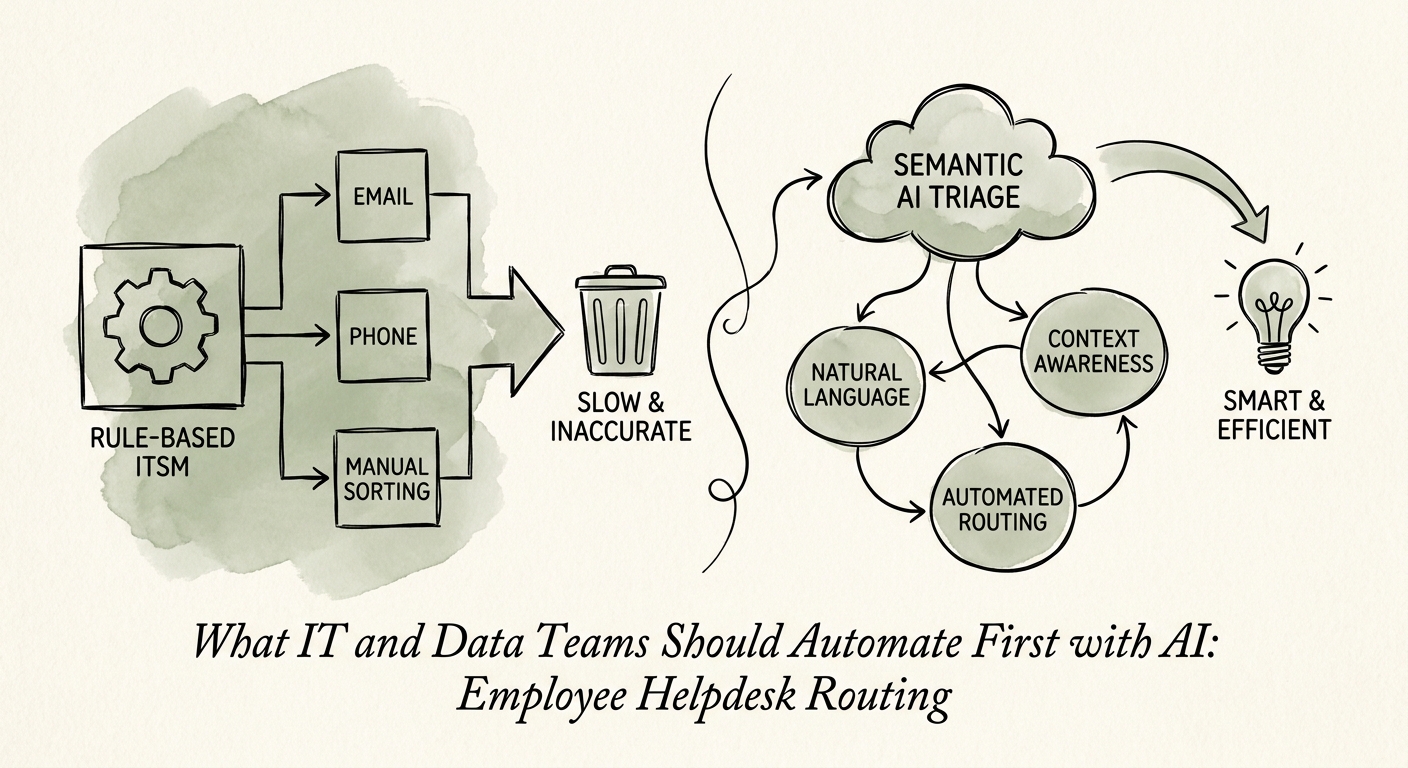
First 30 days: instrument what you have. Measure average time-to-first-correct-team, your reassignment rate, and how many tickets bounce more than once before landing. Those three numbers are your baseline — if you can't state them, you can't claim a win later. Days 30 to 60: run the model in shadow mode. It suggests a route on every incoming ticket, a human still decides, and you log agreement rate by category. You'll find it's already near-perfect on password resets and weak on the vague catch-all tickets — that map tells you exactly where to allow auto-routing and where to keep a human in the loop. By day 90 you make one honest call: promote auto-routing for the high-confidence categories, keep it as a supervised suggestion for the rest, or shelve it because your ticket tagging was too inconsistent to learn from. All three are wins, because all three are decisions backed by your own data.
This is the same pattern the Federal Reserve Bank of San Francisco found in its small-business AI research: adoption sticks when AI is tied to a concrete operating need rather than a broad ambition. Routing earns you the right to go further. Once the classifier is trusted, the natural next steps are internal knowledge search so techs get the fix alongside the ticket, and pilot-to-production controls so the second workflow ships faster than the first. When you're ready to sequence the whole roadmap, the AI Transformation Blueprint turns one proven automation into a governed plan.