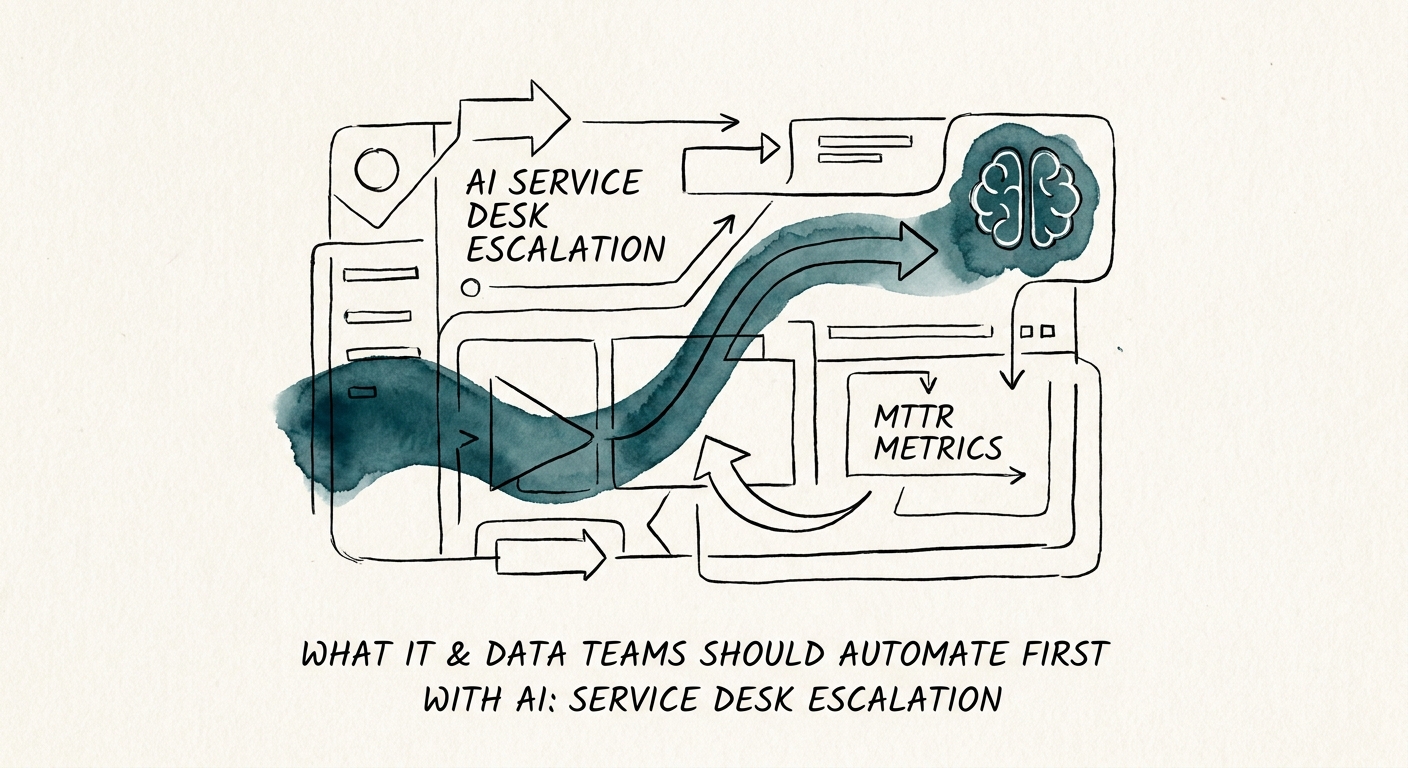
The cheapest ticket to close is not the one quietly costing you the most
Picture a Tuesday in a 120-person tech-services shop. A user files a ticket: "Can't get into the reporting thing, getting an error." Tier 1 reads "error," tags it as an application bug, and routes it to a backend engineer who is mid-sprint. Forty minutes later that engineer discovers it was an expired SSO group membership — an access change, not a bug — and bounces it back. The ticket is now three hours old, two queues deep, and one senior person poorer for the interruption.
That is the ticket worth automating first. Not the password reset everyone fixates on when they imagine an AI support bot. Password resets are cheap to mishandle. The vague, miscategorized ticket that hijacks a Tier 3 engineer is where the money leaks — and ITIC's downtime cost research shows how fast misdirected attention compounds when the underlying issue is actually an outage hiding in a "low priority" wrapper.
Escalation triage is a clean first target precisely because the job is bounded. The system reads the ticket, infers intent, checks whether the required context is present, proposes a queue with a confidence score, and flags the uncertain ones for a human. It never has to resolve anything. It just has to stop sending the SSO problem to the application team. If you are still weighing candidate workflows, run this one through the AI Opportunity Score before committing build time.
Why your category dropdown lies to you
Keyword and category routing assumes the person filing the ticket knows what is wrong. They almost never do. HDI's support center practices have documented for years that users describe symptoms, not root causes — "it's slow," "it won't load," "the thing is broken." A category dropdown turns that ambiguity into a coin flip, and Forrester's ITSM research consistently ties first-touch routing accuracy to overall resolution cost. One wrong tag at the front cascades into every metric downstream.
Here is the failure mode worth naming: keyword rules are brittle in both directions. "Database timeout" in a ticket about a slow expense report sends a finance-app question to the DBA queue. Meanwhile a genuine security incident — "a vendor emailed me asking to reset a shared login" — sails through as a routine access request because none of the alarm words are present. The rule engine is confident and wrong, which is the worst combination.
An intent-based escalation layer reads the description against known issue patterns, notices the missing fields, and produces three things a dropdown never could: a recommended queue, a one-line routing rationale, and a list of the facts still needed before the receiving team can act. The dispatcher keeps the decision whenever confidence is low or the risk is high. McKinsey's work on developer productivity is blunt about where senior engineering time evaporates — context-switching and reactive interruptions — and a clean handoff attacks exactly that. The point is not a smarter bot. It is fewer ambushes on the people you can least afford to interrupt.
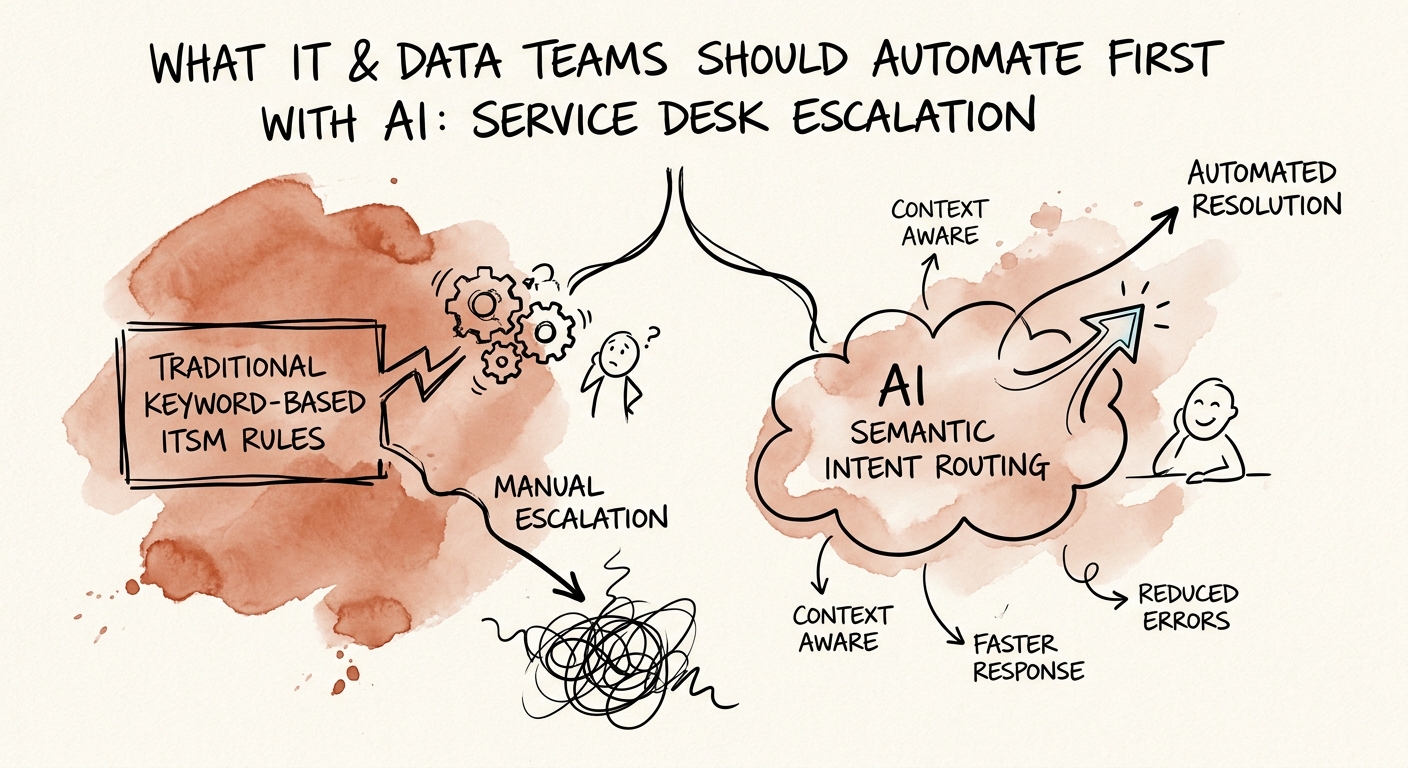
Scope one queue family, govern the dangerous edges, then measure honestly
Do not let the pilot drift toward auto-closing tickets. Gartner's outlook on AI in IT support frames the trajectory toward autonomous resolution, but that is a destination, not a starting line. Start with triage, enrichment, and escalation only. Write down which categories may be auto-routed, which need approval, which should bypass the normal queue entirely, and which stay human-reviewed no matter how confident the model is. Security events, customer-impacting outages, and access changes go in that last bucket on day one — those are precisely the tickets that masquerade as something boring.
Pick one queue family to prove it on — say, access and identity issues, where the misrouting pain is sharpest and the routing logic is teachable. Then measure five things and refuse to let "ticket volume handled" stand in for any of them: misrouting rate, time to the correct queue, Tier 3 interruption load, missing-context rate, and full lifecycle duration. If misrouting drops but lifecycle duration doesn't, you have automated the handoff and broken something downstream — keep digging. These measures tell you whether you preserved technical capacity or just shuffled the work into a new pile.
The Monday version of this: open your last 200 tickets, count how many were re-queued at least once, and tally which ones touched a senior engineer who shouldn't have been touched. That single afternoon tells you whether escalation is your real bottleneck. If the routing rules and data are ready, the build lane is AI Workflow Automation. If your employee-use boundaries aren't written down yet, start with the AI acceptable-use policy template and AI Governance and Training before a single ticket gets auto-routed.