The Monday packet that takes four hours and still gets challenged
Picture the weekly operations review at a 120-person software company. Someone on the data team spends Friday afternoon pulling warehouse metrics, copying dashboard numbers into a deck, summarizing the week's incident queue, and writing two paragraphs of narrative. Monday morning, the head of support says the ticket count looks wrong, the VP of product says "active users" doesn't match what their own dashboard shows, and forty minutes of the meeting evaporate reconciling whose number is right. The report didn't fail because it was slow to build. It failed because nobody agreed what the numbers meant before the meeting started.
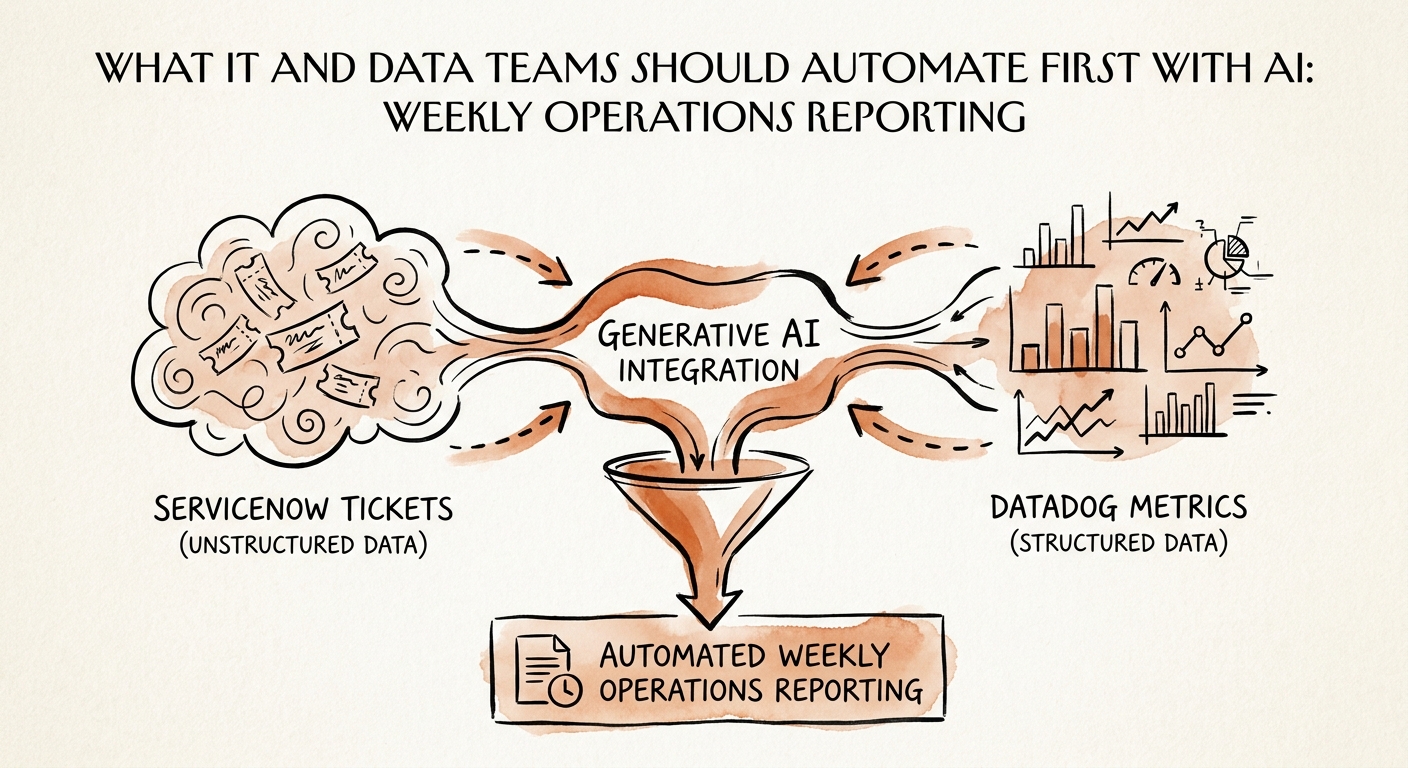
That is exactly why the weekly ops packet is the right first thing for an IT and data team to put AI on — and exactly why it's dangerous to do it wrong. AI is genuinely good at the assembly work: stitching together SLA deltas, freshness flags, incident aging, and owner updates into a clean draft in minutes instead of hours. But assembly was never the bottleneck. The bottleneck is that the same metric is defined in two places, owned by nobody, and re-litigated every week. Bolt a language model onto that and you don't get clarity — you get a more polished, more confident version of the same unresolved argument, delivered faster.
The adoption pressure is real: the U.S. Census Bureau finds AI use jumps sharply with company size, reaching 37% at firms with 250+ employees, and the OECD's work on AI adoption by SMEs shows smaller firms feeling the same gravitational pull with thinner data teams to absorb it. But Deloitte's 2026 enterprise AI research keeps landing on the same point: the value shows up only when there's a process you can measure and improve after the demo. For a weekly report, that process is metric ownership — not prompt engineering.
Build a definitions ledger before you build a prompt
Here's the work most teams skip. Before you let AI touch the packet, take the recurring metrics in the report — say "active accounts," "open P1 incidents," "data freshness lag," "MRR-impacting outages" — and for each one write down three things: the exact source query or dbt model it comes from, the single person who owns that definition, and the one rule that resolves the ambiguity ("active = logged a session in the trailing 7 days, deduped by account, excluding internal users"). That's your definitions ledger. It usually takes an afternoon and it surfaces the disputes immediately, because the moment you ask "who owns 'active users'?" you discover two people think they do and they disagree.
Once the ledger exists, the AI's job gets narrow and safe: it reads from the named sources, populates the metrics against the agreed definitions, flags week-over-week deltas, and drafts the narrative. What it must never do without a human is interpret. No root-cause claims, no "support is slipping because of the migration," no performance verdicts on a team. The line is simple: AI assembles and flags; the metric owner interprets and signs. The review artifact should show, for every number, the source it came from and the owner who stands behind it — so a reviewer can accept, correct, or reject in seconds instead of opening five dashboards to check.
This is where the security and risk discipline earns its place, not as compliance theater but as plumbing. The NIST AI Risk Management Framework is useful here precisely because the risk is contextual — a casual sentence in a draft becomes material the instant it lands in a leadership packet that drives a staffing or budget decision. And since this workflow reaches into the warehouse and the incident system, the CISA AI data-security guidance should set the read-only permission scope, retention, and logging for exactly those tables — not a blanket grant over everything the data team can query.
The 30-60-90 that ends with a quieter meeting
Days 1–30: don't automate anything yet. Build the definitions ledger, resolve the disputed metrics, and run the meeting with the agreed numbers by hand for two or three weeks. If the head of support and the VP of product still argue, your problem is ownership, not tooling, and AI would have hidden that. Days 31–60: introduce the AI draft, but keep the owner sign-off. Each week, compare the AI-generated narrative against what your most experienced analyst would have written — track every place the reviewer had to rewrite it. Days 61–90: decide. Scale it, narrow it to just the metrics that proved clean, or pause if a source system is still producing numbers nobody will defend.
The signal that it worked isn't "the report is automated." It's that the Monday meeting stops being a reconciliation session. Watch four things over the pilot: how many metrics now have a named owner, how often the same number gets disputed, how many reviewer rewrites the AI draft needs each week, and how much meeting time goes to deciding versus arguing. If those trend the right way, scale. If the team is still hand-checking warehouse numbers before the meeting because they don't trust the draft, you've added a review queue, not removed one — and a lean data team can't afford that. This finding is echoed in the Federal Reserve Bank of San Francisco's early work on small business AI: the wins come from tightening a specific workflow, not from a general-purpose assistant.
If the weekly packet is competing with three other "automate this first" candidates, run them through the AI Opportunity Score to rank them honestly, then reach for the AI ROI Calculator only once the pilot has produced real hours-saved or fewer-disputes evidence — not projected numbers. Human Renaissance sequences that work inside the AI Transformation Blueprint, so your data team moves from a trustworthy weekly report to the next workflow without ever losing control of what the numbers actually mean.