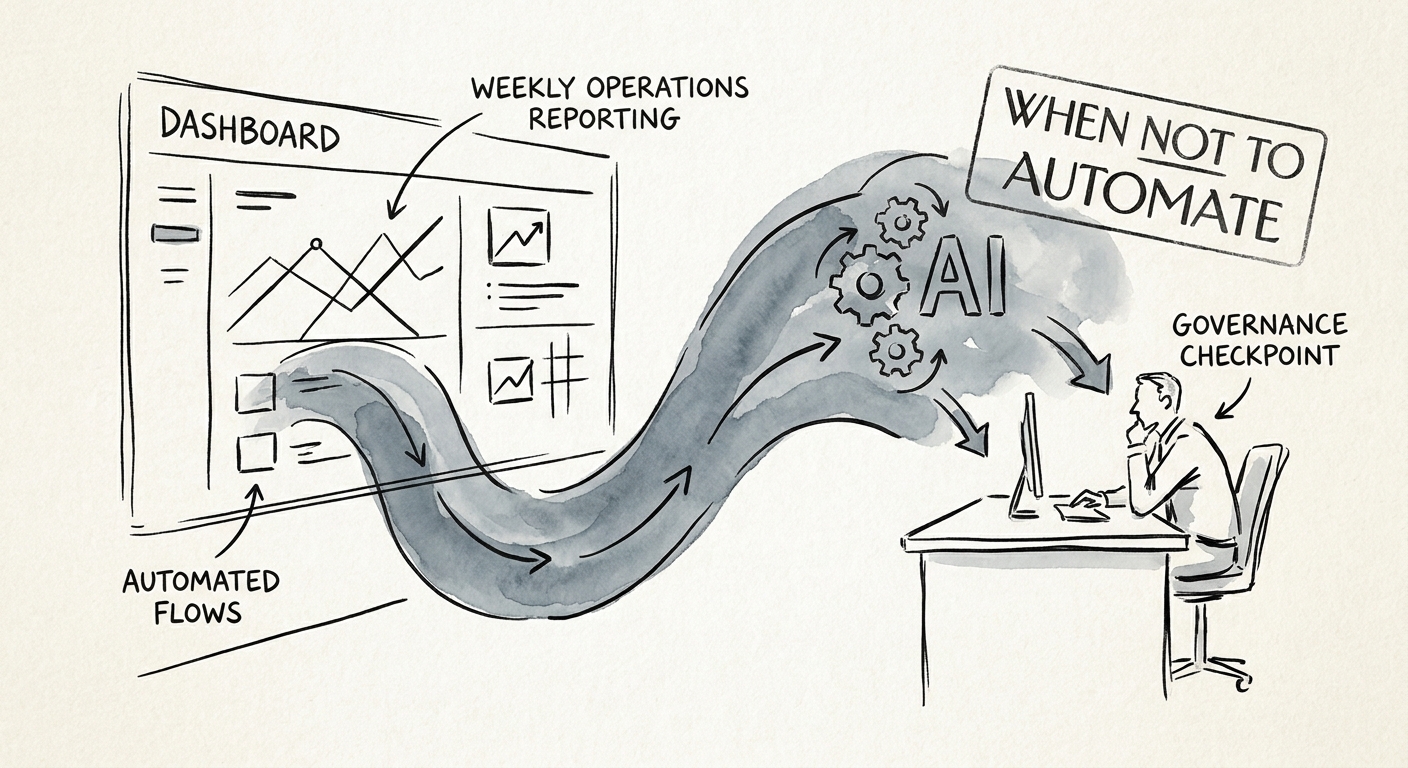
Your CRM says churn is 4%. Finance says 7%. AI will pick one and sound certain.
Picture a 90-person B2B software-and-services shop. Every Monday, an ops lead spends three hours stitching the weekly report: open delivery tickets from Jira, billable utilization from the PSA, churn from the CRM, cash and revenue from the accounting system. It's tedious and repetitive, which is exactly why someone says "let's have AI write it." That instinct is right about the pain and wrong about the timing.
Here's what actually breaks. The CRM counts a logo as churned when the renewal date lapses. Finance counts it as churned when the final invoice clears, which can be a month later. So in any given week, one system says 4% and another says 7% — and both are "correct" by their own definition. A human author quietly resolves this every Monday by knowing which number leadership trusts. An AI doesn't carry that institutional memory. It will grab whichever value its prompt happened to reach first, write a fluent sentence around it, and present a number that nobody can defend in the QBR. McKinsey's State of AI 2025 found that the firms getting real value from AI redesigned the underlying workflow first. For reporting, the redesign isn't "add a writer." It's "agree on what each metric counts, and who owns the system that produces it." Only then does narrative drafting become safe to hand off.
That's also the boundary Bain's agentic AI report draws: agents work when they're scoped to a bounded job with explicit tool access. A reporting agent pulling read-only from Jira, the PSA, and accounting, flagging week-over-week deltas, and drafting commentary — fine. A reporting agent silently deciding that the CRM wins the churn dispute — that's the agent making a finance policy call it was never authorized to make.
The job is two different jobs, and only one is ready for AI
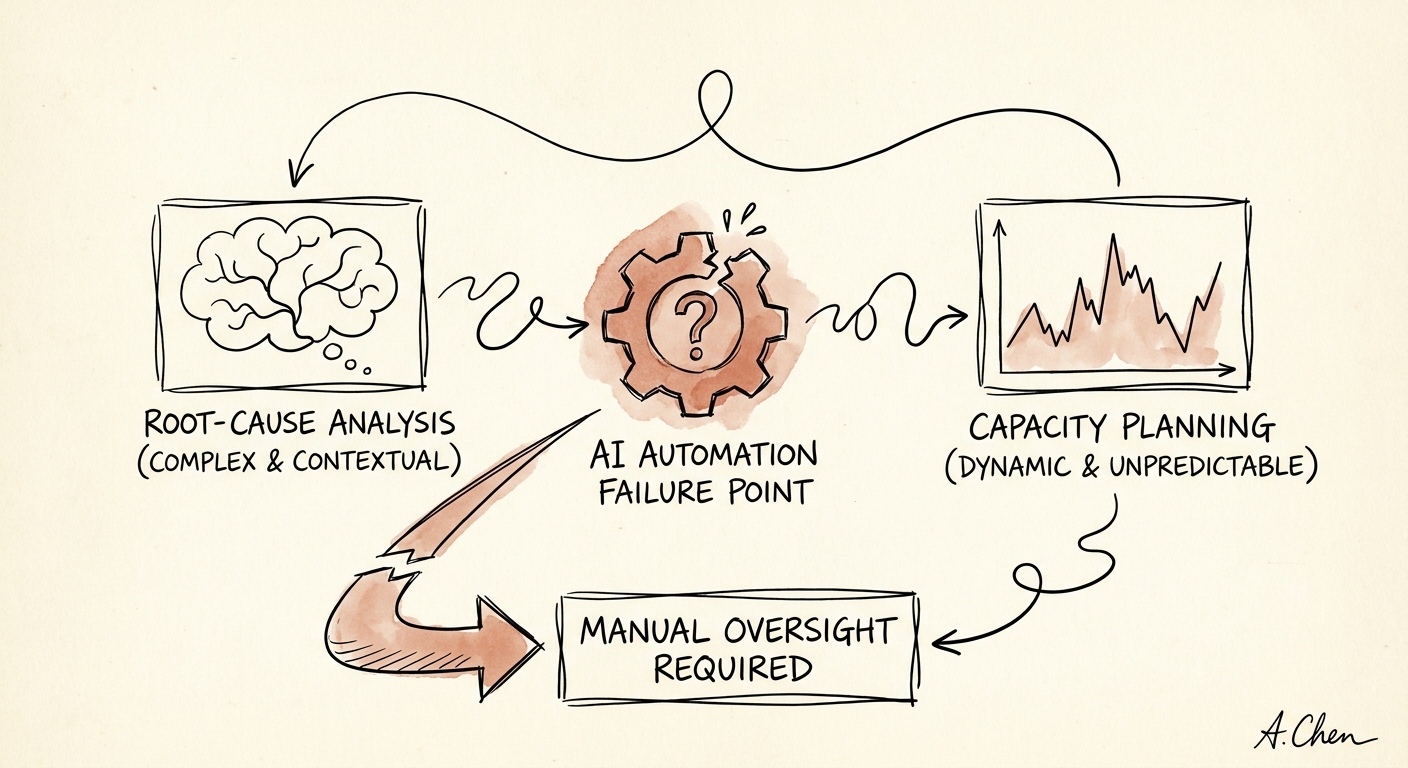
Pull a weekly ops report apart and you find two separate functions wearing one trench coat. The first is aggregation: go to four systems, fetch the right field, line it up against last week. The second is judgment: decide that the 30% utilization drop is a one-week artifact of the holiday, not a staffing crisis, and tell leadership not to panic. Aggregation is mechanical and a good candidate for automation. Judgment is the reason a senior person writes the summary, and it's the part that goes badly wrong when a model fakes it.
The trap is that AI is fluent at imitating judgment without having any. IBM's Institute for Business Value research names data quality and operating model as the foundation capabilities — and for a services firm, "data quality" is concrete: can a human reconcile open tickets, billable utilization, logo churn, delivery risk, and cash without a meeting to argue about whose number is real? If the answer is no, AI won't make the report true. It'll make the disagreement invisible, because the model smooths over the exact seams where your data fights itself. The conflict that used to surface in a Monday Slack thread now ships as a confident paragraph nobody questions.
So before any automation, run the unglamorous pass. For each of the five or six numbers in the report, write down: what it counts, which system is authoritative, who owns that system, and what triggers a definition change. The NIST AI Risk Management Framework's map-measure-manage-govern structure is a usable checklist here — map each metric to its source, measure how reliable that source is, set the review control, and govern who's allowed to change a definition. Until that source layer holds steady, the executive summary stays human-approved. The model can draft the words; a person still signs the numbers.
What to ship Monday: a draft that argues with itself on purpose
Don't aim for a fully automated report. Aim for something more useful and far safer: a draft that cites where every number came from and refuses to hide its own uncertainty. Concretely, the first version should do three things. Put the source system in parentheses after each metric — "logo churn 4% (CRM, renewal-date basis)" — so a reader instantly sees why it differs from finance's figure. Flag any movement past a threshold you set, like utilization swinging more than ten points week over week. And maintain an explicit "unresolved" section that lists every place two systems disagreed and the model couldn't reconcile them. That conflict list is the asset. It's the Monday argument made visible instead of buried.
Then watch four numbers to know if you're ready to widen the agent's mandate: how many source conflicts surface each week, how heavily executives edit the draft before sending, which corrections you have to make again and again, and minutes saved per cycle. When the conflict count trends toward zero and the edit rate drops, your source layer has stabilized — and that's the signal that more of the narrative can move to the agent. If those numbers stay noisy, the report isn't your problem; your metric definitions are, and automating on top of them just adds speed to a wrong answer.
If you want to map where your reporting sources actually conflict before pointing a model at them, a QuickStart AI Audit inspects exactly that layer, and the guide on why AI experiments fail after the demo covers why reporting automation that dazzles in a pilot falls apart in week six.