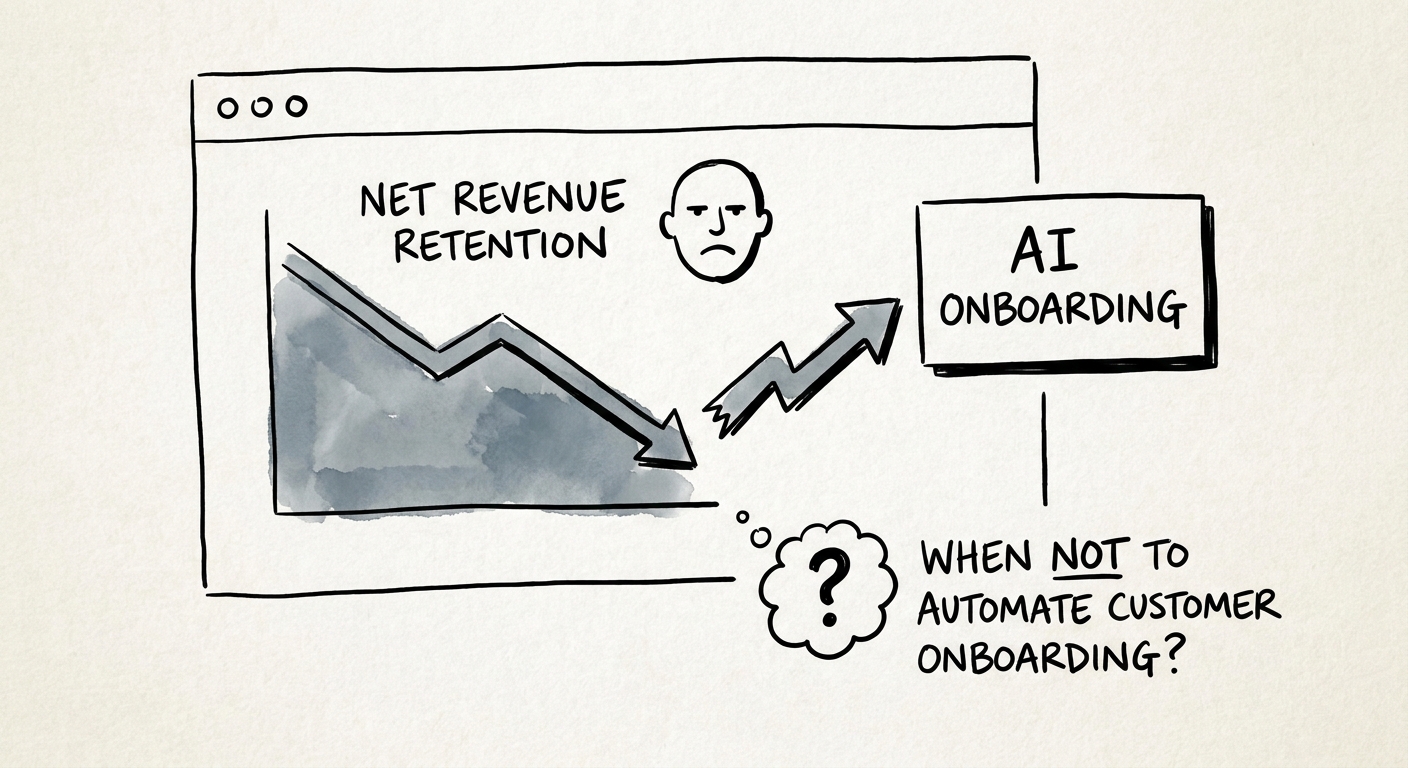
The day-14 silence that no automation will catch
Picture a new B2B software customer two weeks after the contract signs. The welcome sequence fired on schedule. The setup checklist auto-generated. The kickoff invite went out, calendar links and all. Every onboarding metric on the dashboard is green. And the customer's VP of Operations — the person who actually championed the purchase — has gone quiet, because a field-mapping decision their team flagged in week one never got a real answer. By the time anyone notices, the implementation has stalled and the renewal conversation starts from a deficit.
That gap is the whole problem with treating onboarding as an automation surface. The repeatable parts — intake forms, environment provisioning, training reminders, status digests, follow-up drafts — genuinely should run with AI assistance. Those tasks eat coordinator hours and add nothing distinctive when a human does them. But a customer does not measure onboarding by how many tidy messages they received. They measure it by whether your team understood their operating context and moved them to first value without making them repeat themselves.
Customer expectations have shifted toward exactly the kind of judgment a bot can't fake. Salesforce customer research consistently finds buyers expect vendors to understand their specific needs, and McKinsey's growth and customer-experience work ties early experience directly to expansion and retention. PwC's responsible-AI guidance lands on the same operating line: automation should reinforce accountability where confidence is being formed, not quietly remove it. Before you decide what to automate, run the workflow automation diagnostic to separate onboarding administration from onboarding judgment.
The three moments that decide the renewal — keep them human
1. Translating their goals into your configuration. When a customer says "we want faster handoffs between sales and delivery," that sentence has to become specific field setups, permission rules, and workflow stages inside your product. AI can pull the relevant lines from the sales call and the kickoff notes and assemble a draft. It cannot decide that "faster handoffs" actually means restructuring how this customer defines a qualified opportunity — a judgment call that requires someone who can connect software settings to the customer's business outcome. Let the bot prep; let an accountable implementation lead own the success criteria.
2. The data migration handoff. This is where onboarding most often goes sideways, and where AI is most tempting because the work looks mechanical. Let it map fields, flag missing or malformed records, generate transformation checklists, and stage migration scripts for review. Do not let it independently push production changes, resolve an ambiguous data definition ("does 'active account' mean billing-active or login-active?"), or negotiate a cutover tradeoff with the customer's technical owner. Those calls move the timeline, the trust, and the renewal probability all at once, and they belong to a person who can be held accountable for them.
3. The adoption fight inside their org. A new system rearranges who approves what, who reports to whom, and whose Tuesday-morning routine just changed. AI can draft the training plan and answer the "where's the export button" questions. It cannot read the room when the customer's middle managers are passively stonewalling the rollout, or repair the relationship after a frustrated department head loses an hour to a setup error. The human in those moments isn't overhead — they're the reason the software gets used at all.
The healthy pattern across all three: AI-supported onboarding, not AI-run onboarding. Automate preparation, checklist hygiene, knowledge retrieval, and first drafts. Keep every customer-facing commitment under a human's name.
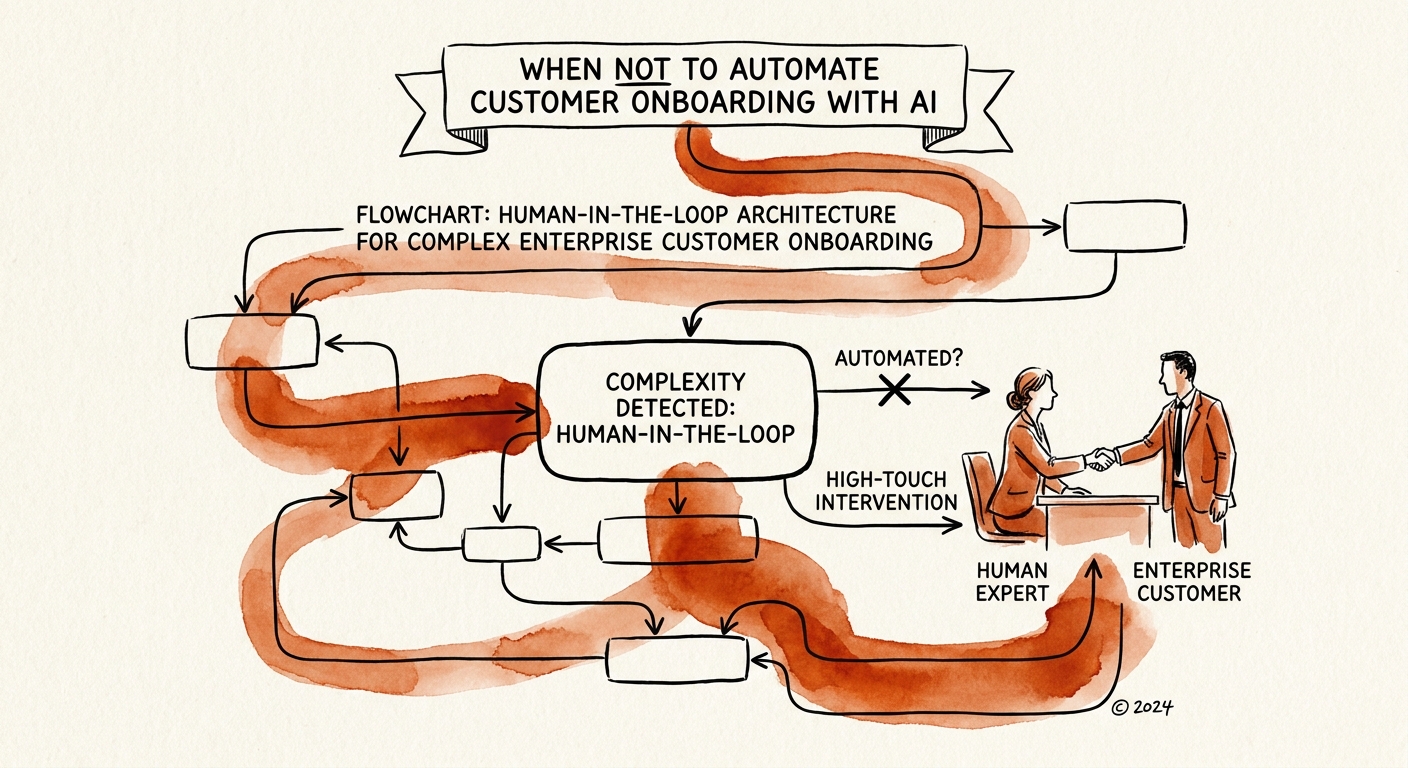
Five trust gates to set before AI touches an onboarding decision
Drawing a clear automation boundary is more useful than any policy document. Before AI assistance goes live in your onboarding flow, lock these five gates so the system can move fast on prep work but stops cold at anything that affects the customer relationship:
- Configuration choices that define how the product behaves for this customer — drafted by AI, approved by the implementation lead.
- Contractual and scope interpretation — what's in the engagement and what isn't never gets answered by a model.
- Security and access exceptions — anything that bends a default permission or data-handling rule routes to a human.
- Migration and production changes — staged automatically, executed only on explicit approval.
- Customer-facing promises — timelines, commitments, and "yes we can do that" stay attributable to a named person.
Then add a source rule: any AI-generated recommendation has to show which customer document, implementation note, or approved playbook it drew from. If the provenance is unclear, the output is a draft, not a decision. The NIST AI Risk Management Framework and Bain's AI work both reinforce treating traceability as a precondition, not a nice-to-have.
Measure the economics honestly. Track time-to-first-value, rework, customer response time, escalation volume, and early active usage. If automation trims coordinator hours but customer confusion ticks up, the workflow isn't ready — pull it back. If it gives your implementation team cleaner context and faster drafts while a human still owns every commitment, expand it. Start by running your onboarding flow through the AI readiness assessment, then score your first candidate workflow with the AI Opportunity Score.
