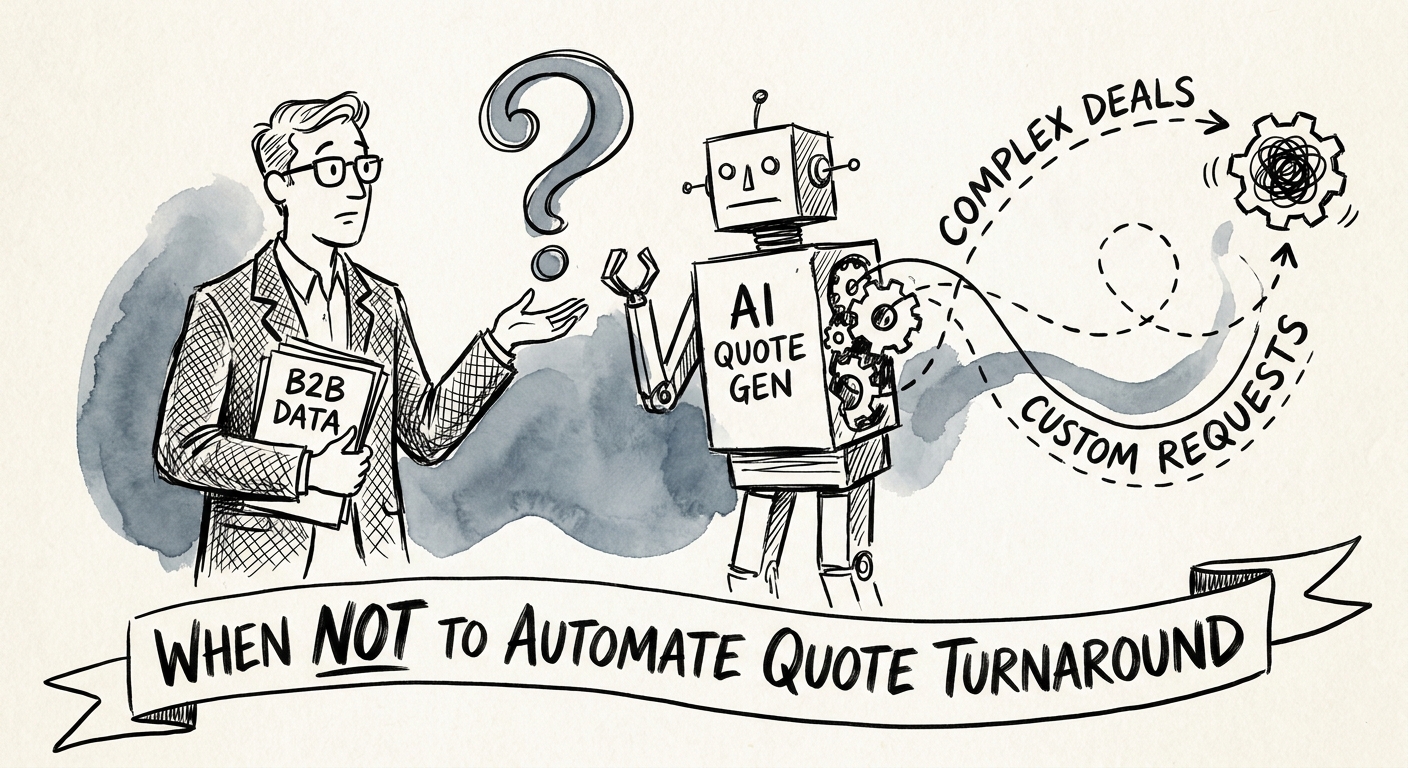
A 14% discount nobody approved
Picture a B2B services shop, maybe 60 people, three product tiers and a tangle of one-off terms accumulated over five years of "just this once" deals. A rep asks the new AI quote assistant to turn around a proposal fast. It pulls the CRM record, matches the customer to a similar past deal, sees that deal closed at 14% off list, and writes that discount straight into the new quote. The rep, racing a Friday deadline, sends it. The problem: the comparable deal was a strategic logo the founder personally approved at a loss. The AI didn't know that. It pattern-matched its way into giving away margin nobody signed off on.
That is the exact failure mode quote automation invites. The work splits cleanly into two halves. One half is retrieval and assembly: pulling account history, prior orders, the right product configuration, standard terms, and the relevant legal boilerplate into a clean draft. That half is a gift — it's the part that has reps copy-pasting from old proposals at 6pm. The other half is commitment: what price, what scope, what delivery date, what exception to standard terms. Salesforce's State of Sales research keeps landing on the same point — sales productivity rises or falls on whether the underlying data is trusted. An assistant assembling a packet from clean data is a force multiplier. The same assistant making pricing calls on top of that data multiplies your mistakes just as fast.
Draw the line at the deal desk, not the draft
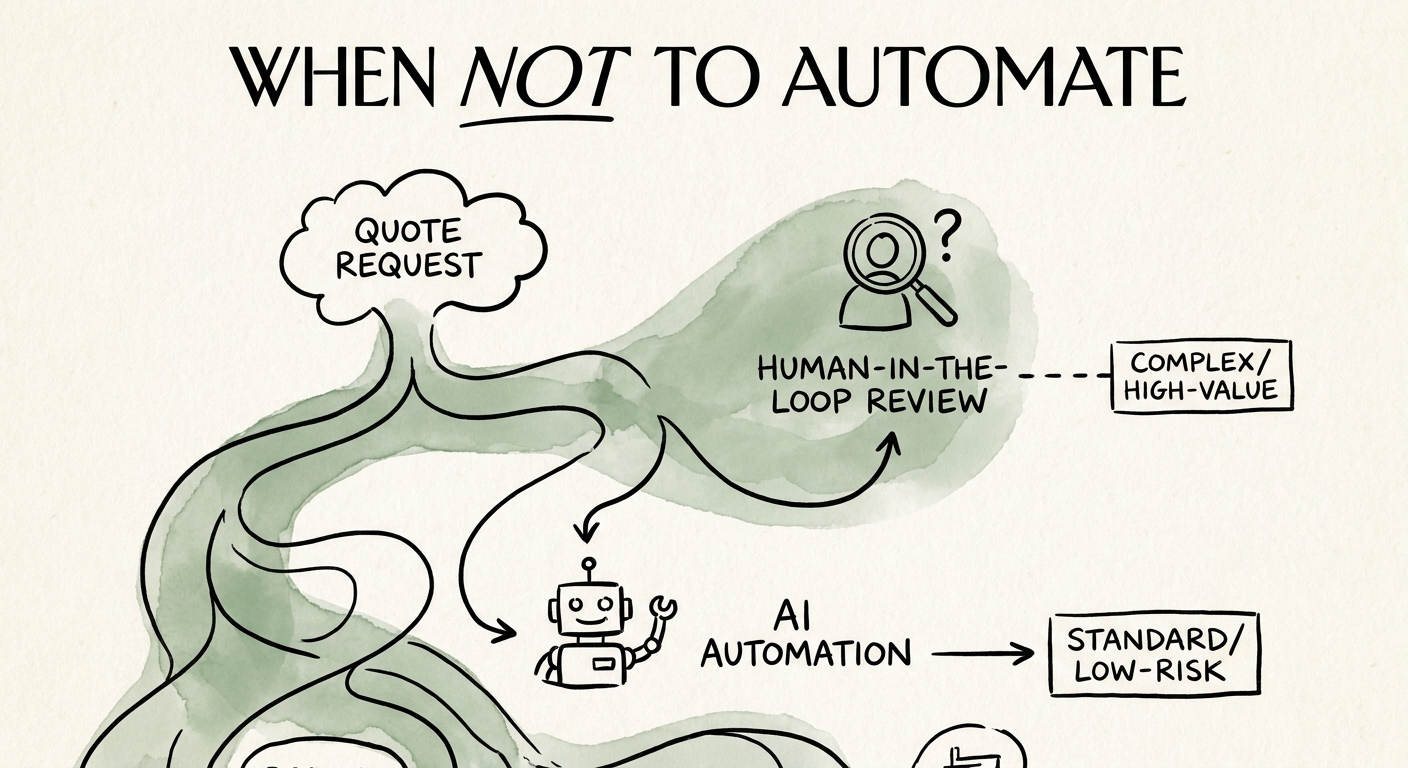
The useful mental model is to treat your AI quote assistant like a sharp first-year on the deal desk: it can do the legwork and flag what looks off, but it doesn't hold signing authority. Bain's work on agentic AI makes the same argument in governance terms — agents need bounded authority and explicit limits on which tools and actions they can reach. For quote turnaround, the boundary is concrete. The assistant can read CRM, read the price book, read past quotes, and write a draft. It cannot apply a discount past the standard threshold, swap in nonstandard payment terms, commit an implementation timeline, or attach a custom SLA without routing to a human.
Here's the test that separates safe from unsafe: would this decision have gone to deal desk or finance if a person made it? If yes, the AI's job ends at flagging it, not deciding it. The NIST AI Risk Management Framework gives you the scaffolding to write this down — map every quote scenario, measure where pricing and scope risk actually live, set the approval controls, then govern them as your price book and product mix change. The output is a short, ugly, specific list: these three products always need finance sign-off, this customer segment caps discounts at 8%, anything touching go-live dates routes to the delivery lead. The AI drafts everything; that list decides what it can't send on its own.
Skip this and you get the worst version of fast: a quote out the door in four minutes that takes six weeks of renegotiation to unwind. McKinsey's State of AI work hammers the redesign point — speed only counts if the workflow around it protects what speed usually erodes, which here is margin and the customer's trust in your numbers.
Watch two clocks, not one
Most teams instrument quote automation with a single number — turnaround time — and declare victory when it drops. That's how you get the 14% discount problem and never see it coming. Run two clocks side by side. The speed clock: quote cycle time, draft-to-send time. The quality clock: exception rate (how often the AI's draft needed a human override), approval rework, margin leakage versus list, and customer correction requests after the quote goes out. If turnaround falls while rework or leakage climbs, you haven't automated quoting — you've automated the production of quotes you'll have to fix.
Practically, do this Monday: pull your last 30 quotes and tag each one for whether a person changed price, scope, or a date before it shipped. That tag rate is your honest map of where commitment authority actually lives in your shop. Let the AI own everything below that line — the retrieval, the formatting, the first draft — and route everything above it to the person who owns the consequence. Then expand the line only when the exception rate proves the AI has earned the next inch. The quote turnaround workflow guide walks the assembly side, and the AI Opportunity Score helps you size whether quoting is even your best first automation before you build anything.
