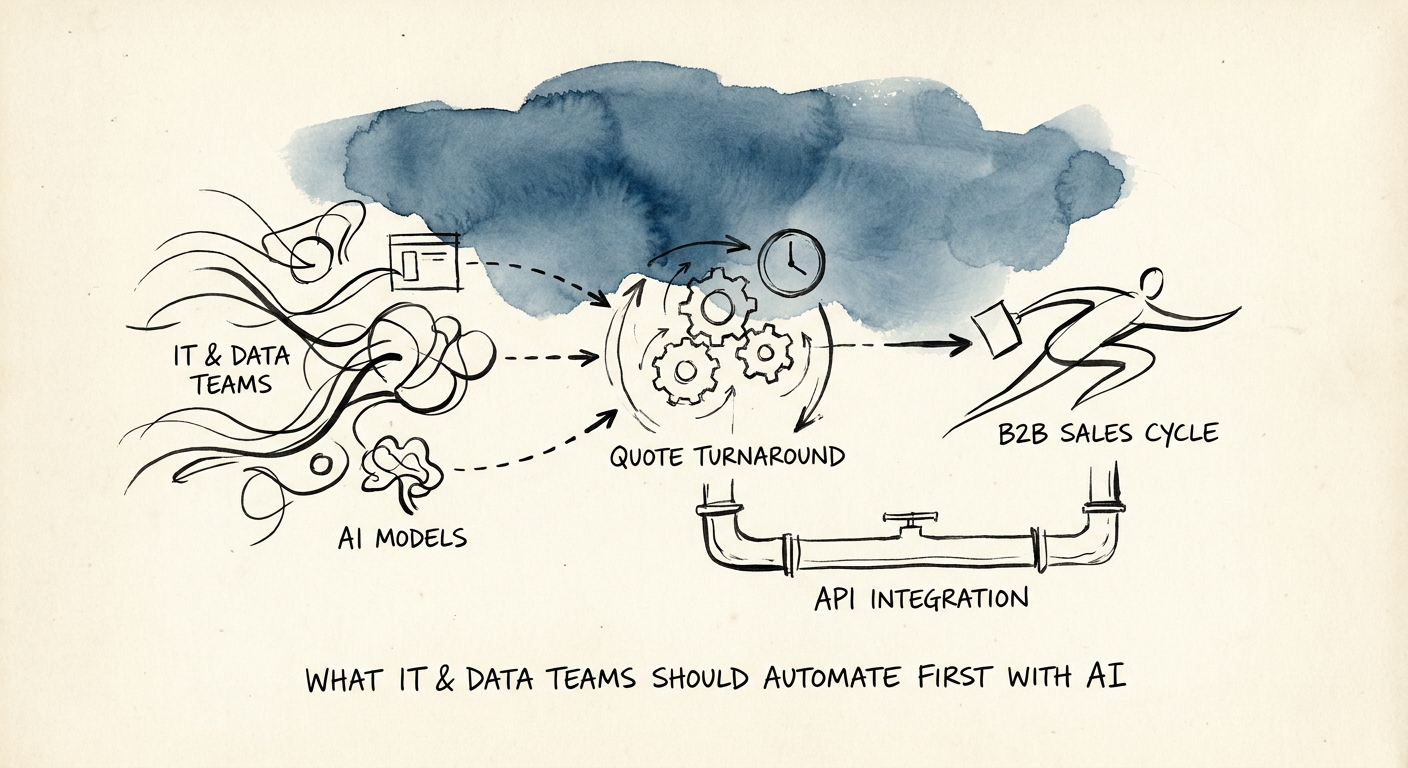
The quote that closed the deal at the wrong margin
Here is the scenario every revenue operations lead recognizes. A rep is on the phone with a buyer who is ready now. The quote takes two days to assemble because someone has to reconcile the CPQ exception, confirm the discount tier, and chase a product-data field that nobody owns. By the time the quote lands, the buyer has cooled or, worse, the rep freelanced a number to keep the deal warm. Speed and pricing discipline pull in opposite directions, and the slow side usually loses.
That tension is exactly why quote turnaround looks like an obvious place to point AI, and exactly why it is dangerous to point it there carelessly. The Salesforce State of Sales report and Deloitte State of AI in the Enterprise 2026 both describe adoption pressure landing on revenue teams, but neither tells you which lane to automate or how to keep the numbers honest. That decision sits with IT and data. A model can assemble a quote in seconds. It can just as easily assemble a fast, confident, beautifully formatted quote built on a price book that expired in the last fiscal year.
The pilot's real job is to find your broken inputs
Treat the first pilot as a diagnostic, not a productivity gadget. The most useful thing it will produce in week one is not faster quotes, it is a list of every place the quote process is held together by tribal knowledge: the discount tier a senior rep approves by Slack message, the margin floor that lives in a spreadsheet instead of CPQ, the product SKU whose list price three people remember differently.
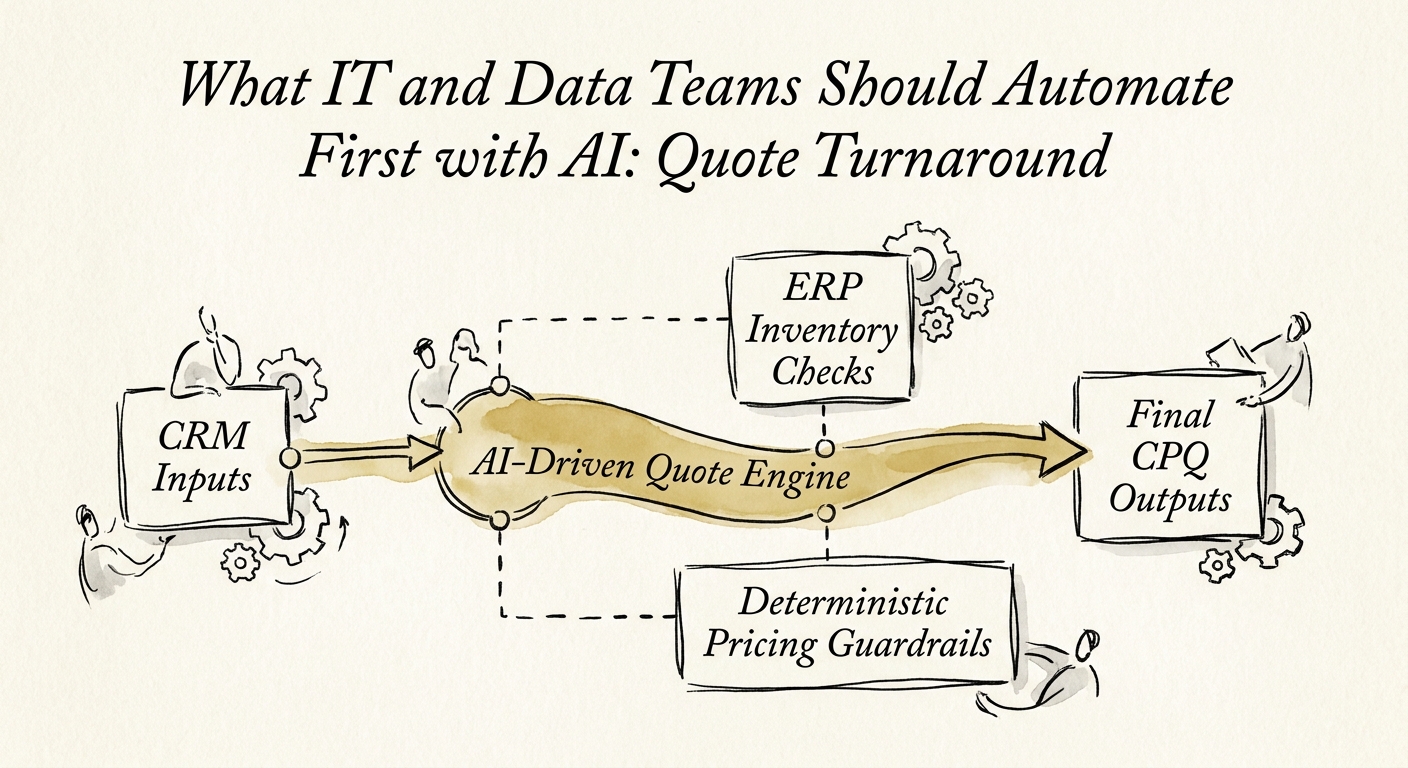
So scope it to one quote lane. Pick a single product family and a single deal motion, lock the price-book version, lock the discount ladder, and lock the approval threshold as source-controlled inputs. Then build the rule that matters most: the workflow fails closed. If the model cannot trace a discount back to an approved tier, or a SKU's price to the current book, it does not guess and it does not draft. It kicks the quote to a human with the missing field named. A quote AI that fabricates a plausible discount is not a faster process, it is unmonitored pricing authority handed to a model.
Measure the right things from day one. Baseline quote cycle time, the rework rate on quotes sent back by sales, the count of pricing overrides, and how often an approval stalls purely because a source field was missing. Run a weekly review of approved quotes, discount-tier exceptions, rep rewrites, and any margin-sensitive case escalated to finance. You are watching whether the operating behavior improved, not whether the model produced more drafts. Once those measures have a named owner, use the AI Opportunity Score to compare this lane against other candidates and the AI ROI Calculator to size the cycle-time recovery.
Who is allowed to change a number, and can you prove it
Quote data is margin-sensitive in a way an internal report never is. A leaked discount ladder tells a competitor your floor; an untraceable price change is the kind of thing that surfaces during a deal audit or a renewal dispute. The NIST AI Risk Management Framework gives you the structure to write down intended use, who is accountable, and how you measure whether the workflow is behaving. The CISA AI data-security best practices should shape what the model can read and write in CRM and CPQ, how pricing data is permissioned, and how long approval logs and quote evidence are retained.
Three non-negotiables make this safe to run: pricing rules stay traceable from the quote back to the approved source, margin-sensitive exceptions route to finance before they reach a customer, and a human in sales signs off before any customer-facing quote changes. Get those right and the pilot leaves you with something more valuable than speed: a documented map of which fields finance keeps correcting and which approvals never had a system of record. That backlog of source-data repairs is the actual return.
Only expand once cycle time improves and pricing drift does not. Then move to an adjacent product family or deal segment, and make it inherit the same fail-closed discipline. The order is deliberate: fix the price book and the discount ladder first, point the AI at them second. When you are ready to sequence which lane comes after quotes, that belongs in a deliberate roadmap rather than a one-off experiment.
