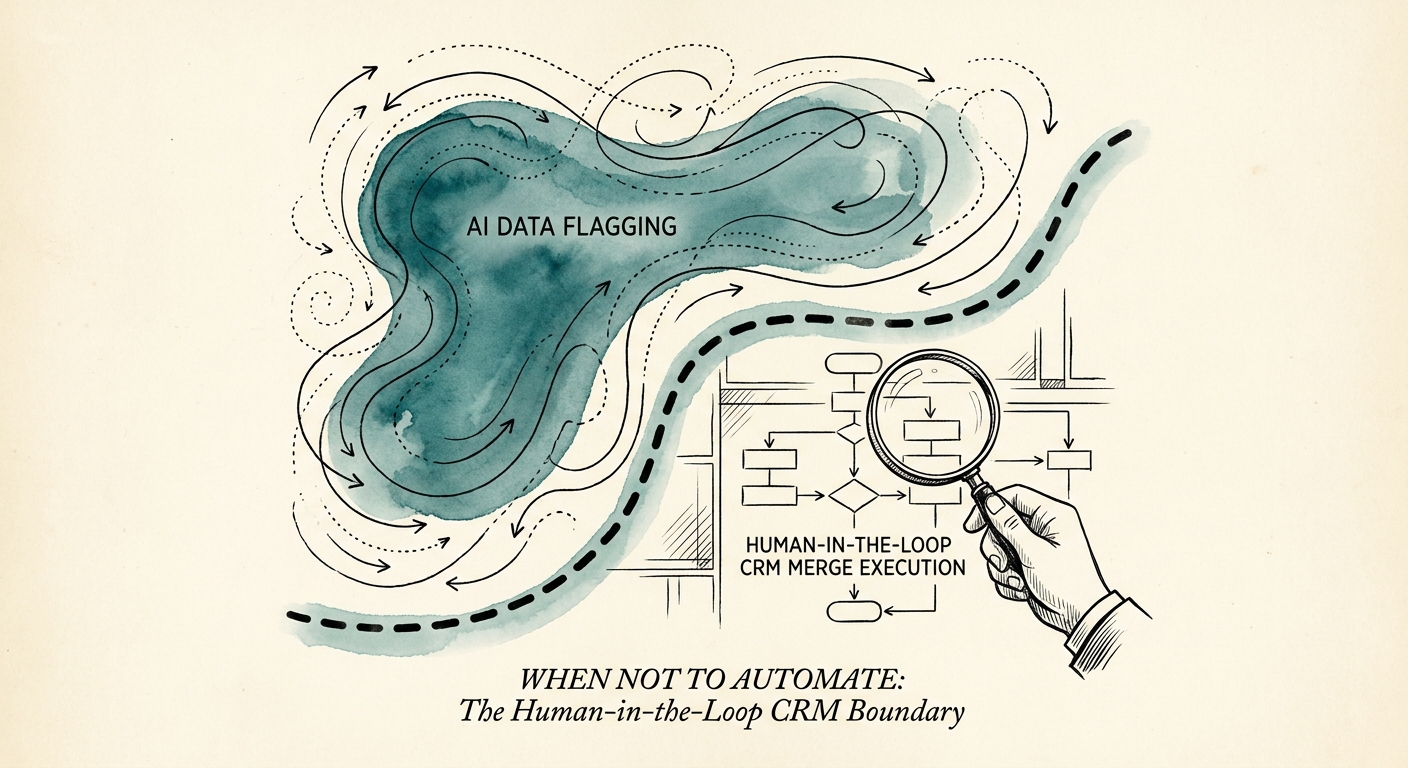
The duplicate that wasn't a duplicate
Picture a 60-person B2B software company. Two records sit in the CRM: "Acme Corp" and "Acme Logistics." Same domain root, same billing city, two different owners. To a deduplication model trained on string similarity, that is an obvious merge. To anyone in the room, those are a parent company and a subsidiary that buy on separate contracts — and the rep who closed the second one is about to lose the account history that justifies her commission.
That is the exact moment CRM cleanup turns from helpful to destructive. The detection was correct: the records look alike. The action was wrong, and the AI had no way to know it, because the thing that made them distinct lived in a rep's head, not in a field. CRM cleanup is one of the best jobs you can hand an AI — it tirelessly finds duplicates, flags fields that haven't changed in 400 days, proposes normalization for "VP Sales" vs "V.P. of Sales" — right up until the moment it has unsupervised authority to write. Salesforce's State of Sales research is blunt about why this matters: sales AI is only as good as the CRM context it sits on. A cleanup bot that quietly corrupts that context degrades every downstream tool — forecasting, routing, the rep's own pipeline view — and nobody notices until the numbers stop reconciling.
Sort every change by how hard it is to undo
Stop arguing about whether to automate cleanup and start sorting the changes by reversibility. That single cut tells you where the AI's authority ends.
Cheap to reverse — let AI write directly. Casing and formatting fixes ("acme corp" to "Acme Corp"), standardizing country codes, trimming whitespace, populating an empty field from a verified enrichment source. If it goes wrong, you re-run the rule. Low blast radius, full speed ahead.
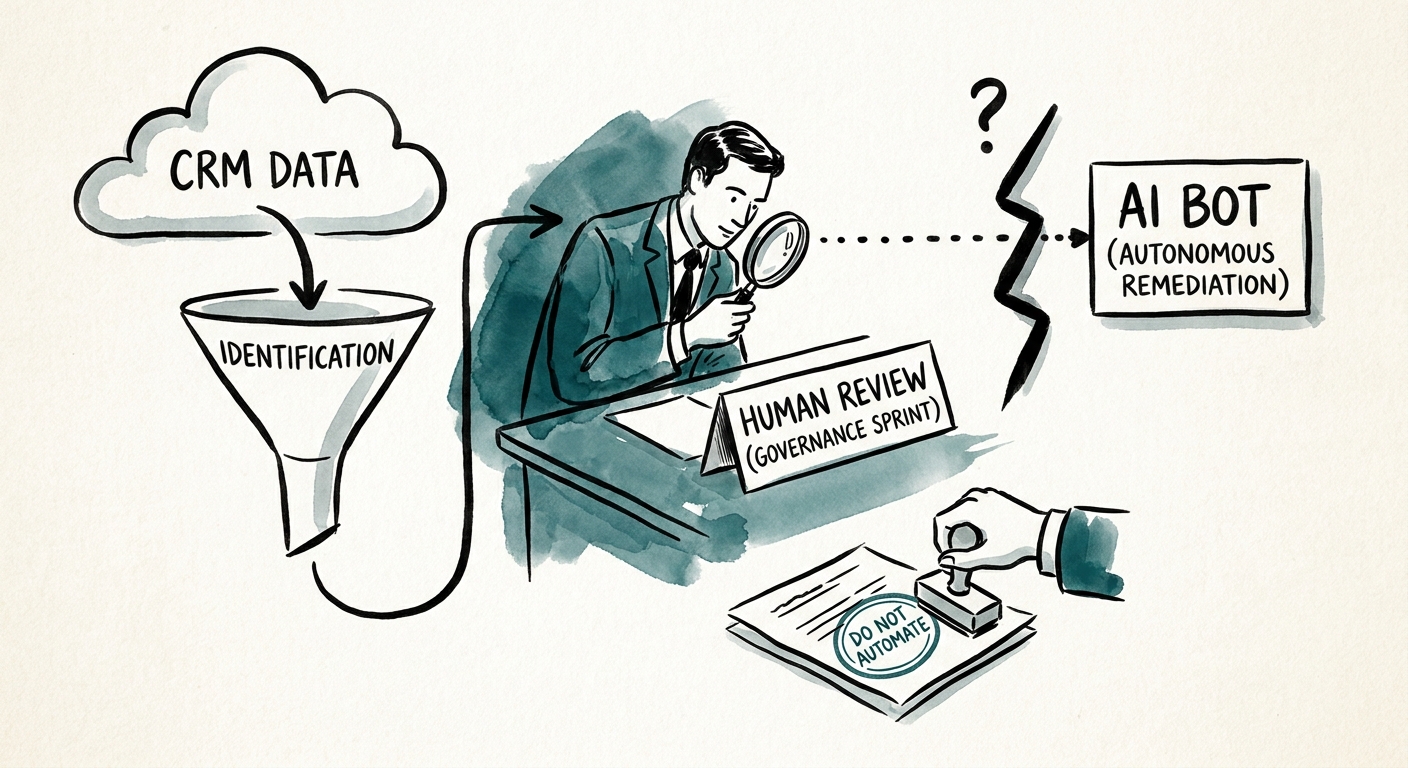
Expensive to reverse — AI proposes, a human approves. Record merges, account ownership changes, anything touching a field that feeds routing, territory, or compensation. A merge collapses two activity histories into one and is brutal to unwind; an ownership flip can silently re-point a deal and the commission attached to it. These go into an approval queue with the AI's reasoning attached, and the data owner clears them in batches.
Never let AI touch — period. Closed-won opportunity records, signed-contract fields, and the buying-signal notes reps write in free text ("said budget frees up in Q3, call back"). Those aren't dirty data; they're the asset. An AI optimizing for field tidiness will happily "clean" a note it reads as clutter.
This maps directly onto the governance sequence in the NIST AI Risk Management Framework: map each field to its business impact, measure the cost of an error, then manage authority accordingly. The capability research from the IBM Institute for Business Value says the same thing in operating terms — AI value depends on reliable data, clear ownership, and measurement before scale. Translation for CRM cleanup: name a data owner, write the merge policy down, and make sure you can roll back before the first destructive edit, not after the first incident.
Earn write access with a number, not a vendor demo
Run the AI in recommendation-only mode for a defined window — say 30 days — and watch one metric above all others: the false-merge rate. That's how often a human rejects a merge the AI proposed. If your team is overriding one merge in five, the model does not understand your business yet, and graduating it to autonomous writes would mean shipping that error rate straight into the database.
Alongside it, track recommendation acceptance, rollback count, and field-completion lift. When false merges sit near zero across a meaningful volume of suggestions, you've earned the right to promote the cheap-to-reverse category to direct writes — and only that category. The expensive and never-touch tiers stay human-approved no matter how good the numbers get, because Salesforce's State of Marketing research is clear that data quality drives every segment, handoff, and personalization decision downstream; one bad bulk merge contaminates them all at once.
What you can do Monday: pull a list of every CRM field that feeds routing, territory, or comp, and mark it off-limits to automated writes today — before you turn any tool loose. If you want a structured read on where the line should sit for your stack, the CRM cleanup workflow guide walks the queue design, and a QuickStart AI Audit pressure-tests your controls before anything gets write access.