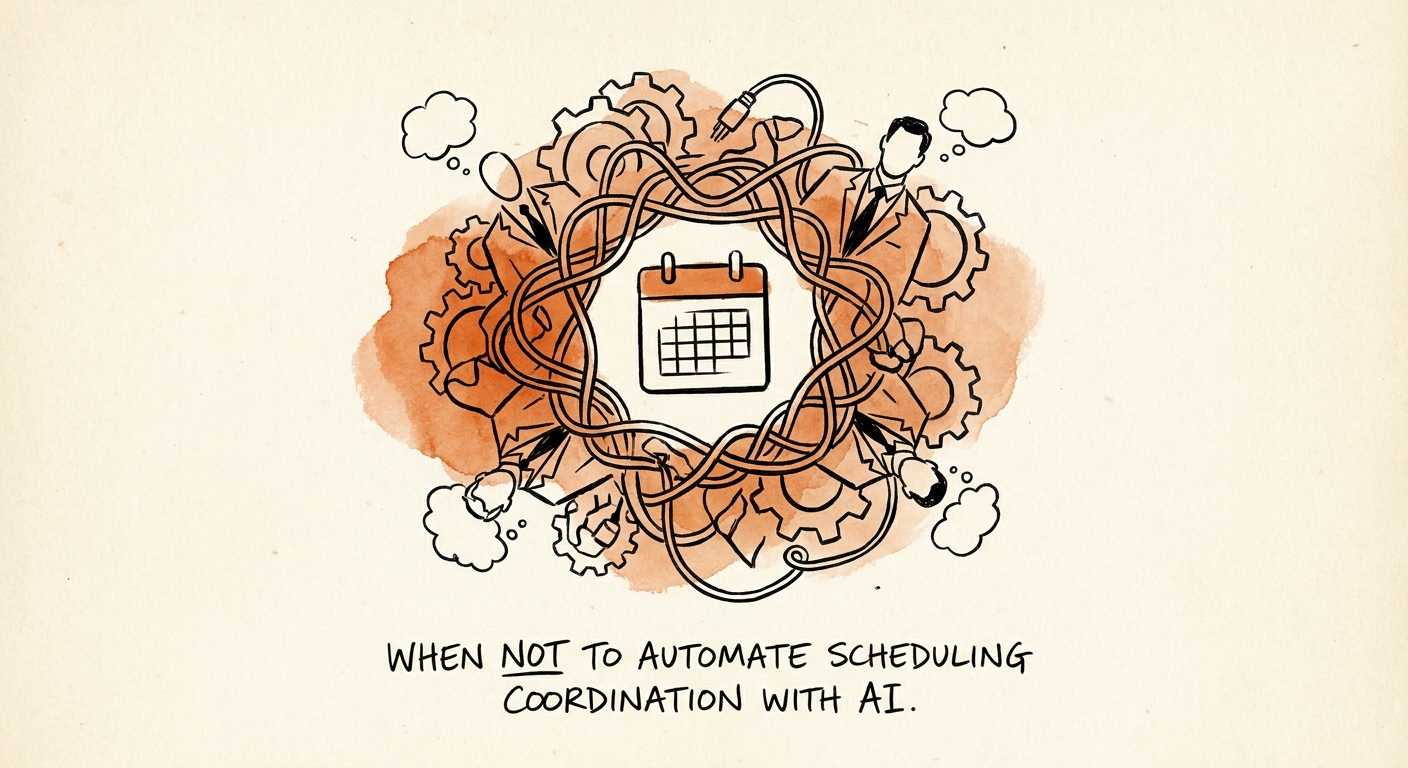
The double-book that costs you the client
Picture a 60-person professional services firm. An AI scheduling assistant sees an open Thursday on a senior partner's calendar and books a new prospect into it. What it can't see: the partner privately blocked that morning for a struggling account that's three weeks from churn, and the "open" slot was a placeholder, not an invitation. Two clients now expect the same two hours. One of them is the relationship you can least afford to mishandle, and the assistant resolved the conflict by ignoring context it never had access to.
That is the heart of where scheduling coordination breaks. The adoption pressure is real — the Census Bureau put AI use among U.S. businesses at 17% to 20% between December 2025 and May 2026, with larger firms moving fastest, and the OECD tracking the same climb among smaller firms. But the question isn't whether AI can touch your calendar. In a services firm, the calendar is the contract: it encodes who gets which expert, when billable work happens, and which clients feel prioritized. The failure mode here isn't a wrong number in a spreadsheet — it's a senior person standing up the wrong client.
The line: drafting versus confirming
The useful distinction isn't "AI good, AI bad." It's the difference between proposing a move and committing one. The NIST AI Risk Management Framework frames this as the gap between assistance and authority, and scheduling coordination splits cleanly along it. Let AI do the work that's reversible and visible: assemble the prep packet before a meeting, flag that two requests want the same slot, batch the five "can we push 30 minutes?" emails into one queue, draft the reschedule note for the owner to send. None of that changes a commitment on its own.
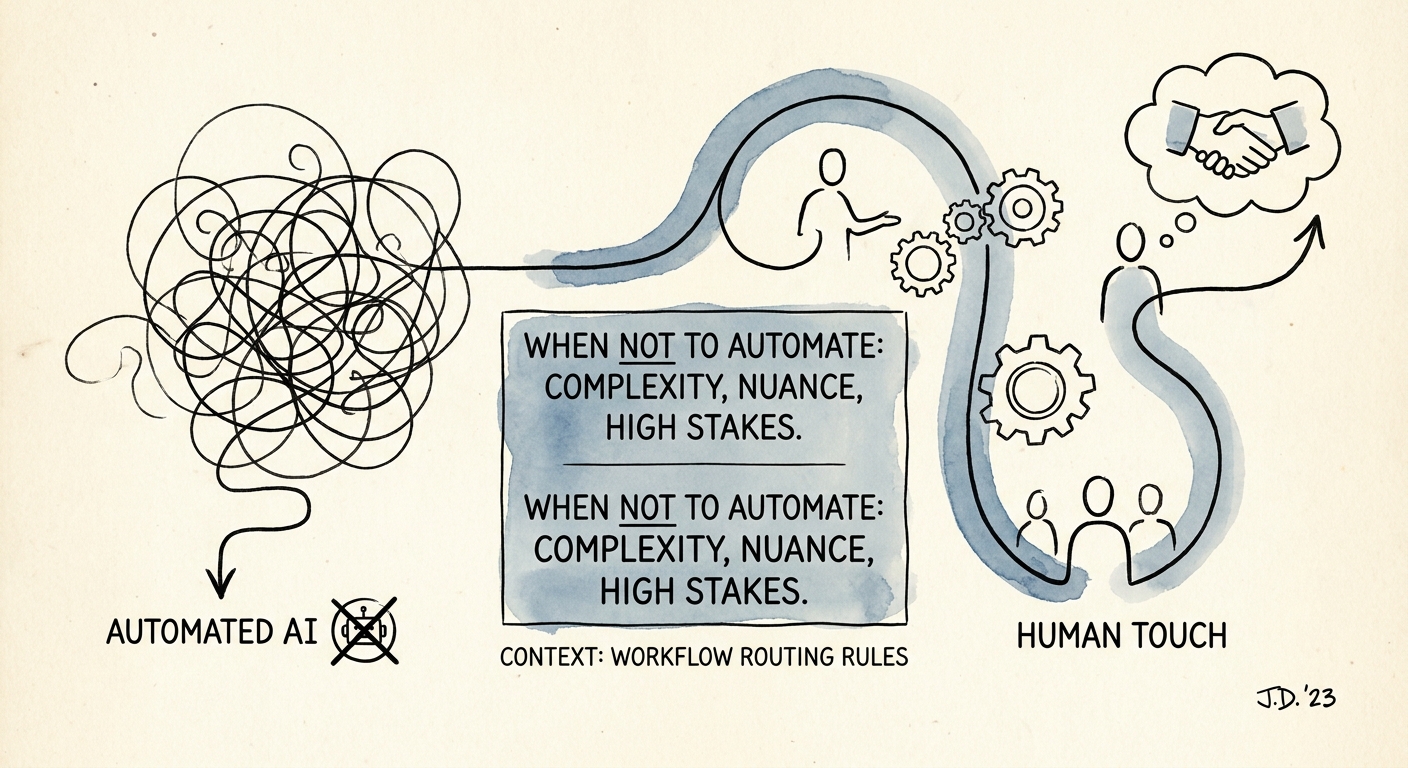
Then there are the three bookings AI should never confirm without a human signing off. First, anything that moves a senior or named-on-the-engagement person — the client bought that face, not a substitute the model picked. Second, anything touching an account already under strain, where the calendar is itself a trust signal and a clumsy reschedule reads as "you're not important." Third, any booking that resolves a conflict by guessing at undocumented context — a private priority, a dependency in the project system, a partner's standing rule that lives in their head and not in the CRM. Those are exactly the cases where the worst outcomes hide.
Then there's the data underneath it. CISA's AI data security guidance pushes operators back to access control and logging. A scheduling agent that reads calendars also reads who is meeting whom — which can expose an unannounced acquisition, a layoff, or a client dispute long before anyone meant to disclose it. If the agent can see meeting titles and attendee lists across the firm, it inherits the most sensitive map of your business. Confirm permission inheritance and an audit trail before it leaves the pilot.
What to set up Monday
Run scheduling coordination as human-in-the-loop exception handling, and you keep nearly all the time savings without the trust risk. Concretely: let the AI own the inbound funnel — intake, conflict detection, prep, and a one-line "why this needs you" note — and route every commitment that touches the three categories above into a review queue. Everything else (a 30-minute internal sync, a routine follow-up with a stable account) can auto-confirm, because the cost of getting it wrong is a quick reschedule, not a lost client. The split itself is your governance: most firms still lack mature controls here, with Deloitte's 2026 research showing only about a fifth of leaders report mature agent governance, and the Federal Reserve Bank of San Francisco noting how thin small-firm guardrails tend to be.
Pick one workflow, prove it, then widen. We use responsible AI governance and pilot-to-production controls to decide where the model helps the coordinator and where it must hand the decision back. The AI Transformation Blueprint turns that line into a roadmap your operations and service teams can actually run.