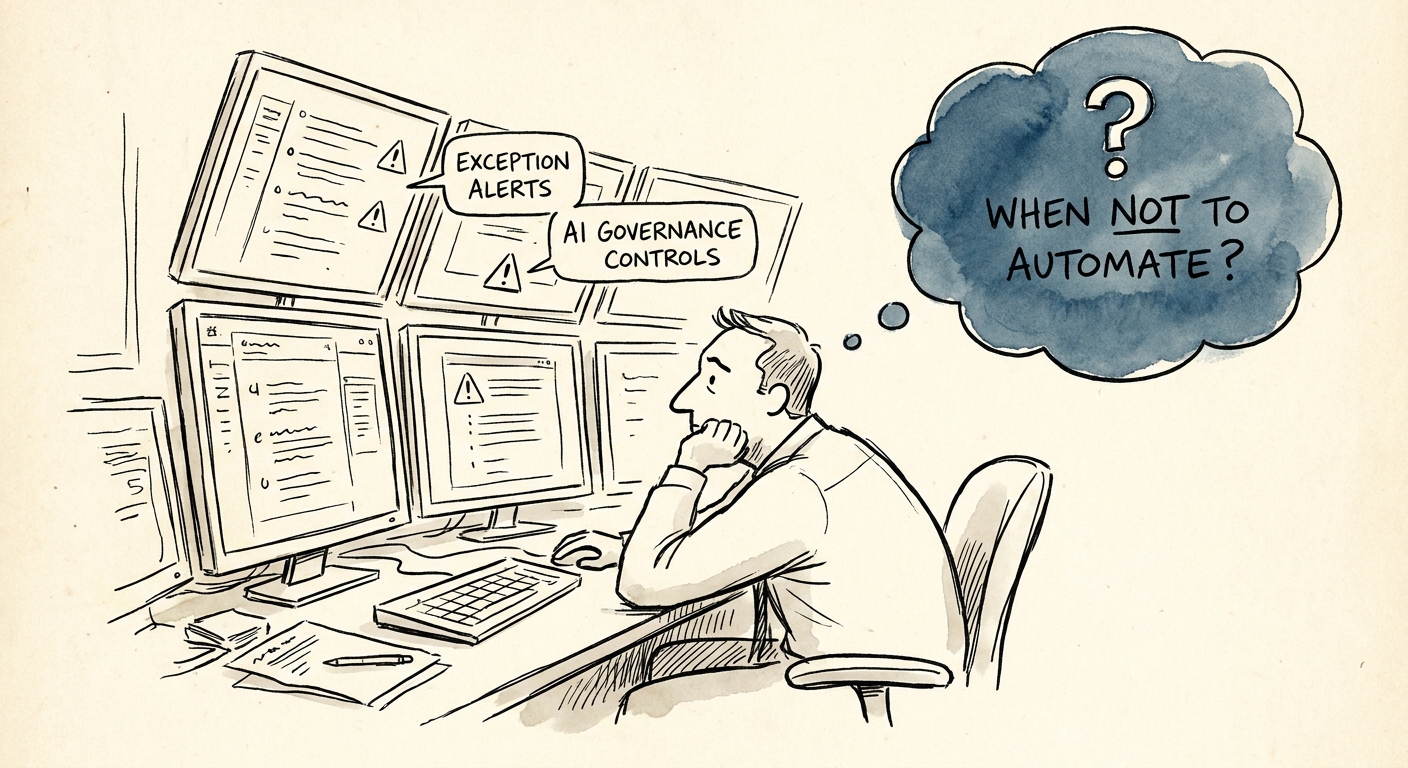
The alert says "Truck 412 delayed." The decision underneath is four-way.
It's 11:40 a.m. Truck 412 is stuck behind a closed lane on I-80, the driver has roughly two hours of available drive time left, the receiver in Reno only takes deliveries until 3 p.m., and the carrier running this lane is one you fought to keep on contract after a rough Q1. An AI can read all of that off the telematics feed and the TMS in under a second. What it cannot do is decide whether to push the appointment, swap the load to a nearby truck, eat the detention, or call the customer and renegotiate — because that single choice trades driver safety against a delivery promise against a carrier relationship against margin, all at the same time.
That four-way tension is exactly why dispatch exceptions look automatable and aren't. The intake is structured: ETAs, hours-of-service clocks, appointment windows, accessorial rules. The judgment isn't. McKinsey's supply chain work keeps landing on the same point — resilience comes from visibility, planning discipline, and how an operation responds under stress, not from removing the responder. AI belongs on the intake layer: it should classify the exception, pull the route, hours, appointment, and customer-tier context into one view, and hand the dispatcher a clean read instead of a screen full of red. The reroute itself stays with the person whose name is on the lane.
Where most dispatch teams put the AI line wrong
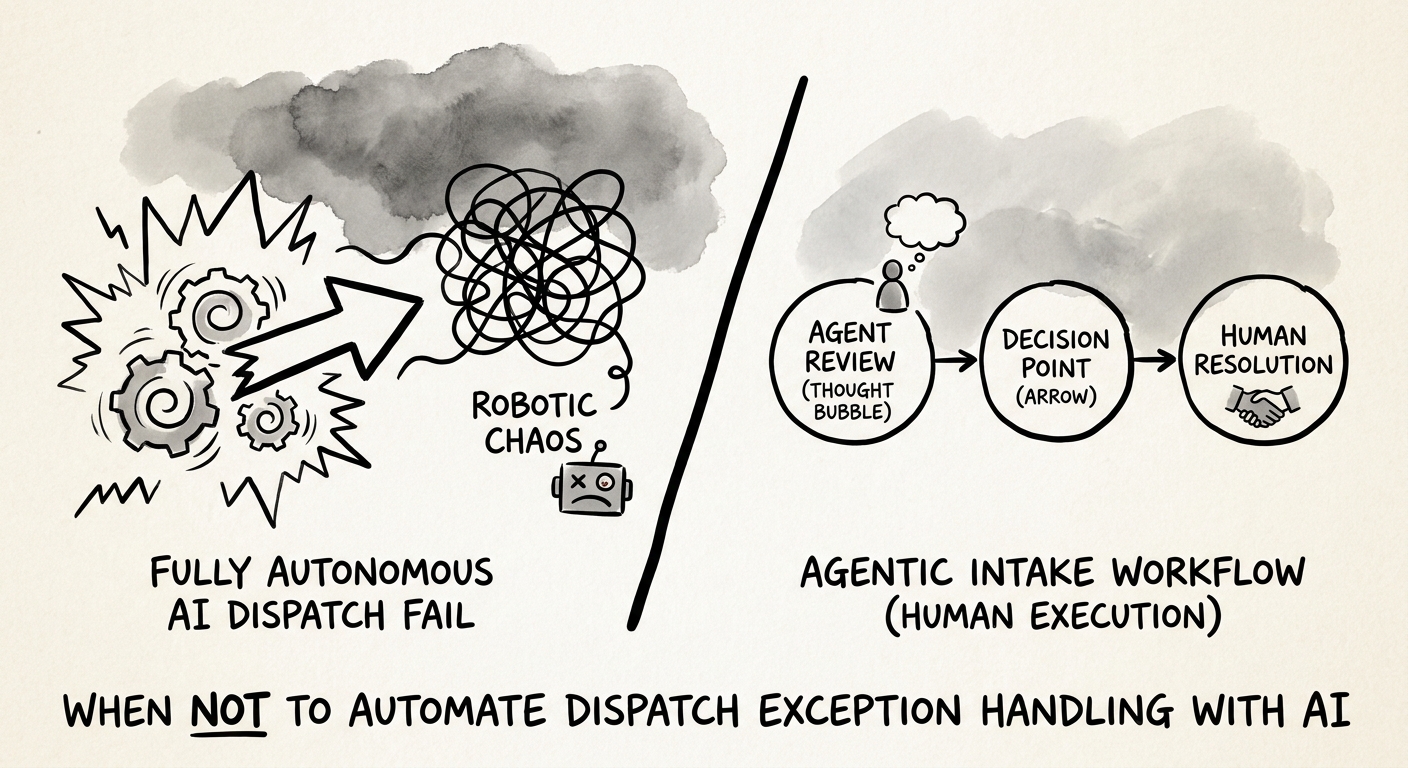
The common mistake isn't automating too much. It's automating the wrong tier. Teams let the model auto-execute the things that feel low-stakes — texting the receiver a new ETA, reassigning a load to the next-closest truck — and those are precisely the actions that quietly burn detention dollars, trip a customer's missed-appointment penalty, or hand a load to a driver who's three hours from an HOS violation. The NIST AI Risk Management Framework gives you the sequence to fix this: map, measure, manage, govern. Mapped to a dispatch board, that means writing down explicitly which exception types are safe for an AI recommendation a dispatcher accepts with one click, which require a supervisor's sign-off, which require the customer's confirmation, and which an autonomous system must never touch — anything involving hours-of-service limits, hazmat, temperature excursions, or a contractual delivery commitment. The first thing you let the AI prove is recommendation quality, not autonomous action.
And the recommendation is only as good as the data feeding it. IBM's Institute for Business Value research on AI capabilities is blunt that performance hinges on data, operating model, adoption, and measurement — not the model alone. In dispatch terms: if your TMS shows a carrier "available" when the truck's actually on a 34-hour reset, if accessorial rules live in a spreadsheet nobody syncs, or if "who owns the Reno account" is tribal knowledge, an AI will produce confident wrong answers faster than any human could. McKinsey's State of AI ties value to redesigning the workflow rather than bolting AI onto a fragile one — so the early scorecard is exception-resolution quality, not heads removed from the dispatch desk.
What you can build by Monday: one lane, one exception type
Don't roll AI across the whole board. Pick one lane, one dispatch team, and one exception category — say, the appointment-window misses on a single high-volume customer. Stand up the AI to draft the resolution (here's the truck, here's the HOS clock, here are three options ranked by cost and risk) and have dispatchers accept, edit, or reject. Then instrument five numbers: time to classify the exception, the missing-context rate (how often the AI lacked a fact it needed), the percentage of recommendations dispatchers accept unchanged, the customer-escalation rate on those exceptions, and post-resolution corrections (how often someone had to undo the call). Watch those for a few weeks. Only the categories where acceptance is high and corrections are near zero earn a promotion from "drafts options" to "executes the low-risk step on its own."
Before you build, get the source systems and decision rights on paper — which feeds are trustworthy, who owns which account, where the hours-of-service guardrails sit. A QuickStart AI Audit maps exactly that. Then run the AI Opportunity Score to check whether dispatch exceptions are even your best first move, or whether a lower-consequence workflow should go first.