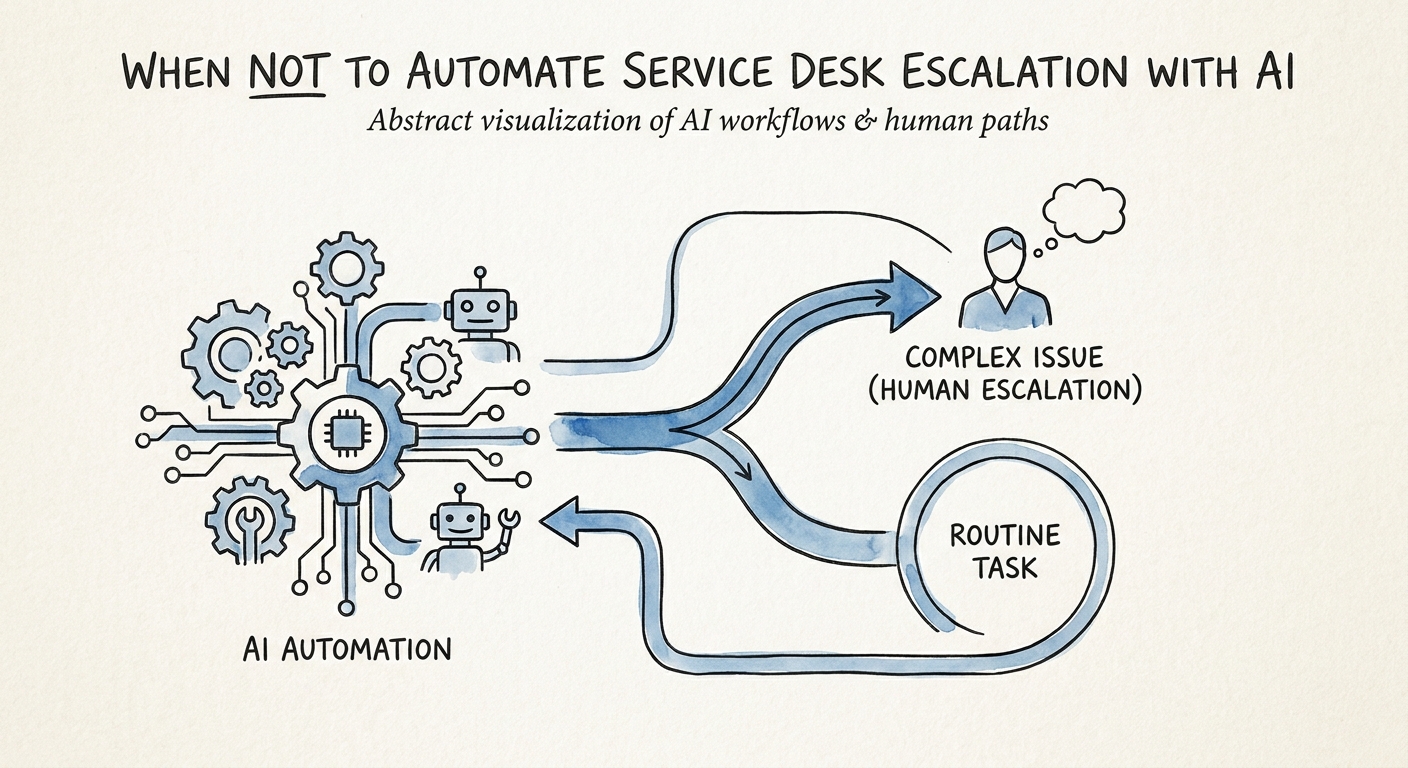
Escalation is the one decision that changes three things at once
Picture a Tuesday on a 200-person professional-services firm's IT desk. A ticket comes in: "shared drive is slow." Routine, Sev-3, goes in the queue. Forty minutes later a second person on the same team can't open files at all, then a third, and the "slow drive" is actually a failing storage controller about to take down the practice's document repository during a client filing deadline. The skill that turns that into a 2 a.m. page instead of a Thursday line item is escalation judgment — recognizing that severity just changed, that ownership has to move to infrastructure, and that someone with the authority to declare an incident needs to be looped in now.
That is exactly the call most teams are tempted to hand to AI first, and it is the one they should hand over last. Triage — routing "I forgot my password" to the right queue — is safe to automate because a wrong guess costs a re-route. Escalation is different in kind: a single decision simultaneously reclassifies severity, transfers ownership, and changes who is permitted to see and touch the ticket. The Salesforce State of Service report shows service orgs leaning hard into AI-assisted work, but the same data underscores that the workflow only holds up when the knowledge behind it is current and the handoffs are accountable. An AI that escalates from stale runbooks or fuzzy severity definitions doesn't move faster — it manufactures false alarms and, worse, mis-sizes the real ones.
So the honest test isn't "can a model classify tickets?" It's "would I let a brand-new hire, on day one, declare a Sev-1 and page the on-call engineer without checking with anyone?" If the answer is no — and for most desks it is — then your escalation logic isn't ready to be automated either, because the model is exactly that day-one hire with no judgment and infinite confidence.
The four things that have to be true before AI gets the keys
Before autonomous escalation earns a seat, four conditions need to hold — and on most desks at least one of them is quietly broken.
Severity has to be defined, not vibed. If "Sev-2" means "the customer sounded angry" to one agent and "more than five users affected" to another, an AI will inherit that inconsistency and amplify it across every ticket. Write the severity matrix down with countable triggers: users affected, revenue or deadline exposure, security flag, no workaround available. A model can apply rules. It cannot invent the rules you never agreed on.
Permissions have to gate what the system can even see. Escalation often pushes a ticket toward people and data that the original requester — and the bot — shouldn't touch: an HR-flagged access issue, a security incident, a client whose contract has confidentiality terms. The Microsoft 365 Copilot data protection architecture is worth studying here precisely because it ties what an assistant can retrieve to identity, data labels, and an audit trail. The lesson for escalation: the AI's reach should be scoped by the same permission boundaries as a human in that role, and every routing of a sensitive ticket should leave a record. If your system can't enforce that, it shouldn't be auto-routing anything sensitive — full stop.
A human override path has to exist before the automation does, not after. An agent who sees the bot mis-sized a ticket needs a one-click way to reclassify and reroute, and that override has to feed back into how the model behaves. Build the brake before you press the accelerator.
The whole thing needs a risk frame. The NIST AI Risk Management Framework gives you the scaffolding: define confidence thresholds (below X, the model recommends rather than acts), name who owns override rights, and schedule the post-incident review where you actually look at what the automation got wrong. Skip this and you don't have governance — you have a guess with a dashboard.
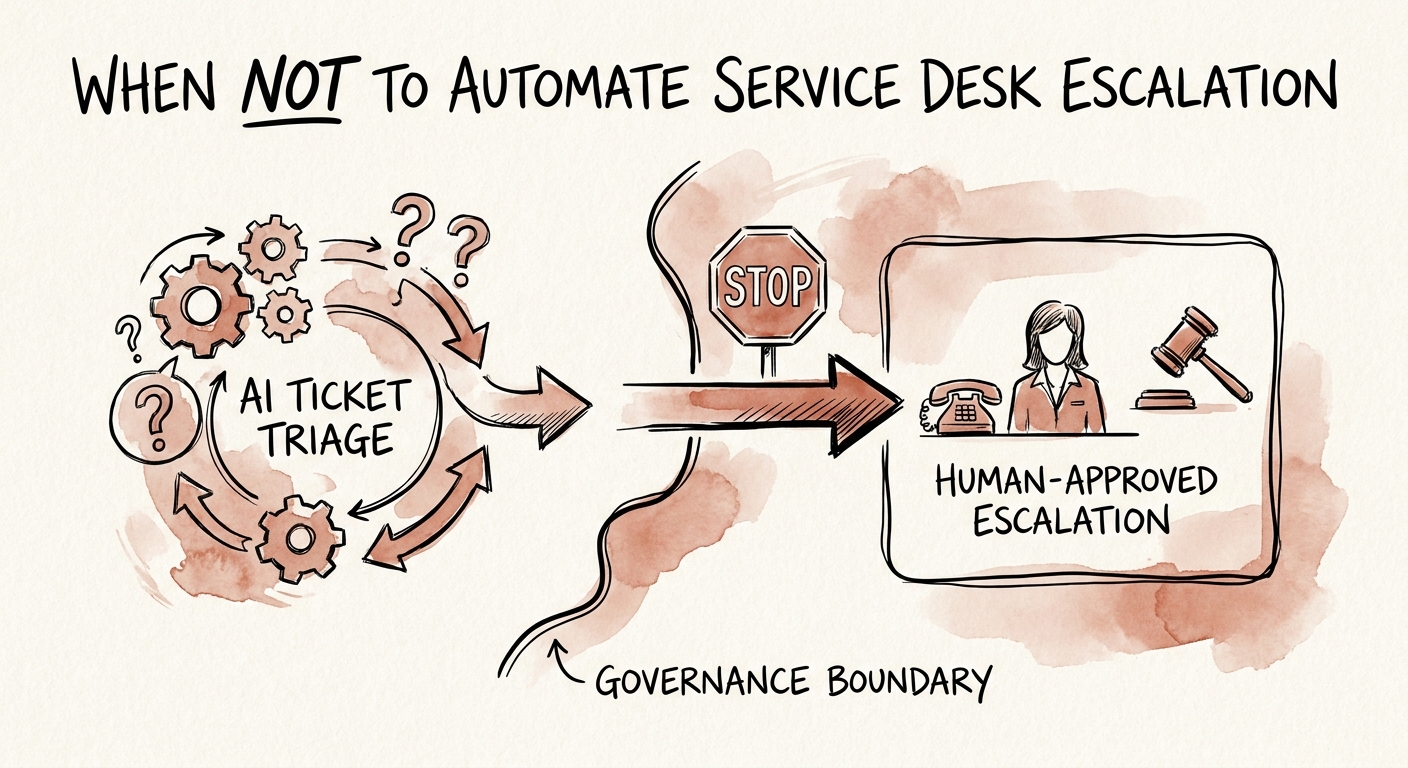
Start where a wrong answer is cheap: supervised triage
The move that actually de-risks this is sequencing. Let AI do triage first — suggest a category, surface the likely owning queue, pull the relevant knowledge article — while a human still confirms before the ticket moves. You get most of the speed with none of the irreversible-escalation downside, and you generate the data you need to know whether the model is trustworthy on the harder call.
Watch five numbers, because they tell you the truth a confidence score won't. Misroute rate: how often the AI sends a ticket to the wrong owner. Escalation delay: time from "severity actually changed" to "right person notified." Override frequency: how often agents reverse the model's classification (a high number means it isn't ready, a falling number means it's learning your rules). False-escalation rate: Sev-1s the model declared that weren't, because every false alarm spends on-call credibility you can't refill. And knowledge-article gaps: the tickets where there was no current runbook for the AI — or a human — to act on. The IBM Institute for Business Value AI capabilities research keeps pointing at the same prerequisites — data quality, operating model, measurement — and these five metrics are how you check whether you actually have them or just hope you do.
Here's what to do Monday: pull last quarter's escalations and count how many were reclassified by a human after the fact. That single number tells you whether your severity rules are clear enough for anyone — model or person — to apply consistently. If reclassifications are common, fix the matrix before you touch automation. When you're ready to design the supervised path, Customer Service AI is where to start.
