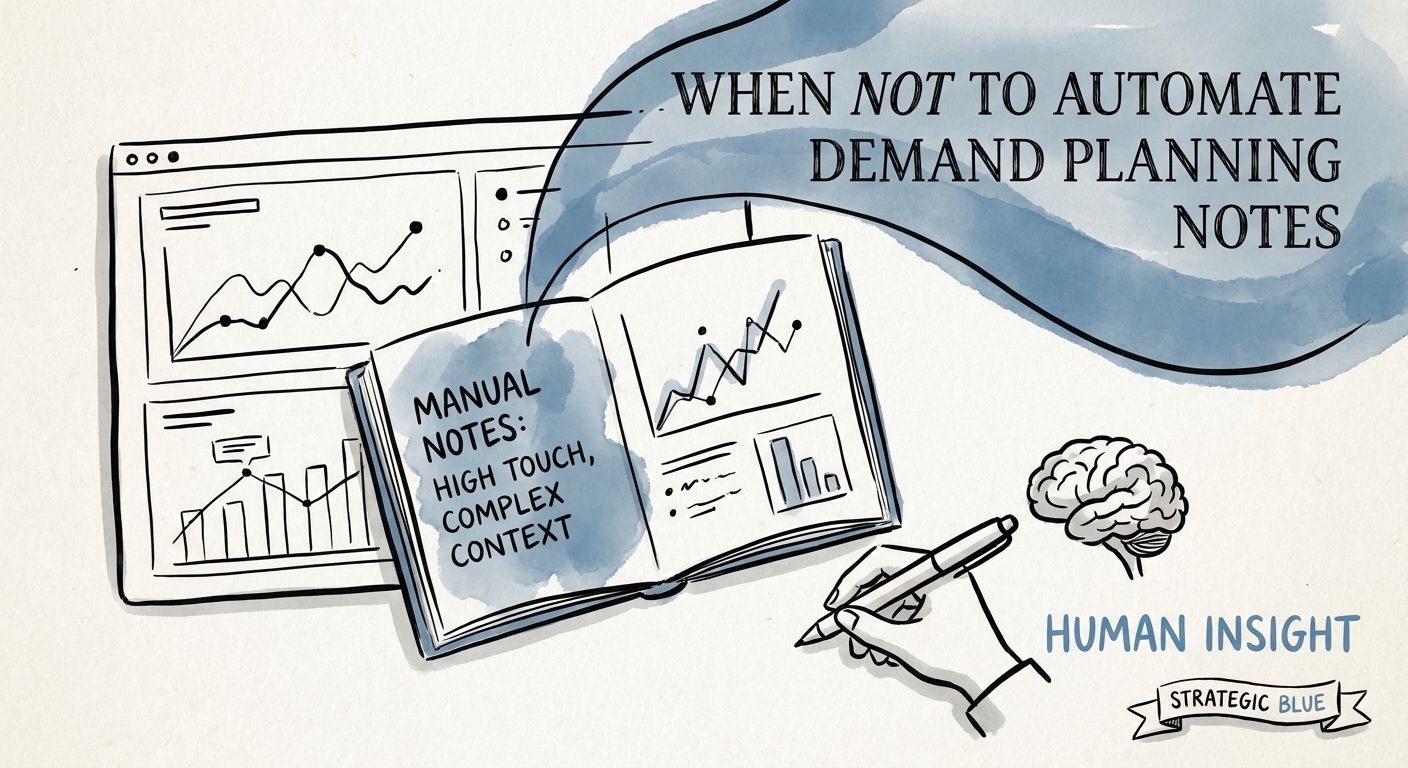
A clean note that hid a $40K bet
Picture the Monday before the monthly demand review at a 120-person distributor. A planner pastes last cycle's actuals, the open promo calendar, and a week of inventory movement into an AI assistant and asks it to draft the forecast change notes for the top 30 SKUs. Ninety seconds later: tidy paragraphs. "Forecast for SKU 4471 raised 18% on observed sell-through and confirmed Q3 promotion." It reads like a senior planner wrote it. So it gets pasted into the deck and nobody touches it.
The problem is buried in the word "confirmed." The promotion wasn't confirmed — it was sitting in the calendar as a proposal merchandising hadn't signed off on. The AI didn't lie. It read a row in a spreadsheet and described it fluently. But that 18% uplift just committed inventory against a promotion that may not happen, and the explanation was smooth enough that the variance never got challenged in the room. That's the specific failure mode in demand planning: the better the prose, the less anyone interrogates the assumption underneath it.
McKinsey's supply chain work keeps landing on the same point — resilient planning depends on visibility and disciplined response, not on faster narration of bad inputs. And the inputs in most mid-market planning environments are messy: item masters that disagree with the ERP, customer forecasts that arrive in three formats, promo calendars maintained in someone's personal sheet. IBM's Institute for Business Value research frames why this matters: AI value tracks data quality, adoption, and governance — not model fluency. Feed an AI inconsistent item masters and it will produce a note that sounds authoritative and is built on the exact distortions you've been fighting all year.
Three calls the assistant drafts but never owns
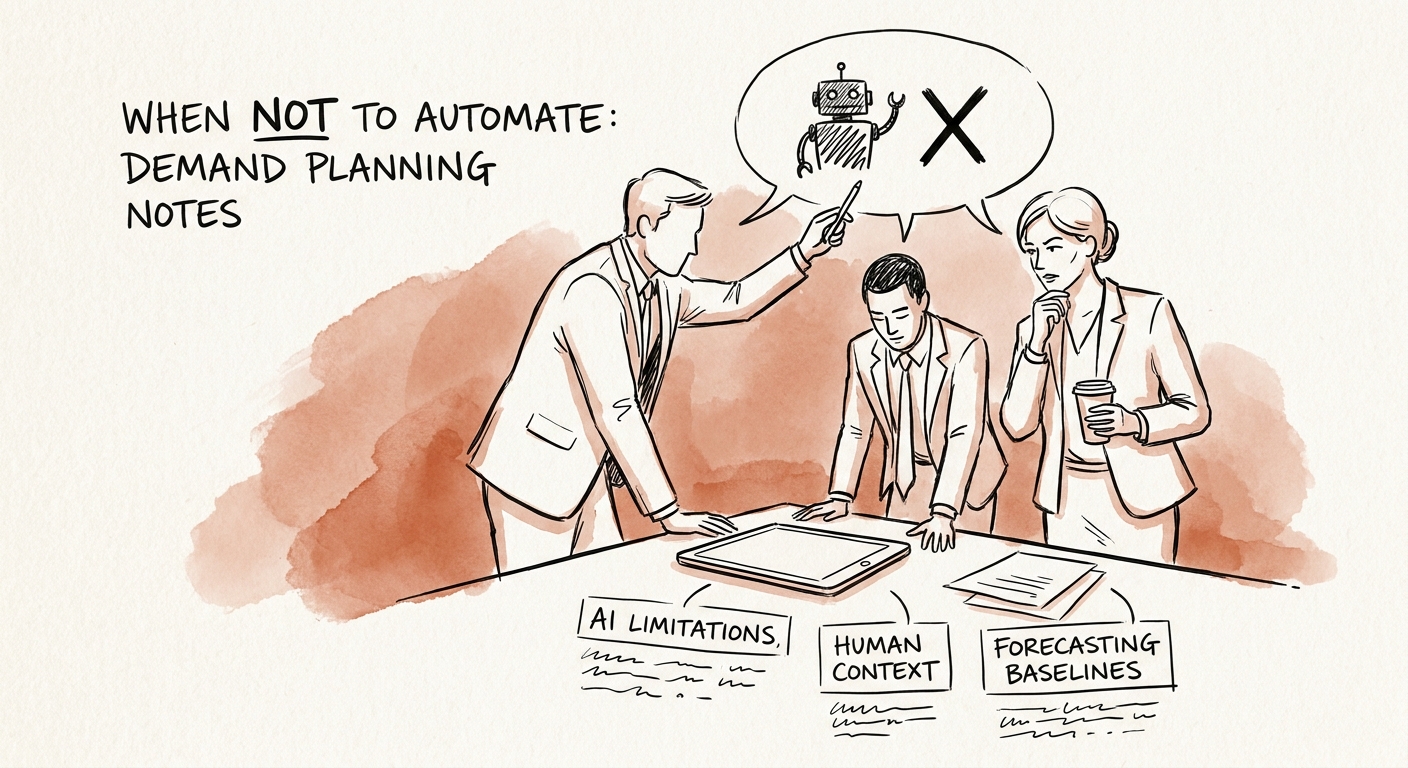
Here's the line that holds up across every demand cycle I've watched: AI is allowed to reconcile and explain; the planner is required to decide and own. Spelled out for the work that actually happens in a demand review, three judgment calls stay human no matter how good the draft is.
The promotion uplift. Is the +18% credible, or is it last year's halo with no real lift behind it? An AI can pull the prior promo's actuals and flag the comparison. It cannot weigh whether the rep's pipeline note about the regional chain is real or wishful. That's a bet on revenue, and bets need a name attached.
The supply constraint cap. When demand outruns what the line or the supplier can deliver, someone has to decide whether the forecast reflects true demand or gets capped to constrained supply — and how that allocation hits each customer. The AI should surface the gap loudly. Choosing who gets shorted is an account-relationship call, not a data operation.
The strategic customer override. Your largest account always runs hot or cold against the statistical baseline because of contract timing the model can't see. Overriding the system forecast for that account is a deliberate human exception, and it should read as one in the notes — not get blended invisibly into a clean paragraph.
Bain's agentic AI report is blunt that these systems earn their keep when the workflow is narrow and governed. Reconciling sources and listing exceptions is narrow. Owning a forecast that commits cash and capacity is not. NIST's AI Risk Management Framework gives you the language to draw the line on paper: map the context, measure where the assistant fails, manage the controls, govern the changes. In practice that becomes a one-page split — assumptions the AI may draft, assumptions it must cite a source for, and assumptions that require a named human approval before they enter the plan.
What to measure before you give it more rope
Don't argue about autonomy in the abstract — instrument it. Run the assistant in draft-and-review mode for three full planning cycles and watch five numbers. Planner edit rate: what fraction of drafted notes get changed before they enter the plan? Unsupported-assumption flags: how often does a claim like "confirmed promotion" turn out to have no source behind it? Citation coverage: what share of forecast changes trace to an actual data row versus a fluent guess? Acceptance rate: how many explanations do planners take as written? Post-cycle corrections: how often did you walk a forecast back after the fact?
If the edit rate is dropping and corrections are falling, the assistant is sharpening planning discipline — earn it more scope. If edits are dropping but corrections are flat or rising, you've taught the room to trust prose instead of checking it, which is the most expensive outcome here, because it's invisible until you've already over-committed inventory. Monday action: pick your top 30 SKUs, draft the notes with AI, then have a senior planner mark every line as data-backed, needs verification, or human bet. That tally is your real readiness signal.
When you're ready to build the draft-and-review process deliberately, the AI workflow automation path covers how to structure the handoff, and the AI Opportunity Score helps you check whether demand planning is genuinely a safer first candidate than a lower-stakes workflow like internal knowledge search.