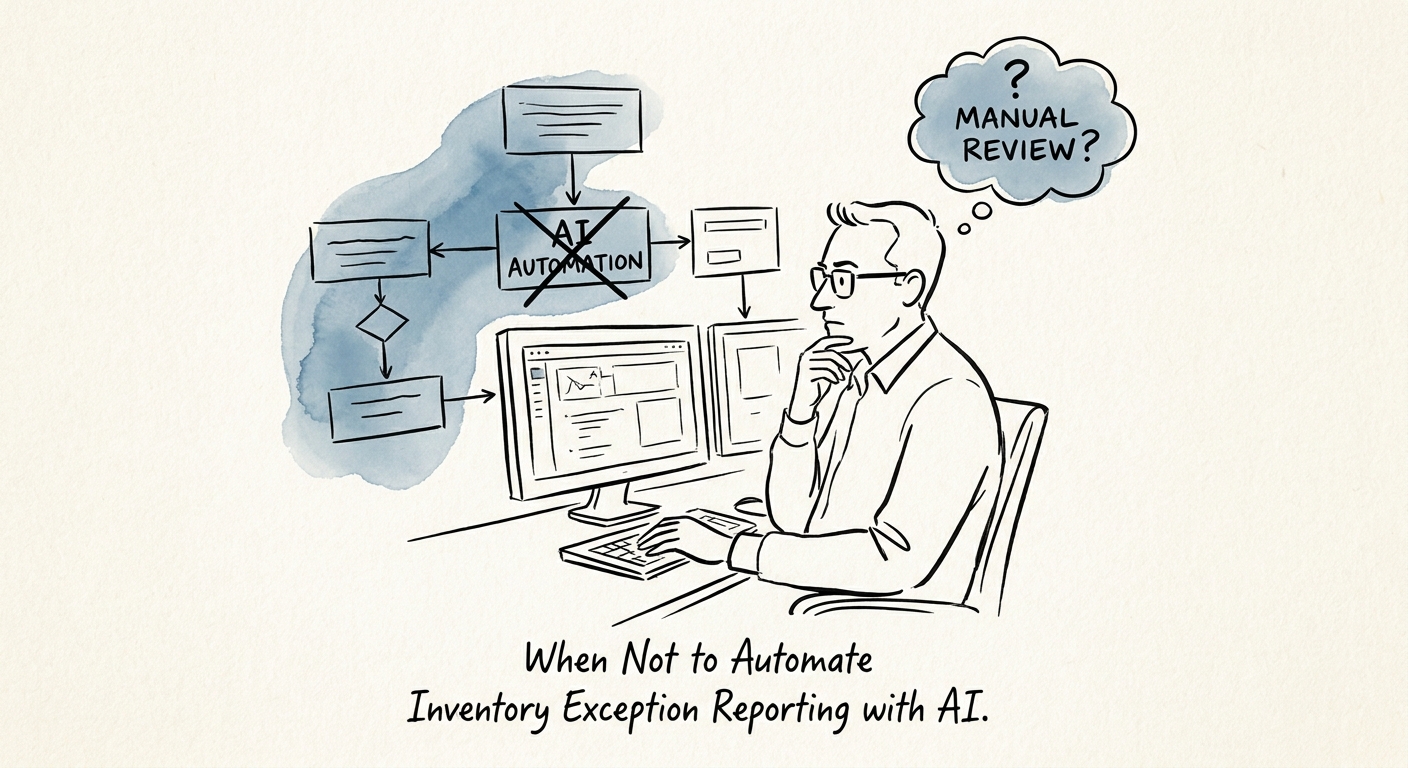
The negative-on-hand that wasn't real
Picture a 90-person distributor running a wall-to-wall in three regional DCs. Monday morning the new AI exception layer flags SKU 44120 as a stockout risk in the East bin and routes an expedite order to the buyer. The buyer pulls the trigger on an air freight charge. Then a warehouse lead walks the aisle and finds 340 units sitting one bin over, received against the wrong location two weeks ago because a scan gun timed out mid-putaway. The AI didn't make a mistake. It faithfully reported a system quantity that was already fiction.
That is the trap with inventory exception reporting. It is a genuinely good AI workflow when the job is grouping similar exceptions, drafting a likely-cause summary, and routing each one to an owner who can act. It is a bad automation candidate when the underlying counts, lot assignments, location mappings, and substitution rules drift faster than anyone reconciles them. McKinsey's supply chain insights tie performance to integrated planning and end-to-end operating visibility — and a model writing a tidier exception note does nothing for either if the receiving dock and the ERP disagree about where pallets physically are.
IBM's Institute for Business Value research on AI capabilities keeps landing on the same dependency: output quality is capped by data reliability, operating discipline, and adoption. In a warehouse that means cycle-count cadence, putaway scan compliance, and unit-of-measure consistency. When those slip, automation doesn't surface the problem — it normalizes the wrong explanation and sends three people chasing a phantom shortage while the real misplaced pallet stays invisible.
Let AI sort the bucket. Keep the buyer's hand on the trigger.
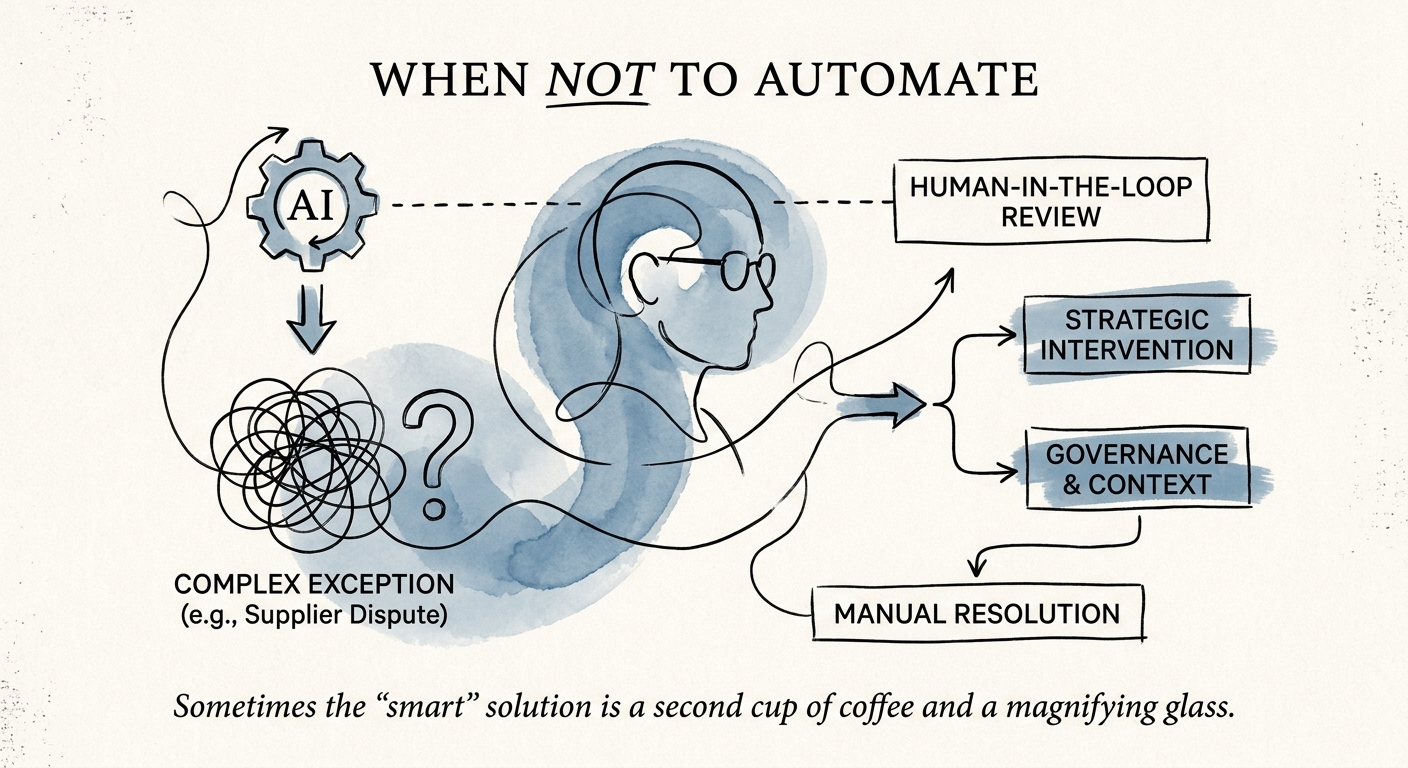
The line that matters is between classification and consequence. The NIST AI Risk Management Framework gives you the control model for where to draw it. Sorting an exception into stockout risk, excess, location mismatch, delayed receipt, or a master-data defect is low-stakes pattern work — let the model own it, and it can clear the easy bulk of your daily exception queue before a human touches it. Deciding the root cause and firing the corrective action is a different class of decision, because the action spends money or breaks a promise: an expedite hits freight and working capital, a write-down hits the P&L, a supplier chargeback hits a relationship you have to keep.
So bound the automation to triage and a ranked hypothesis, never the commit. SKU 44120 should land in the buyer's queue tagged "probable location mismatch — 340 units last scanned to bin E-07-3, confirm physically before expediting," not as an auto-cut purchase order. That one phrasing change converts the AI from a thing that quietly spends your money into a thing that tells the buyer exactly which aisle to walk first.
Bain's agentic AI transformation report makes the case that agentic workflows need bounded tasks, scoped tool access, and real governance to be trustworthy. Translate that to the floor: start with read-only triage that classifies and routes, give the model no write access to the ERP, and only widen its authority on a single exception type after you've proven its recommendations actually shorten resolution — not just shorten the meeting.
Run it as a learning loop, not a Monday narrative
Here is the test that separates a useful deployment from expensive theater. Track five numbers and watch which direction they move. Exception age: are items resolving faster or just getting summarized faster? Classification accuracy: how often does the human confirm the AI's bucket? Override rate: how often does the owner reject the suggested cause — and is that climbing for one exception type, which tells you that category isn't ready to automate? Source-data correction count: every time someone fixes a bin location or a count behind an exception, log it, because that backlog is your real adoption blocker. And repeat exceptions by item or location: if SKU 44120 trips three weeks running, the model is describing a process defect, not an inventory event.
That last metric is the whole point. If repeat exceptions stay flat or rise while your reports get prettier, the AI is laundering a counting problem — the variance is in the warehouse, not the spreadsheet. If repeats fall as corrections accumulate, the loop is working and you can responsibly hand the model more rope. The deciding question on any Monday is plain: did this report help operations learn where the process actually breaks, or did it just give us a cleaner way to be wrong on schedule?
Map your own stop line before you turn anything on. Use the inventory workflow guide for the build side, then set your approval boundaries with AI governance and training.
