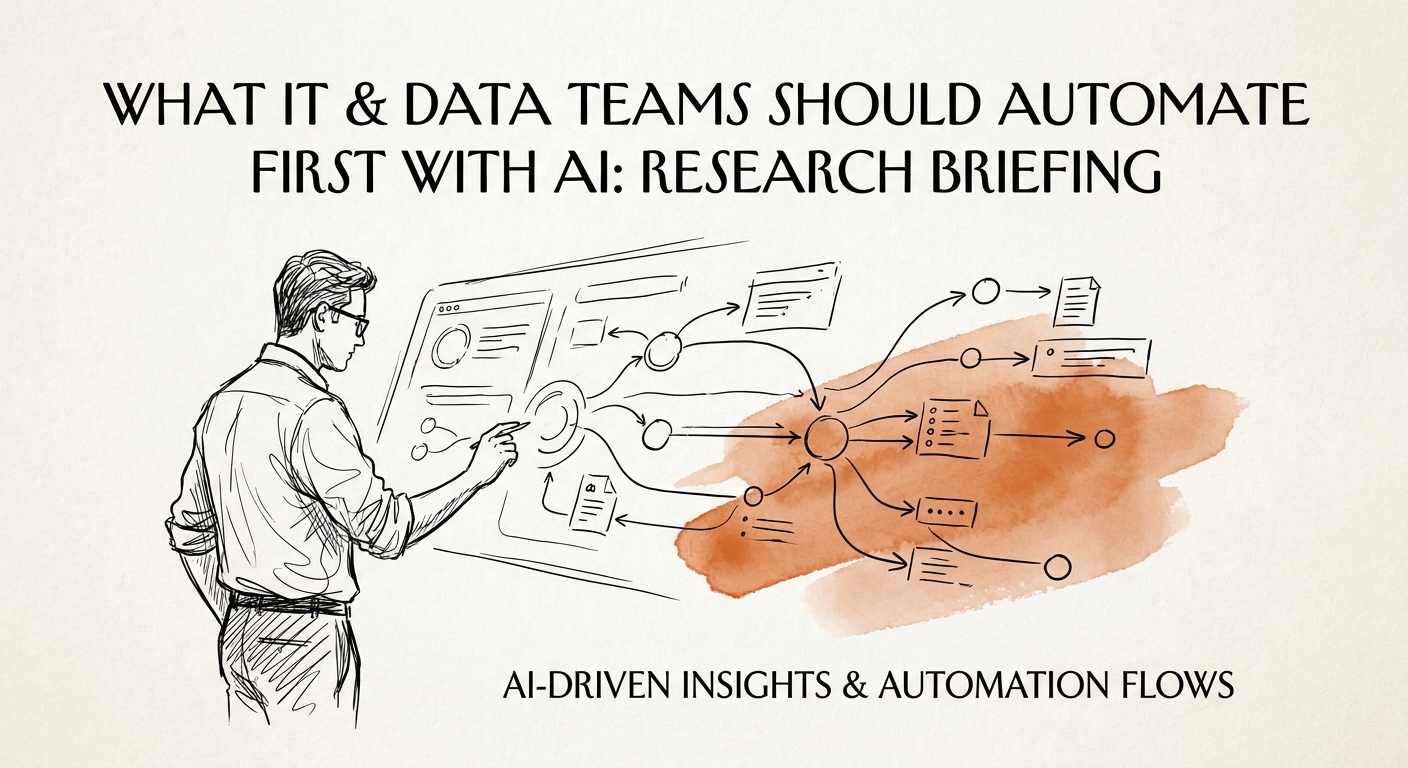
The Tuesday That Repeats Itself
A vendor security questionnaire lands. Someone needs to know: do we use this product, on what data, since when, who approved it, and what did the last review say? On a typical Tuesday, that answer lives in four places—a Confluence page that's eight months stale, a closed Jira epic, a vendor PDF in someone's Downloads folder, and a Slack thread that scrolled into oblivion. A senior engineer spends ninety minutes reconstructing a story they technically already know. Multiply that by every "what do we know about X?" request your team fields, and you've found the most expensive habit in the building.
That recurring reconstruction job is the research briefing, and it's the single best workflow for an IT or data team to automate first. Not because it's flashy—because it has the three properties that separate a workable automation from a demo: a repeatable input (a question about systems you already steward), a visible owner (you, the team that holds the source data), and a baseline you can put a number on (the ninety minutes). Most teams reach for chatbots or code generation first. Those are harder to govern and harder to measure. The briefing is the one where you already control the inputs.
The timing is on your side. The U.S. Census Bureau reported in May 2026 that AI adoption has become meaningful in mid-sized firms, including 32% of firms with 100 to 249 employees. For a middle-market data team, that means your first use case isn't a science experiment anymore—it's a choice your peers are already making, and a workflow that builds operating confidence if you pick the right one and ship it narrow.
Build It So It Cites, Not Invents
Here's where most briefing automations quietly fail: they sound confident and cite nothing. A research briefing that hallucinates a "last reviewed: March 2026" date is worse than no briefing at all, because a human will trust it. The difference between a slick demo and something you'd actually let answer a security questionnaire is operating design—and the gap is real. Deloitte's 2026 State of AI research found that only 25% of leaders moved 40% or more of their AI pilots into production. The other 75% are stuck in the demo phase, and unsourced output is a big reason why.
So build evidence in from the start. Pull twenty real briefings your team produced over the last quarter. For each one, write down the correct answer and, critically, which systems it came from. Now run your AI workflow against those same twenty questions and grade it on three things: did it retrieve the right source, did it quote that source instead of paraphrasing from memory, and did it say "I don't have a record of this" when the record genuinely doesn't exist? A briefing tool that can't admit ignorance is a liability. For a data team, the win condition isn't fluency—it's traceability: every claim links back to a document a human can open.
Governance here is lighter than people fear, because you're not training a model—you're retrieving from systems you already secure. Map the workflow against the NIST AI Risk Management Framework so the measure-and-govern steps are explicit rather than assumed. Use CISA's AI data security guidance to make sure the retrieval layer respects the same permission boundaries your source systems already enforce—a briefing tool that surfaces a restricted HR doc to an engineer is a breach, not a feature. And if you're buying a commercial assistant, pin down its data-retention and data-use commitments in procurement; don't assume the default is safe.
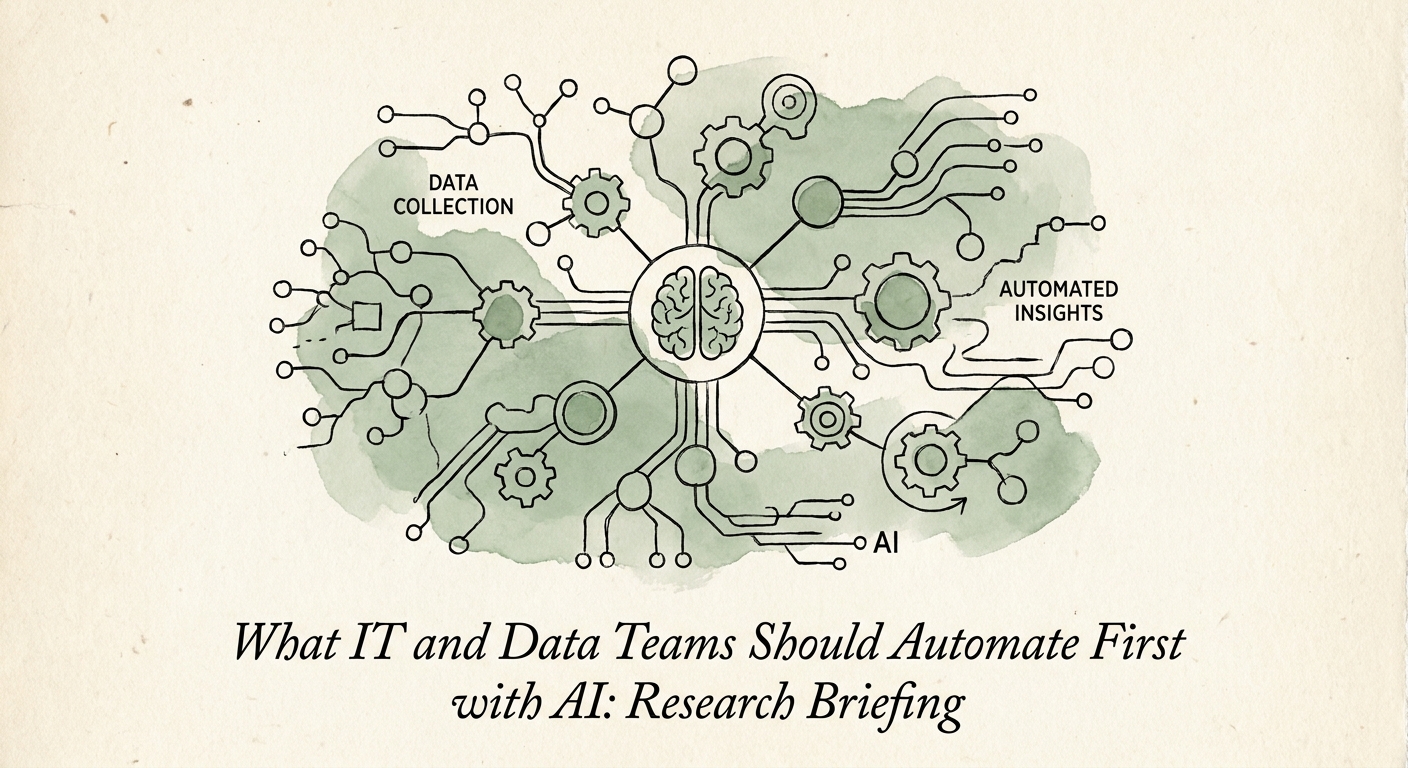
Ninety Days From Habit to Production
Days 1 to 30: don't touch a model yet. Instrument the current habit. Log how often briefing requests come in, who they go to, how long each takes, and how often the answer turns out to be wrong because a source was stale. That last number is your secret weapon—if your humans are already getting it wrong because the Confluence page lied, a tool that timestamps and cites every source is an upgrade on day one, not a compromise.
Days 31 to 60: run the AI briefing against live requests in parallel, with a human reviewing every output and confirming the citations resolve. You're not measuring whether it's faster yet. You're measuring whether you can trust it. Track how often the reviewer has to correct a source attribution—when that number falls toward zero, you have something real.
Day 90: make the call. Either it goes to production as a first-draft generator that humans approve, it stays a supervised assistant for low-stakes questions, or you kill it because your underlying knowledge is too scattered to retrieve from reliably—which is itself a finding worth the ninety days. The Federal Reserve Bank of San Francisco's research on AI and small businesses reinforces the pattern: adoption sticks when leaders tie AI to a concrete operating need, not an abstraction. The same lesson shows up internationally—the OECD's review of AI adoption by SMEs finds the firms that succeed start narrow and expand from a proven base. Once the briefing earns trust, it becomes the spine for internal knowledge search and the pilot-to-production controls you'll reuse on every workflow after. That's the path the AI Transformation Blueprint is built to walk you down—one governed automation at a time.