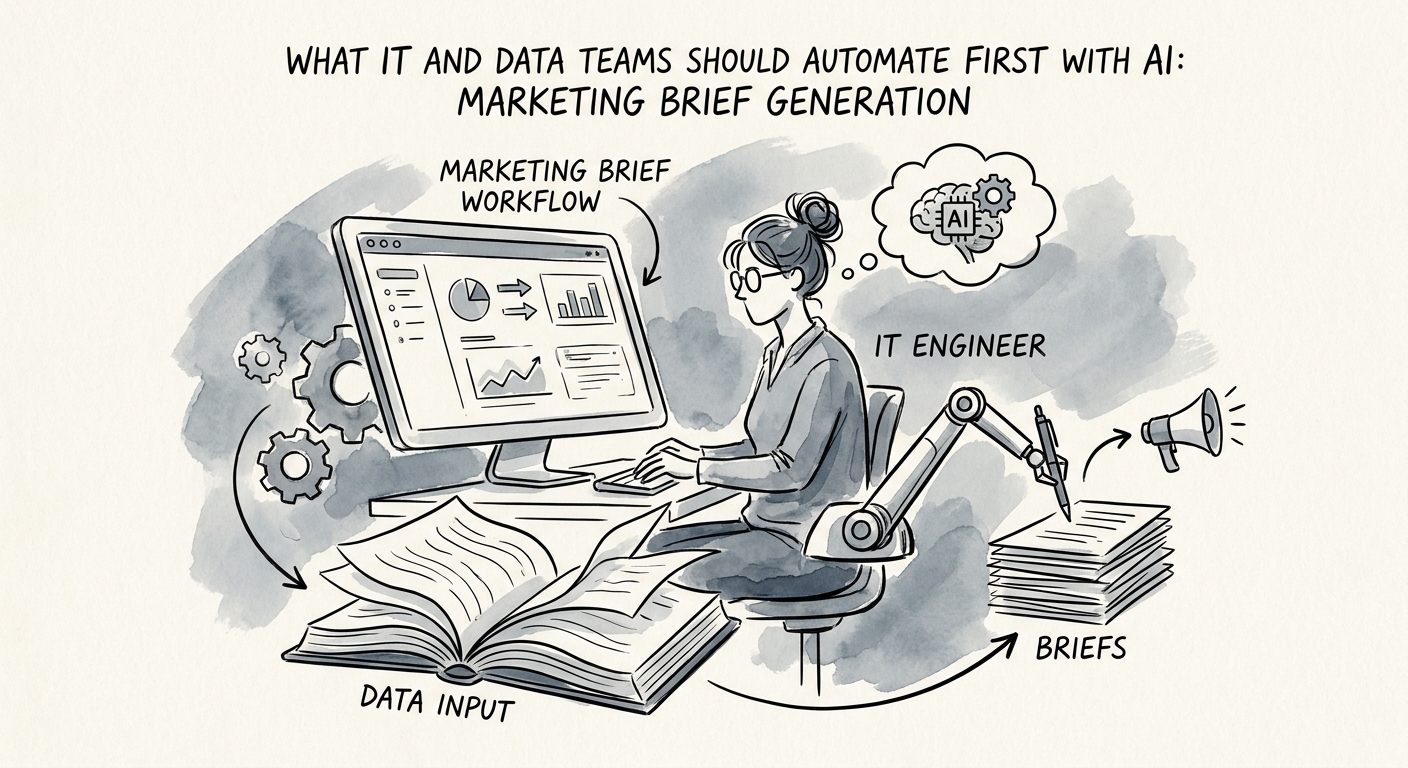
The brief that quoted a discount nobody approved
Picture a 140-person SaaS company. A campaign manager asks the new AI assistant for a brief on the spring renewal push. Ten seconds later it returns a clean, confident document: positioning, three headline options, audience segment, and a line that says "promote the 25% loyalty discount." The discount was 15%. It expired last quarter. Nobody on the call caught it because the brief looked finished, and finished-looking documents get believed.
That is the specific failure mode of marketing brief generation, and it is why IT and data teams should treat it as a first AI workflow rather than handing marketing a chatbot and walking away. A brief is not a summary email. It is the upstream source-of-truth for ad copy, landing pages, sales enablement, and sometimes a regulated claim. Every fabricated number in a brief gets amplified downstream by people who assume the hard part was already verified.
The reason this is an IT-and-data problem, not a marketing-tooling problem, is that the danger lives in the data layer. The Census Bureau's AI Use at U.S. Businesses data shows adoption climbing fastest in exactly the 100-249 employee band where this company sits — meaning the tool will get used whether or not the plumbing behind it is trustworthy. Deloitte's State of AI in the Enterprise 2026 keeps landing on the same point: the value shows up when the workflow can be measured and corrected after launch, not in the demo. And the OECD's SME research is blunt about why smaller firms stall — they lack the internal data discipline to feed the tool, so it confabulates the gaps. Your job is to remove the gaps before the model fills them in.
Wire it so the model can quote facts but never invent them
Here is the architecture that separates a useful brief generator from a liability. A marketing brief is made of two ingredient types, and they need to be plumbed completely differently.
The first type is retrieved facts: current price and discount, the offer's start and end dates, the audience segment definition, product capabilities, and any compliance-gated claim ("HIPAA-compliant," "SOC 2," "fastest in category"). These should never be generated. They should be pulled by reference from a system the marketing operations owner already maintains — the offer table, the product fact sheet, the approved-claims register. If the value is not in the source, the brief shows a visible "[MISSING: discount %]" placeholder instead of a fluent guess. A blank is honest; a hallucinated 25% is dangerous.
The second type is drafted language: headline options, hook angles, tone variations. This is where the model should be creative and where a reviewer expects to rewrite. Letting AI draft headlines is fine. Letting it draft the discount percentage is not. Most teams fail because they treat the whole brief as one generation task; the fix is to retrieve the facts and only generate the prose around them.
That split also gives you a clean control story. The NIST AI Risk Management Framework frames risk as contextual, and a brief is the textbook case — "save 25%" is harmless in a brainstorm and a false-advertising exposure once it ships to a customer list. Use CISA's AI data security guidance to set the permission and retention rules on the fact sources specifically — the offer table and claims register, not "all marketing files." Then make the review packet show, for every brief: the source record each fact was pulled from, the fields it could not fill, and the headline drafts flagged as model-generated. Track approved-fact coverage, the rate of factual corrections at review, missing-field flags, and time from request to approved brief. If corrections stay high, the answer is a cleaner offer table — not a better prompt.
Your first 90 days, and the boring outcome you want
Days 1-30: pick one campaign type — say, renewal or webinar promotion — and map every fact a brief needs back to a named source the marketing operations owner will personally defend. The deliverable of this phase is unglamorous: a list of fact fields and the system each one comes from. Any field without a clean source either gets one or gets a permanent visible placeholder. Days 31-60: run the generator in parallel with how briefs are written today, and compare each AI brief against what a trained marketer would have produced. You are looking for the fabricated-fact rate trending to zero, not for prettier prose. Days 61-90: decide whether to expand to a second campaign type, hold at one, or pause because the source data is not ready.
The result you want looks dull from across the room. Marketers stop re-verifying the discount and the expiry date by hand because the brief pulls them by reference and flags the blanks. Reviewers spend their time sharpening headlines, not catching invented numbers. The San Francisco Fed's early findings on small business AI point the same way — the gains accrue to firms that fold AI into a repeatable process, not the ones chasing the most impressive single demo. A brief generator that creates a new "double-check everything" review queue has made the team slower, not faster.
If marketing brief generation is competing with three other "automate this first" candidates, run the AI Opportunity Score to rank them on data readiness and downstream risk. Once the review path produces real time-saved and correction-rate evidence, model the payback with the AI ROI Calculator. Human Renaissance sequences exactly this — fact-source cleanup, then governed generation, then the next workflow — inside the AI Transformation Blueprint, so your team moves to the next use case without losing control of the source trail.
