The most expensive thing your ops team does is ask "where's the answer?"
Picture a 140-person services firm on a normal Tuesday. A coordinator needs the current refund policy for a client in a regulated state. She checks the wiki (last edited 14 months ago), pings the #ops channel (no reply for 20 minutes), then Slacks the one senior person who actually knows — who is in a meeting. Forty-five minutes gone on a question that has a correct, knowable answer. Multiply that by a team of fifteen, every day, and you are funding a full-time salary just to relocate information you already own.
That is why internal knowledge search is the right first AI workflow for operations — not invoice automation, not auto-drafted emails, not an "agent" that takes actions. The middle market is the segment where this compounds: the U.S. Census Bureau reported in May 2026 that 32% of firms with 100 to 249 employees now use AI, and at that headcount you are big enough to have real institutional knowledge but too small to have a dedicated knowledge-management function curating it. The knowledge exists. It is just scattered across SOPs, ticket histories, contracts, and three generations of shared drives.
Start narrow on purpose. The first version answers questions and cites where the answer came from. It does not change a commitment, approve an exception, or invent a policy that isn't written down. If it can't find a grounded answer, it should say so and point to a human — not guess. You are making a trained employee faster, not removing the human from the loop.
The gap between a slick demo and a tool ops actually trusts
Knowledge search demos beautifully and dies quietly. Deloitte's 2026 State of AI research found that only 25% of leaders moved 40% or more of their AI pilots into production. The reason is almost always the same with knowledge tools: it answered the three questions the vendor rehearsed, then confidently made something up on question four, and your ops lead stopped trusting it. One bad answer about a refund window or a compliance step erases ten good ones.
So build the proof before you build the rollout. Pull 40 to 60 real questions your team actually asked last month — from tickets, from Slack, from "quick question" emails. Write down the correct answer and the source document for each. Then score the tool on three things: did it retrieve the right source, did it cite it, and did it say "I'm not sure" when the answer genuinely wasn't in the corpus. That last one is the whole ballgame. A knowledge tool that admits uncertainty is an asset; one that bluffs is a liability with a UI.
Keep governance practical, not theatrical. Use the NIST AI Risk Management Framework to map, measure, govern, and manage — but for ops, the sharp edge is permissions. Internal knowledge search will happily surface a salary doc or a board memo if your access boundaries are sloppy, so lean on CISA's AI data security guidance to make sure the tool respects who is allowed to see what. And if you're buying a commercial assistant, pin down data retention, training-use, and permission inheritance in procurement — not after a leak.
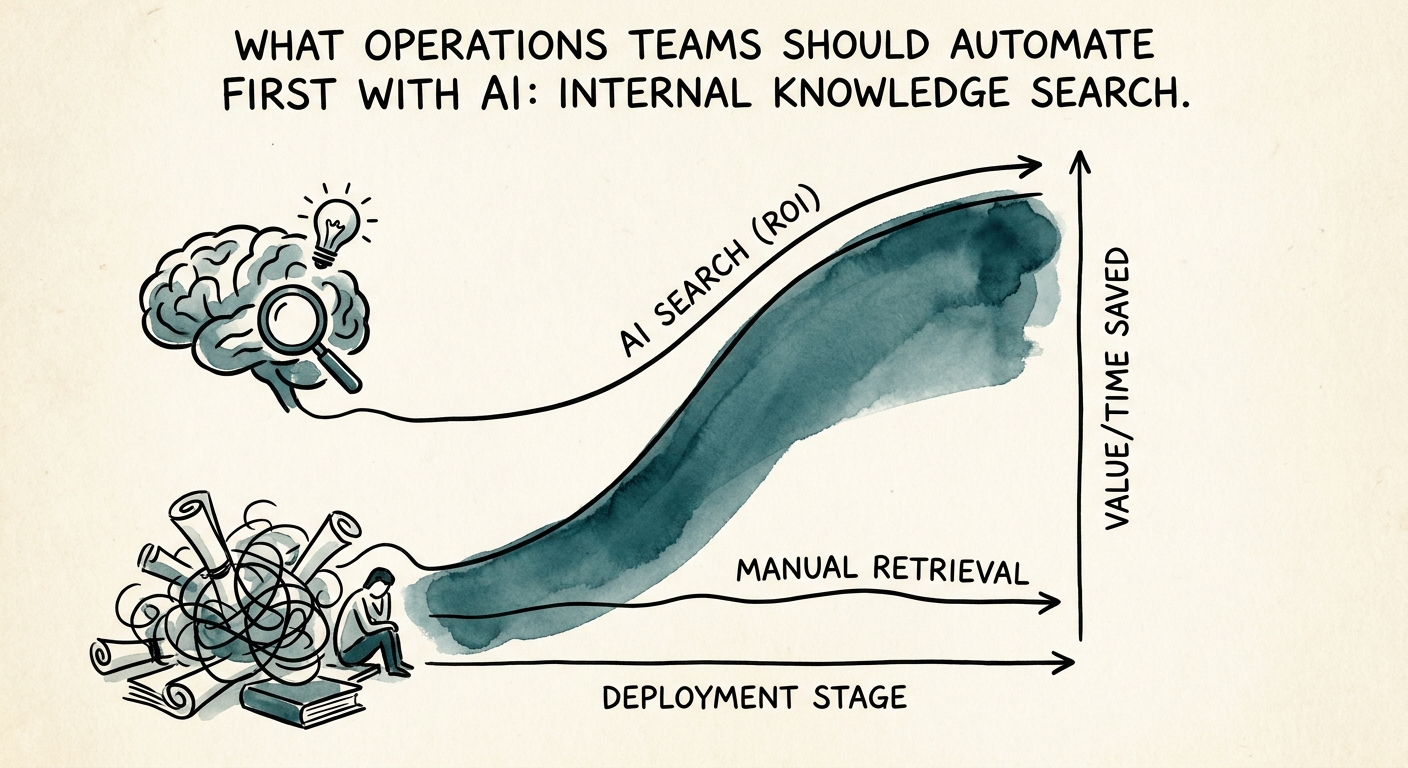
A 30-60-90 plan you can run with your existing team
Days 1-30: pick one document domain — not "all company knowledge." Choose the one that generates the most repeat questions (often SOPs, policy, or onboarding). Baseline the pain: how long does the average lookup take, how many questions bounce to a senior person, how often does the team get it wrong? Write those numbers down. You cannot prove a win you never measured.
Days 31-60: run the tool against real questions with a human reviewing every answer and every citation. Track the same metrics. You're looking for two signals — fewer escalations to the one person who knows everything, and faster, correctly-sourced answers from everyone else. Days 61-90: decide. Move it to production, keep it as a supervised assistant for higher-stakes domains, or kill it because the underlying documents are too stale or contradictory to ground on. A "no" here is a real result; it tells you to fix your knowledge base before any AI can help.
This mirrors what the Federal Reserve Bank of San Francisco found in its small-business AI research and the OECD's read on SME adoption: AI sticks when it's tied to a concrete operating need, not a broad mandate. If you want the playbook for going from one proven workflow to a governed system, see how we connect internal knowledge search, pilot-to-production controls, and the AI Transformation Blueprint.