
The practical answer
- Short answer
- Stop trading at 1.5x revenue. A diagnostic guide for UiPath partners to pivot from implementation projects to high-margin Agentic Managed Services.
- Best fit
- Industry: Intelligent Automation. Function: Managed Services
- Operating path
- Revenue Architecture → Commercial Performance → Office of the CFO
- Key metric
- 40% Annual breakage rate of unmanaged RPA bots, creating the 'Maintenance Hangover' opportunity.
The 'Sugar Rush' of Implementation vs. The 'Maintenance Hangover'
For the last five years, the UiPath partner ecosystem has been fueled by a simple, lucrative loop: sell the license, build the bot, bill the hours. It was a gold rush. But in 2026, the market has shifted. The low-hanging fruit of rules-based automation has been picked, and partners relying solely on implementation revenue are finding themselves on a treadmill—needing to sell more hours just to stand still.
The problem is structural. Implementation revenue is non-recurring, low-margin (typically 35-45%), and increasingly commoditized. Worse, it traps your valuation. Private Equity buyers view pure-play implementation shops as "staffing businesses with better marketing," typically trading at 6x to 8x EBITDA. In contrast, Managed Services Providers (MSPs) with high recurring revenue and intellectual property (IP) command multiples of 10x to 14x EBITDA.
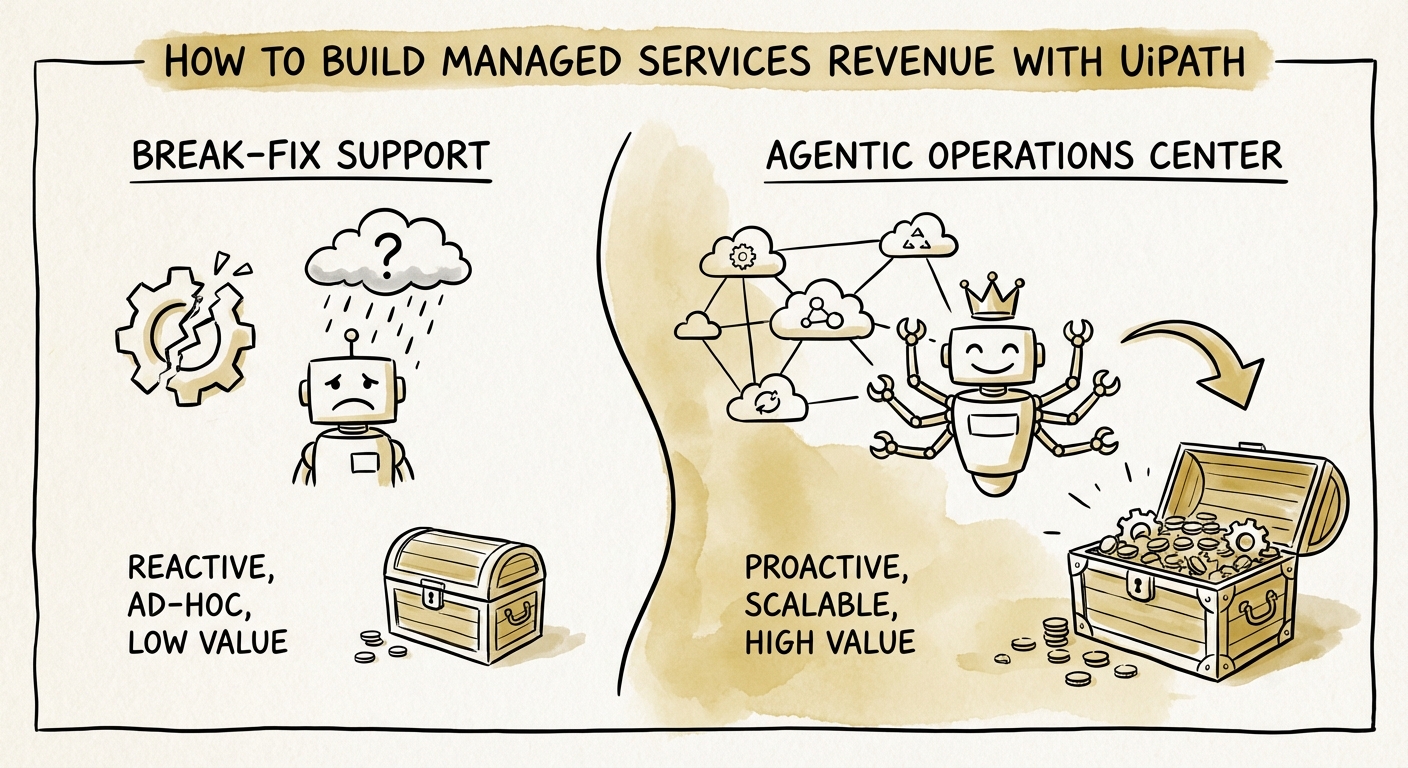
The opportunity for the pivot lies in what we call the "Maintenance Hangover." Industry data suggests that without proper governance, 40% of RPA bots break annually due to application updates, UI changes, or data drift. For the client, this is a crisis. For the strategic partner, it is the foundation of a high-margin recurring revenue stream. The partners winning in 2026 aren't just building bots; they are running "Agentic Operations Centers" that guarantee the uptime and performance of the digital workforce.
The partners winning in 2026 aren't just building bots; they are running 'Agentic Operations Centers' that guarantee the uptime and performance of the digital workforce.
Structuring the 'Agentic' Managed Service
To break the valuation ceiling, you must move beyond selling "support hours." Support is reactive; Managed Services are proactive. The most successful UiPath partners have restructured their offering around Automation-as-a-Service (AaaS), which decouples revenue from hours worked.
1. The Service Catalog
Your managed service must be a product, not a bucket of hours. Leading partners offer tiered packages:
- Tier 1: Sustain (Bot Maintenance). Monitoring, incident response, and minor fixes (e.g., selector updates). Pricing is per-bot/per-month.
- Tier 2: Optimize (Process Mining & Intelligence). Utilizing UiPath Process Mining and Communications Mining to proactively identify bottlenecks. Pricing is a flat monthly fee + gain-share on efficiency.
- Tier 3: Orchestrate (Agentic AI Management). With the 2025 rise of UiPath Maestro and Agentic AI, the value shifts to managing autonomous agents. This involves governance, guardrails, and model tuning.
2. The Pricing Pivot
Stop charging hourly rates for maintenance. It aligns your incentives against the client's—you want things to break so you can bill more. Instead, adopt "Per Digital Worker" pricing (e.g., $500 - $1,500 per bot/month depending on complexity). This incentivizes your team to build robust, self-healing automations because every hour you don't spend fixing a bot increases your margin.
3. The Gross Margin Target
Your target for this business unit should be 60% Gross Margin. If you are below 50%, you are over-servicing or under-pricing. Achieving this requires investing in your own IP—automated monitoring tools, code quality analyzers, and "self-healing" scripts that resolve common errors without human intervention.
The Valuation Arbitrage: Why This Pivot Matters
The shift from Project Revenue to Managed Services Revenue is not just an operational upgrade; it is a valuation arbitrage. In the current M&A climate, acquirers are scrutinizing the Quality of Revenue. A dollar of recurring, high-retention managed services revenue is worth approximately 2.5x more than a dollar of project revenue in an exit scenario.
Consider two UiPath partners, both generating $10M in revenue:
- Partner A (The Builder): 90% Project Revenue / 10% Recurring. EBITDA Margin 15%. Valuation: ~$9M (6x EBITDA).
- Partner B (The Operator): 50% Project Revenue / 50% Recurring. EBITDA Margin 25%. Valuation: ~$25M (10x EBITDA).
Partner B is worth nearly 3x more because they have solved the "re-buy" problem. They don't start every quarter at zero. By anchoring your relationship in the ongoing operation of the client's mission-critical workflows—especially as they integrate Generative AI and Agentic capabilities—you become difficult to displace. This "stickiness" is the primary driver of premium multiples in the 2026 IT Services market.