
The practical answer
- Short answer
- Same firewall install base. A 5x VAR business or a 14x MSSP, depending on how you book the SOC. The Cortex XSIAM pivot playbook for NextWave partners.
- Best fit
- Industry: Cybersecurity / MSSP. Function: Managed Services
- Operating path
- Revenue Architecture → Commercial Performance → Office of the CFO
- Key metric
- 14% Projected CAGR of the SOC-as-a-Service market through 2030, driven by the mid-market's inability to staff internal SOCs.
Two PANW partners, identical revenue, a 3x difference in price
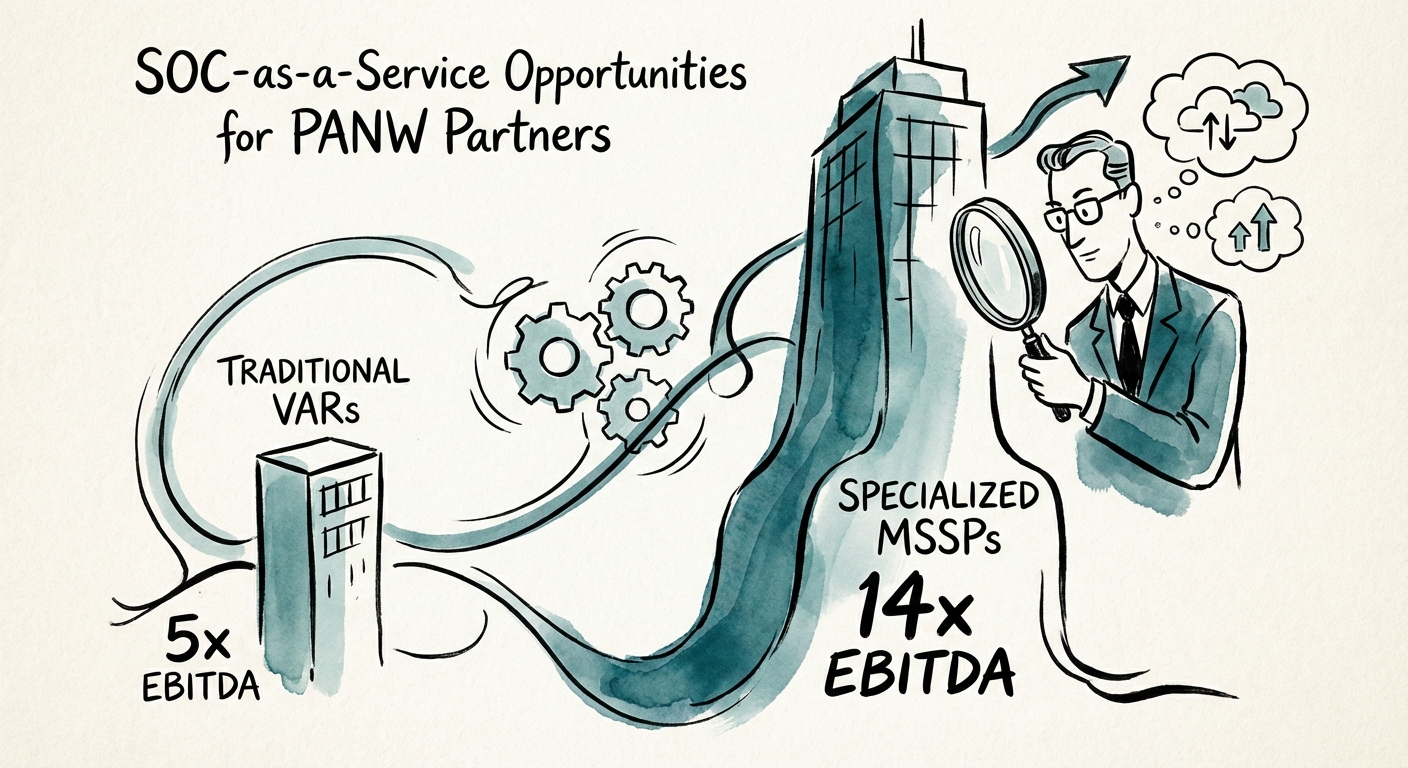
Picture two Palo Alto Networks NextWave partners, both clearing $20M in revenue. Partner A invoices the same way they have since 2010: PA-Series firewalls, a stack of support SKUs, and a renewal forecast that lives and dies on the refresh cycle. Partner B sells the same hardware to the same mid-market CISOs — but every box ships wrapped in a monitored SOC subscription billed monthly. On paper, they look like twins. In a sale process, Partner A gets quoted somewhere in the 3x to 5x EBITDA range that buyers reserve for value-added resellers. Partner B fields offers at 12x to 15x. Same logos, same engineers, triple the enterprise value.
The gap isn't about who sells more. It's about how the revenue behaves. Resale dollars are lumpy and low-margin — a PA firewall pass-through clears maybe 10-15 points of gross margin, and it vanishes the moment a competitor underbids the renewal. SOC-as-a-Service revenue does the opposite: it recurs, it compounds, and architected on the right platform it holds 45-60% gross margins. A buyer modeling your next five years would rather own a stream they can forecast than a transaction they have to re-win every 36 months. That preference is the entire valuation delta.
And the demand is real, not aspirational. The SOC-as-a-Service market is forecast to grow at roughly a 14% CAGR through 2030, almost entirely because a 180-person manufacturer or regional health system cannot hire and retain twelve analysts to run a 24/7 SOC. They were never going to build it themselves. The only question is whether their firewall partner becomes the one who runs detection and response — or whether someone else does, and slowly takes the account.
Diligence teams don't read your pitch deck about "managed services." They read your billing system. If 80% of your invoices still say "Firewall, qty 1, plus 3-year support," you're a VAR with a SOC hobby — and they'll price you like one.
The math that used to kill SOC margins — and what XSIAM changed
For years, the reason most PANW partners stayed in the box-pushing lane wasn't ignorance. It was arithmetic. Standing up a real 24/7 SOC meant hiring eight to twelve analysts before you billed a dollar, and every new client added more headcount to keep the follow-the-sun coverage honest. Revenue and payroll grew on the same line. That's the staffing-agency trap: you scale, but your margin stalls around 35% because tier-1 analysts spend their shifts closing the same false positives over and over.
Where Cortex XSIAM bends the curve is the tier-1 layer specifically. By using AI-driven correlation and automated investigation to absorb the triage that used to eat an analyst's entire night — cutting manual workload by as much as 75% — it breaks the link between adding clients and adding bodies. Your senior people stop babysitting alert queues and start doing the threat hunting and response work clients will actually pay a premium for. That's how a 35%-margin "body shop" turns into a 50%-plus business that scales more like software than like a staffing firm.
XMDR is the credential buyers can't fake-check around
The pivot has a formal on-ramp: the Cortex XMDR Specialization inside the NextWave Partner Program. Don't treat it as another logo for the website. In diligence, the XMDR designation reads as evidence that your detection-and-response practice is a real, repeatable capability — not a side service propped up by one heroic engineer who could quit next quarter. That's what lets you sell retainers and incident-response engagements on top of the recurring SOC subscription, the combination that pushes Net Revenue Retention past 110% and signals to a buyer that your accounts expand on their own. A generalist VAR competing on firewall price has nothing to put in that column.
What a buyer needs to see in your billing system before they pay 14x
Here's the trap partners fall into: they build a credible SOC, then bury its revenue inside one blended P&L line next to hardware and support. A PE buyer will never underwrite 14x against blended revenue — they can't tell where the durable ARR ends and the lumpy resale begins, so they default to the lower VAR multiple to protect themselves. The fix is unglamorous and entirely within your control: carve "Managed Security ARR" into its own reported unit, with recurring service fees — not hardware bookings — as the headline growth metric. Make the high-value revenue legible, or it gets priced as if it doesn't exist.
The most disciplined partners don't wait for new logos to build that line. They run the conversion against the asset they already own: the existing firewall install base. Audit every account on a support-only contract, then systematically attach the managed SOC wrapper — bundling Cortex XDR licensing with monitoring and response so the relationship can't be unwound by a cheaper refresh quote. A firewall renewal is a coin flip every three years. A SOC subscription that holds the keys to a client's detection coverage is the kind of specialized, sticky subscription that multiplies a customer's lifetime value and survives the next procurement cycle.
If you're steering toward an exit, three thresholds in your revenue mix do most of the work of moving the multiple:
- Managed services above 50% of revenue. This is the line that flips a buyer's default model from VAR comp to MSSP comp.
- Service gross margins above 45%. Proof you're scaling on XSIAM automation, not throwing analysts at alert volume.
- XMDR Specialization in hand. The barrier to entry that keeps a generalist competitor from claiming the same story in their own data room.
Where partners get the distinction between recurring and project revenue wrong, our breakdown of how managed-services and professional-services revenue get valued differently is the place to start. For the broader deal-structure picture, see our read on IT services M&A trends. The work is structural, it takes a few quarters, and it's the difference between selling your firm once for 5x and selling it for 14x.