The practical answer
- Short answer
- Veeva ships three releases a year — every one is a recurring billing trigger. How implementation partners turn 25R1/R2/R3 into MSP revenue buyers pay 12x for.
- Best fit
- Industry: Life Sciences Technology. Function: Managed Services
- Operating path
- Revenue Architecture → Commercial Performance → Office of the CFO
- Key metric
- 3x Annual Major Releases from Veeva, creating a guaranteed recurring revenue trigger for 'Release Management as a Service' (RMaaS) products.
You bill $250 an hour and your revenue still resets to zero every January
A Vault migration is one of the most lucrative engagements in technology services. Specialized architects command rates north of $250/hour, because in a validated, FDA-regulated environment the cost of getting it wrong is measured in warning letters, not bug tickets. The go-live party is genuinely earned. And then the project ends — and you are back to hunting for the next whale to replace the one you just delivered.
That is the trap specific to a Veeva implementation practice. Your top line can look spectacular during a big PromoMats or Vault CRM rollout, but the revenue is structurally fragile: it is non-recurring, concentrated in a handful of large engagements, and exposed to the gap between one project ending and the next one starting. Buyers see this clearly. According to First Page Sage's 2025 analysis of consulting firm valuation multiples, pure project-based consultancies sit at the low end of the range precisely because that revenue churns to zero and has to be re-won every year.
Here is the irony that makes Veeva different from a generic implementation shop: in life sciences, there is no "steady state." Veeva ships three major releases a year — the 25R1, 25R2, 25R3 cadence — and none of them is optional. Every release changes objects, introduces features, and re-triggers validation obligations for a regulated customer. The platform never stops moving, which means the work never stops either. The partners who have figured this out are not "supporting" the software. They have wrapped a managed services layer around the one thing in this ecosystem that is genuinely guaranteed to recur: the release calendar.
In the Veeva world, your implementation team wins you the logo and then immediately starts looking for the next one. Your managed services team wins you the renewal — and the renewal is what a buyer actually pays for.
What most partners get wrong: they sell a help desk instead of selling the release cycle
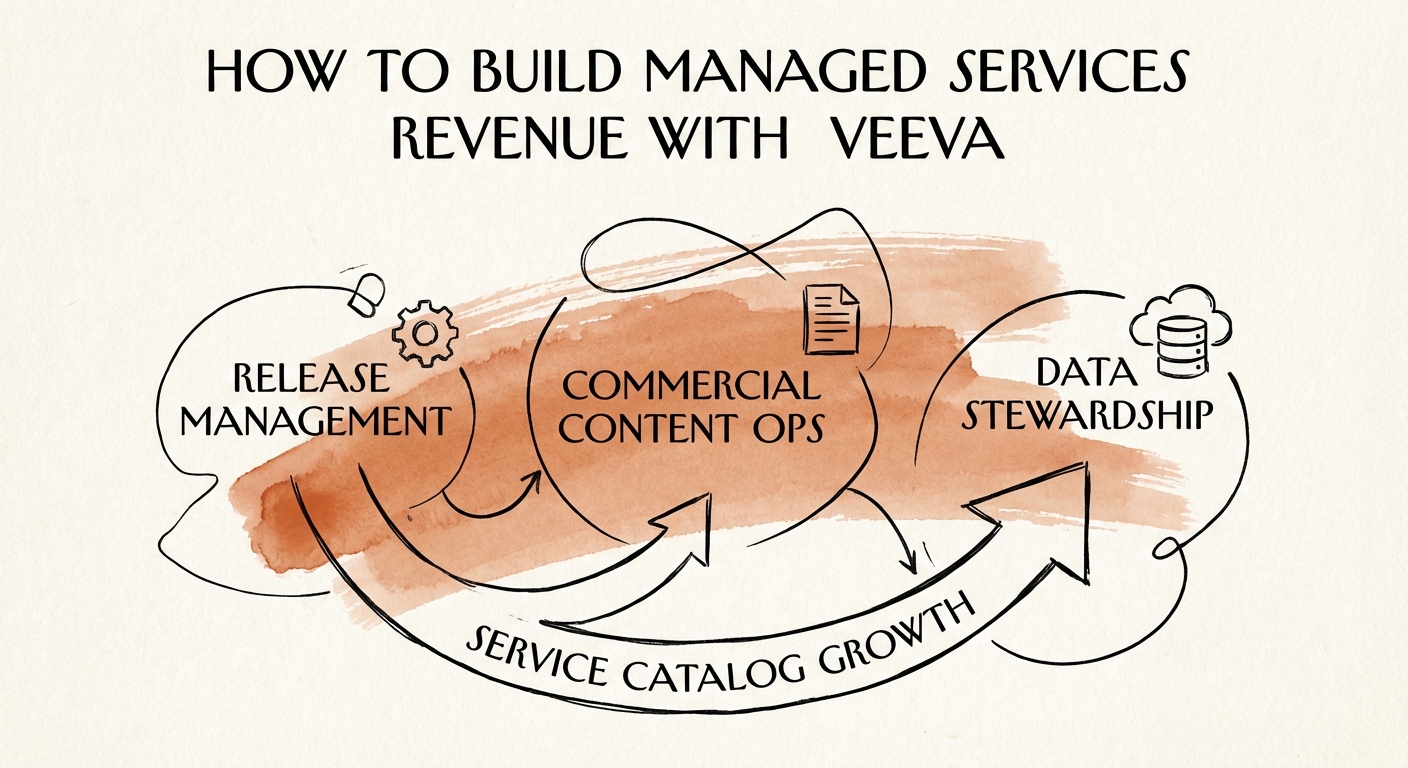
The reflex, when partners hear "managed services," is to stand up a Tier 1 help desk — password resets, login tickets, "have you tried logging out." That is a commodity, it runs at thin margins, and it is the first thing a pharma client cuts when budgets tighten. The premium MSP practice does the opposite: it productizes the high-anxiety, recurring workflows that a customer's internal admin team genuinely cannot keep up with. In the Veeva ecosystem, three of those stand out.
Release Management as a Service — billed against a calendar you don't control
This is the cleanest product in the catalog because Veeva sets the schedule for you. Six weeks before each general release, a regulated customer needs a tailored impact assessment: which configured objects break, which new features matter, what validation documentation has to be updated, and which regression scripts have to be re-run before they can sign off. Internal teams dread this three times a year. So sell it as a subscription — not hours, but "release continuity." You are billing for the fact that 25R2 is coming whether anyone is ready or not, and they would rather not find out the hard way.
MLR Concierge for PromoMats — attached to marketing velocity, not IT budget
Vault PromoMats moves thousands of commercial assets through Medical, Legal, and Regulatory review, and the review queue is where launches go to die. A managed service here is an SLA on content tagging, reference linking, and expiration management — keeping the MLR pipeline flowing. The reason this is stickier than IT support: you are now tied to how fast the client's commercial team can get campaigns to market. Nobody cancels the thing standing between them and their launch date.
Data stewardship for Veeva Network — high volume, leveraged labor, compliance pricing
With Veeva Network and OpenData, the integrity of HCP records drives whether reps can actually call on the right physicians. Data Change Request (DCR) validation is repetitive, rules-driven, and high-volume — exactly the kind of work a leveraged, partly offshore team can deliver efficiently while you bill it at onshore compliance rates because the customer cannot afford bad data in a regulated channel.
The pattern across all three: you are selling outcomes anchored to Veeva's own immovable cadence, not bodies billed by the hour.
The three numbers a buyer checks before they pay you 12x
Moving from project work to managed services changes which metric runs your business. In the project model you live and die by utilization — chasing that 68.9% to 75% sweet spot the Deltek 2025 Professional Services benchmark identifies. In the MSP model, utilization becomes secondary. The number that matters is gross margin per contract, and a buyer will pressure-test three things before they'll credit your firm with a recurring-revenue multiple:
- Recurring revenue mix above ~30% of total. Below that line, the recurring stream doesn't yet cover your fixed cost base, so a buyer treats it as a project shop with a side gig. Cross it, and the conversation about your multiple changes.
- MSP gross margin in the 50–70% band. If your managed services margin is under 40%, you have built staff augmentation in disguise — selling hours with a recurring label on the invoice. The fix is structural: automate the repeatable work (release regression, DCR validation) and run a leveraged labor model, rather than throwing your $250/hour architects at maintenance.
- Annual dollar churn under 10%. In Veeva specifically, churn should be near-zero — the switching cost on a validated-system support partner is brutal, because re-validating with a new vendor is its own painful project. If your churn is high anyway, you have a delivery quality problem, usually the symptom of treating MSP as the B-team behind your implementation pipeline.
So if you run a Veeva practice, do one thing this week: map your current book of business against the next release date. Every client you implemented and then handed back to their internal admins is a renewal you are not billing. The release calendar already wrote the recurring-revenue plan for you — the only question is whether you're the partner who gets renewed and expanded, or the one who gets hired and fired.