
The practical answer
- Short answer
- A 15% discount for a 3-year SaaS lock-in is debt at a 44% effective rate. Here's the math, the year-four downsell it hides, and how to restructure the trade.
- Best fit
- Industry: B2B Software & Services. Function: Revenue Operations
- Operating path
- Revenue Architecture → Commercial Performance → Office of the CFO
- Key metric
- 44% The effective cost of capital when utilizing a 20% annual discount to incentivize upfront B2B SaaS payments.
A Series B founder once walked me through his ARR like it was a trophy case: 65% of revenue under three-year contracts, every one of them locked with a 15% discount off list. He thought he'd built a fortress. What he'd actually done was issue himself a debt facility at a 44% effective interest rate and call it "predictable revenue."
Here's how the trade looks from the buyer's side of the table. You shaved 15% off the deal to win 36 months of commitment. Capchase's models on annual-discount economics put a number on what that costs you: a 20% discount to pull payment forward equates to roughly a 44% cost of capital. You financed your own growth at a rate no credit committee on earth would approve — and you did it because re-earning the customer every twelve months felt scarier than the discount felt expensive.
Why this trade feels smart and reads as a liability
The whole SaaS ecosystem trained you to do this. Multi-year discounts in the 15-20% range became the default, almost unquestioned, and Gartner has tracked the shift toward longer enterprise contract durations as the market norm. So you reach for the lever everyone reaches for. The problem is what the lever does to the only number a private-equity buyer actually underwrites: the quality of the revenue, not its volume.
When that founder's team "won" a three-year deal, they weren't selling the platform. They were selling the discount. The product became the thing you accepted in exchange for the price cut — and a diligence team reads that pattern in about an hour. A buyer doesn't apply a multiple to your list price; they apply it to recognized, defensible revenue, the kind of number that lives inside an ARR multiple calculation. A cohort built on standing discounts is a cohort that gets marked down on sight.
A 15% discount for three years of lock-in isn't a sales win. It's a debt facility at a 44% effective rate, signed by a rep who'd rather discount than defend the price.
The two costs nobody priced into the discount
Run the unit math. Say your standard ACV is $100,000 at a 75% gross margin. You cut it to $85,000 to land the three-year lock. Your cloud bill, your implementation hours, your customer-success headcount — none of those drop 15% to match. The entire haircut lands on margin, dragging your real gross margin from 75% to roughly 70%. In diligence, multiples get applied to gross-margin dollars, not theoretical top line, which is exactly why PE buyers run a revenue-quality scorecard that penalizes discounted cohorts directly. That's cost one, and it's visible.
Cost two is the one that ambushes you. A customer locked in for three years at a steep discount cannot churn in month twelve — so your gross retention looks immaculate. But that pristine number is hiding a stalled net revenue retention figure. You've anchored the account to a budget-vendor price. You can't push a list increase or land an organic upsell, because every expansion conversation now starts from the discounted floor you set. The account feels safe. It's actually frozen.
The reckoning shows up in year four
Watch how the failure mode plays out structurally at the deal desk. A rep facing a quarter-end pulls the 15% lever to compress the cycle rather than defend the platform's value. The customer, sensing a "use it or lose it" discount window, over-buys to lock the rate. Forrester's work on extended software contracts shows buyers routinely over-provision licenses by 20-30% on multi-year deals because nobody forecasts utilization three years out.
Then the contract comes up for renewal. Procurement runs a utilization audit, discovers the company used 70% of what it bought, and walks in demanding a downsell. The "guaranteed" revenue you toasted in year one becomes a 30% contraction in year four — and that contraction lands squarely in the NRR figure a buyer is staring at while deciding your multiple. You didn't secure revenue. You deferred a churn event and timed it, with cruel precision, to detonate right when you're trying to sell.
Trade something that costs you nothing in margin, not 15% of the top line
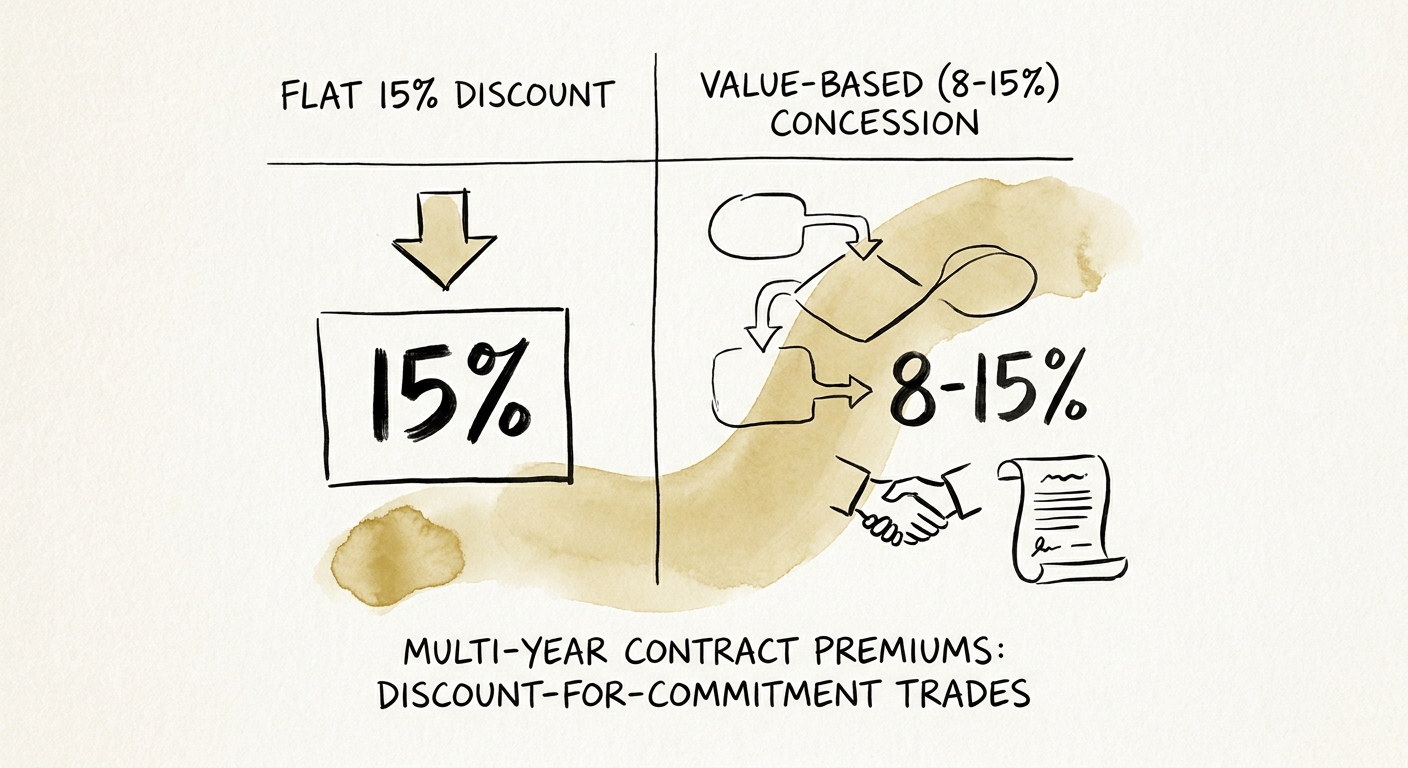
The fix isn't to ban multi-year deals — it's to change what crosses the table when a customer asks for one. The discount is the laziest possible concession because it's the only one that hits your recurring-revenue baseline permanently. Replace it with structural trades that carry high perceived value and near-zero recurring cost: waive the implementation fee, bundle a premium support tier, hand them early access to a beta module. Procurement still gets to walk away with a "win" to report. Your ARR baseline never moves.
If you genuinely must touch ARR, never do it as a flat haircut. Structure an escalator: 10% off in year one, 5% in year two, full list in year three. Now the contract appreciates instead of stagnating — and if you're aiming to sell inside 24 to 36 months, that's the difference between a buyer underwriting a rising revenue stream and one underwriting a flat, discounted one. Same customer. Radically different exit math.
What to change at Monday's deal review
Pull your three largest multi-year contracts and check one thing: is the customer paying for a discount, or for the product? If your reps can't articulate the value they held the line on, the discount is doing the selling — and that's a coaching problem, not a pricing problem. Set a default: annual contracts at full price, multi-year only when the customer asks for it. When your platform is genuinely critical, they come back asking to commit — and now you negotiate from leverage, with a deal that expands NRR instead of freezing it. Every point of discount you don't give away today is a turn of multiple you keep at exit.