
The practical answer
- Short answer
- Switching SaaS billing from seats to consumption drops recognized revenue for one ugly quarter before it climbs. Here is the month-by-month curve and how to hold the board's nerve through it.
- Best fit
- Industry: B2B SaaS. Function: Revenue Operations
- Operating path
- Revenue Architecture → Commercial Performance → Office of the CFO
- Key metric
- 26% Maximum Revenue Trough During Migration
The dip you forecasted still feels like a heart attack
Here is the number nobody puts in the migration kickoff deck: when a B2B SaaS company moves off per-seat licensing and onto consumption pricing, recognized monthly recurring revenue can fall before it ever rises. Not "growth slows." Falls. The customer base you spent years building stops paying for shelf-ware the week you let them, and your usage hasn't ramped to fill the hole yet. The gap between those two events is a quarter long, and it is where most migrations die — not in the model, but in the boardroom three months later.
The pressure to make the move is real and it is not going away. L.E.K. Consulting reports that the overwhelming majority of SaaS companies are now using or actively rolling out usage-based or hybrid pricing. The reason is structural: AI is letting your customers do more with fewer headcount, which means a seat-count line item is a shrinking line item. You are not pricing against your competitor anymore. You are pricing against your customer's org chart, and the org chart is contracting.
So the destination is correct. The trap is that founder-CEOs read the endpoint statistics — the expansion, the net revenue retention north of 115% — and assume the path there is a smooth upward line. It is not. Picture a 60-customer Series C platform, mostly on annual seat contracts. The board has internalized the OpenView-style averages and expects NRR to step up the quarter you flip the switch. Instead, watch what actually happens to the P&L: by month three, recognized revenue is down roughly a fifth, the trailing NRR chart looks like a cliff, and a CFO who didn't build the model is asking why you broke a working business.
The whole game is surviving that gap with your forecast intact. Per-seat revenue is a floor your customers were paying whether they used the product or not. The moment you remove the floor, they optimize — instantly, rationally, all at once. Their real consumption of your core features takes a full quarter to ramp past that old floor. If you treat the dip as a failure signal instead of a scheduled event, you'll panic-discount and anchor your new pricing at the bottom of the curve forever.
A usage-based migration doesn't fail in the spreadsheet. It fails in month three, when a recognized-revenue dip you forecasted shows up on the board deck and someone with no model in front of them decides to abort.
Six months, three acts, one ugly quarter
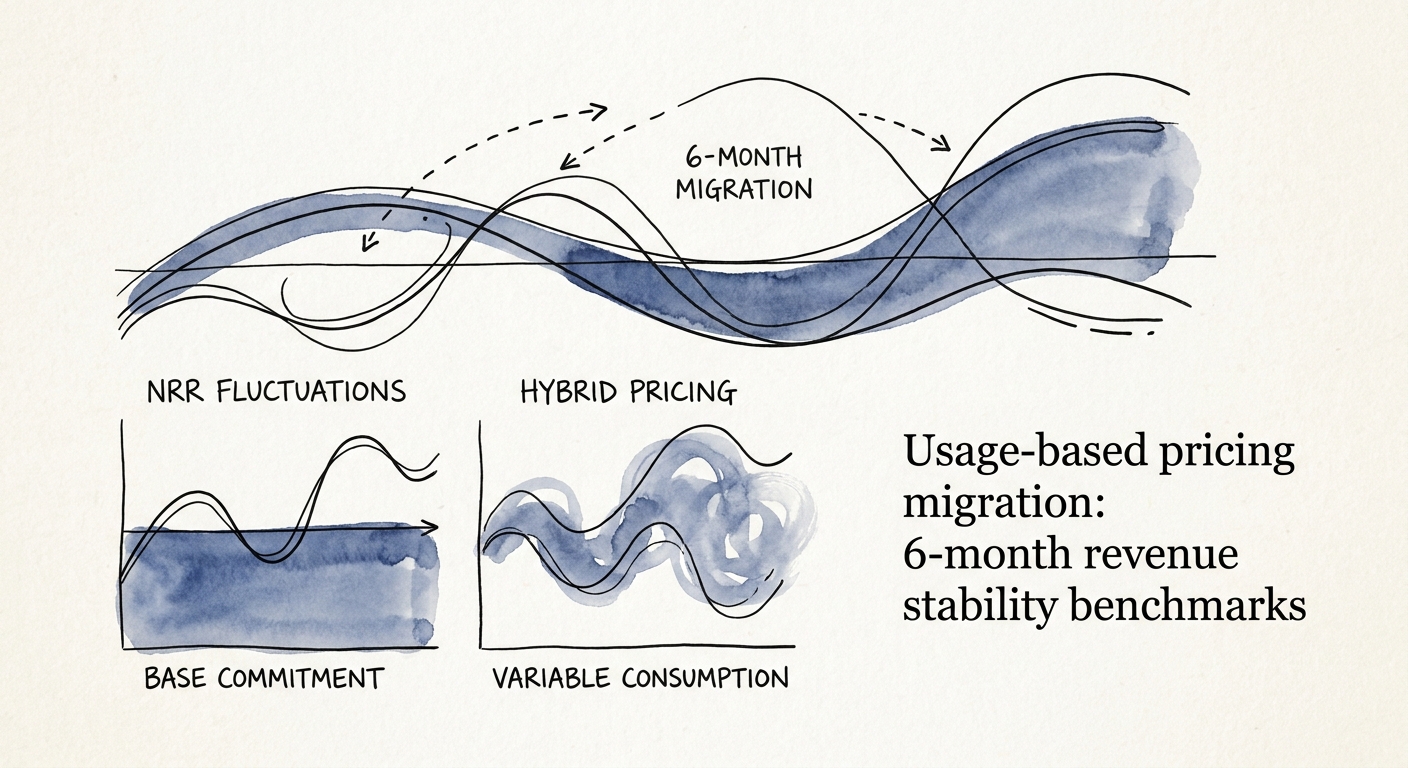
The migration follows a curve specific enough that you can forecast against it month by month. It is the arithmetic of moving a contracted seat base onto metered consumption — committed-but-unused credit on one side, organic usage ramping on the other, and a window where neither is carrying the revenue. Map your board deck to these three acts before you flip anything.
Months 1–2: the cash mirage
The first 60 days look great, and that is the danger. Reps spooked by variable comp herd customers into big prepaid usage commitments to lock in their numbers before the comp plan changes. Bookings spike. Cash lands. The dashboard says you nailed it. But almost none of that committed credit is being consumed — customers bought a tank of gas they haven't started burning. If you anchor the board's expectations on these two months, you've hidden the cliff from the only people who need to see it coming.
Months 3–4: the trough
This is where it breaks teams. The prepaid credits from month one still aren't drawn down, so nobody needs to top up. At the same time, your legacy seat customers hit renewal, look at their actual usage, and right-size their commitment down — hard. Both forces pull the same direction at the same time. Expect recognized revenue to sit somewhere in the high-teens to mid-20s percent below your pre-migration baseline; in the rough case it touches 26%. The trailing three-month NRR will look like a resignation letter. This is the moment someone proposes "just discount to drive top-ups." Do not. Forced top-ups in the trough teach your entire base that your new pricing is negotiable downward, and you never get that anchor back.
Months 5–6: the inflection
Around month five, organic usage finally clears the old per-seat ceiling. The customers who used to ration logins because every new user meant a procurement conversation now roll the product into adjacent teams, because adding a user costs them nothing up front. Chargebee's State of Subscriptions Report finds a large share of companies have landed on hybrid models — a fixed platform fee plus metered usage — precisely to bridge this gap. With the base fee holding the floor and consumption now compounding on top, NRR pushes back through 115% by month six. Same logic OpenView documents in its State of Usage-Based Pricing: the trough ends and the expansion engine you were promised finally turns over.
Three things to build before you flip the switch
You can't engineer the trough away — the customer optimization is rational and immediate. What you can do is make the floor of the dip shallower and the slope out of it steeper. Stability in consumption pricing is a design decision you make in advance, not luck you hope for in month four. Three concrete builds, in order.
1. Never ship pure pay-as-you-go without a floor. A model with no fixed component is a model whose revenue can go to zero in a quiet month, and that volatility is what scares both your CFO and your eventual acquirer. Set a core platform fee that covers your fixed cost and baseline support, then meter the variable value metric on top. The hybrid structure isn't a compromise — OpenView's research consistently shows hybrid models outgrowing pure per-seat peers by a wide margin, because they keep downside protection while opening unlimited upside.
2. Put expiring quarterly commitments under the contract. If a customer commits to, say, $50K of annual usage, bill a minimum of $12,500 per quarter that expires if unused. This is the single biggest lever against the months 3–4 trough: it stops customers from fully pausing spend while their internal teams figure out adoption cadence. Run these quarterly floors through at least the first year of any migration. The expiration is the point — rollover credit just rebuilds the prepaid-mirage problem you saw in month one.
3. Re-cut sales comp the same day you re-cut pricing. Leave your reps on a seat-era commission plan and they will quietly torpedo the migration — shoving customers into the wrong tier to bank an upfront commission, exactly the behavior that inflates months 1–2 and deepens the trough that follows. Pay a modest base on the platform fee, then weight comp heavily toward realized consumption milestones. The instant a rep's paycheck depends on the customer actually logging in and using the product, your sales floor turns into a second customer-success team that hunts adoption for you.
That's the whole playbook: model the six-month curve so the board sees the trough before it arrives, hold the line through months three and four without discounting, and pre-build the hybrid floor, expiring quarterly commitments, and consumption-linked comp. Do that and you earn the expansion multiple usage-based companies trade at — instead of being one of the teams that aborted the migration in month three and told themselves the model didn't work.