
The practical answer
- Short answer
- Mid-market SaaS pricing pages convert at 4-8%. If yours sits below 3%, the leak isn't traffic — it's packaging. Where qualified buyers quit, and how to win them back.
- Best fit
- Industry: B2B Software & SaaS. Function: Revenue Operations
- Operating path
- Revenue Architecture → Commercial Performance → Office of the CFO
- Key metric
- 17% Percentage of total B2B buying journey spent actually meeting with potential suppliers.
Picture the most valuable visitor your pricing page gets this week. A VP of engineering at a 180-person company. She has a budget line, a renewal date on an incumbent tool she dislikes, and authority to bring three names to her CFO. She typed your URL in directly. She is not browsing — she is building a business case.
She scans your three columns for eleven seconds, looking for one thing: the number that tells her what her company would actually pay. Your top two tiers show prices. Your third column — the one that fits her headcount — says "Contact Sales." She closes the tab and opens your competitor's, who published a per-environment rate she can multiply in her head. You never knew she came. You will never know she left.
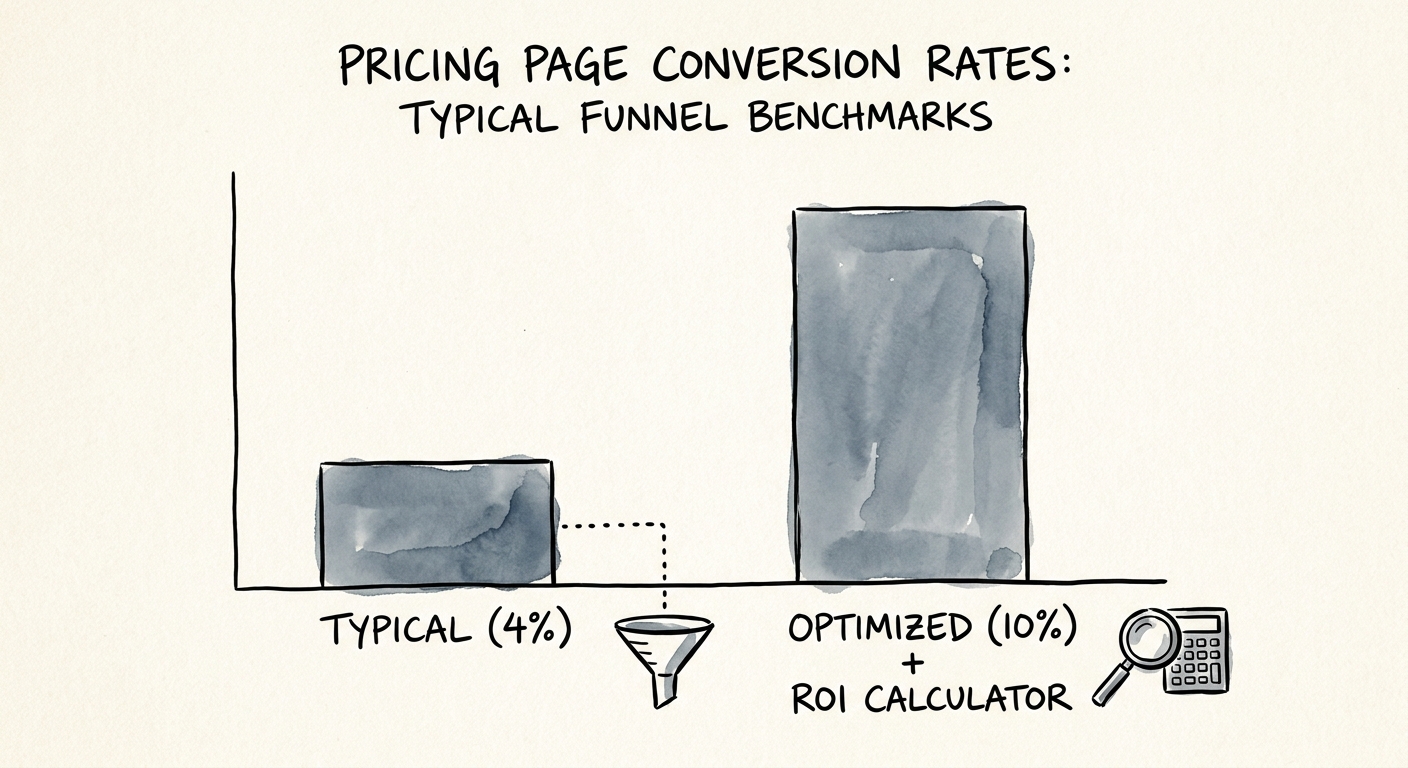
This is the core mechanic founders miss at $10M-$50M ARR. At that stage the pricing page stops being a brochure and becomes the single most consequential qualification gate in the funnel — the moment a self-funded business case either gets built or dies. Pricing data compiled by Paddle puts a healthy mid-market visitor-to-lead conversion at roughly 4% to 8%. If yours is sitting at 2%, the instinct is to buy more traffic. That is the wrong invoice. You don't have a traffic problem. You have a packaging problem, and every extra visitor you buy hits the same wall.
]]>A pricing page that hides the number isn't protecting margin. It's outsourcing your qualification to whichever competitor publishes theirs.
Pricing-page abandonment is not random. It clusters at three specific decisions the buyer is trying to make, in order. Fix them in this order, because each unblocks the next.
Decision 1: "Which column is me?"
Before a buyer reads a single feature, she is trying to locate herself. A forty-row feature matrix with three nearly identical columns of green checkmarks does the opposite — it forces her to audit your roadmap to find her own row. The fastest pricing pages answer "which column is me?" in the first screen by naming tiers after the buyer, not the product. A column called "Pro" tells her nothing. A column scoped to "teams up to 50" or "10+ production environments" lets her self-select before she has to think. The feature list is a tiebreaker she consults second, not the map she navigates first.
Decision 2: "What am I being charged on?"
This is the one that quietly kills more mid-market deals than any feature gap. If your value metric — the thing you meter and bill — doesn't match where the customer feels value, she can't model her own cost, and a buyer who can't model cost will not advance. The classic mismatch: you charge per seat, but the product's value is automated throughput that runs whether ten people log in or two. She does the math, realizes the meter punishes her for adding viewers, and bounces. Getting the metric to track consumption is also what lets a company capture the consumption premium that buyers reward at exit. The test is brutal and simple: can a stranger compute her annual bill from your pricing page in under a minute, without a calculator and without you? If not, that's your leak.
Decision 3: "Do I have to talk to someone to find out the price?"
For the deal sizes that matter at your stage, the answer can't be a blank tier. Gartner's research on the B2B buying journey found buyers spend only about 17% of their evaluation time meeting with any supplier — and a chunk of that goes to your competitors. A "Contact Sales" tier with no anchor doesn't gate the right buyers out; it gates the serious ones out, because they read a blank price as a signal you'll quote off their funding round, not their usage. The fix is not to publish a rigid enterprise number. It's to give an anchor — a "starting at" floor, a worked example, an interactive estimate — so the high-touch motion starts after she's qualified herself, not before. Moving cleanly between a self-serve floor and an enterprise motion is its own design problem; the margin math behind it is in self-serve vs. high-touch gross margins.
]]>
You don't need a redesign. You need three changes you can scope this week and measure inside a month.
1. Put a calculator where the "Contact Sales" wall is. Forrester's work on B2B buyer behavior is blunt about it: buyers want to do their own homework before a rep is ever in the room, and they'll pick the vendor who lets them. Let the visitor drag a slider for seats, environments, or volume and watch the number move. You're not giving away leverage — you're letting her capture the exact screenshot she needs to forward to finance. That screenshot is your real conversion event. The form fill comes after.
2. Rename your tiers after the buyer, then test the order. Drop "Basic / Pro / Enterprise." Use names that map to where she is — by scale, by outcome, by stage. This isn't cosmetics; it's how you stop your reps from spending discovery calls re-explaining your own tier logic, which is exactly the confusion that pushes deals into the discounting death spiral when a rep cuts price to compensate for a page that didn't sell.
3. Instrument the column, not just the click. Most teams track clicks on "Start trial." Track where the cursor dies instead. If a large share of traffic reaches your top tier, hovers, and exits without touching the calculator, that column's packaging is the problem — not your funnel volume. Watch the per-tier drop-off for two weeks and you'll know precisely which of the three decisions above is failing you, which means you'll know what to fix without guessing. The pricing page is the highest-leverage square foot you own. Stop styling it like a menu and start instrumenting it like a checkout.
]]>