
The practical answer
- Short answer
- Don't pay $250/hr for a 'paper tiger.' Learn the real ROI of NetSuite certifications and how to build an implementation team that actually delivers.
- Best fit
- Industry: B2B Tech / Services. Function: Operations / IT
- Operating path
- Team & Hiring → Operational Excellence → Transaction Execution Services
- Key metric
- 150% Average cost of a 'Rescue Project' relative to the original implementation budget.
The Certification Premium vs. The Reality
If you are a Series B Founder or CEO currently staring at a NetSuite Statement of Work (SOW), you are likely seeing a blended billing rate between $175 and $250 per hour. The partner justifying this rate will inevitably point to their "Gold" status and the number of certified consultants on their bench. They are selling you on the idea that a badge equals competence. In the trenches of mid-market operations, this is a dangerous half-truth.
The data tells a conflicting story. While 50% of professionals report a salary increase after certification, often exceeding 20%, the functional failure rate of ERP implementations remains stubbornly high at roughly 50%. This creates a paradox: the market values the certification (higher salaries, higher billing rates), but the certification itself does not guarantee project success. You are often paying a senior rate for a "SuiteFoundation" certified junior who has memorized the exam guide but has never navigated a complex revenue recognition cycle under audit pressure.
We call this the "Paper Tiger" Tax. You aren't paying for the outcome; you're paying for the partner's marketing collateral. True ROI comes not from the badge itself, but from the combination of certification and industry-specific battle scars. A "Certified Administrator" with zero years of experience is a liability at $150/hr; a non-certified operator who has survived three migrations is a bargain at $300/hr.
The most expensive NetSuite consultant you will ever hire is the 'cheap' one you have to fire three months after go-live. The rescue always costs more than the build.
The ROI Hierarchy: Which Badges Actually Matter?
Not all certifications justify a rate hike. When vetting a partner team or making an internal hire, you must distinguish between "Table Stakes" and "Value Drivers." If you treat them all as equal, you will burn your implementation budget on administrative overhead rather than architectural intelligence.
1. Table Stakes (Zero Premium Worthy)
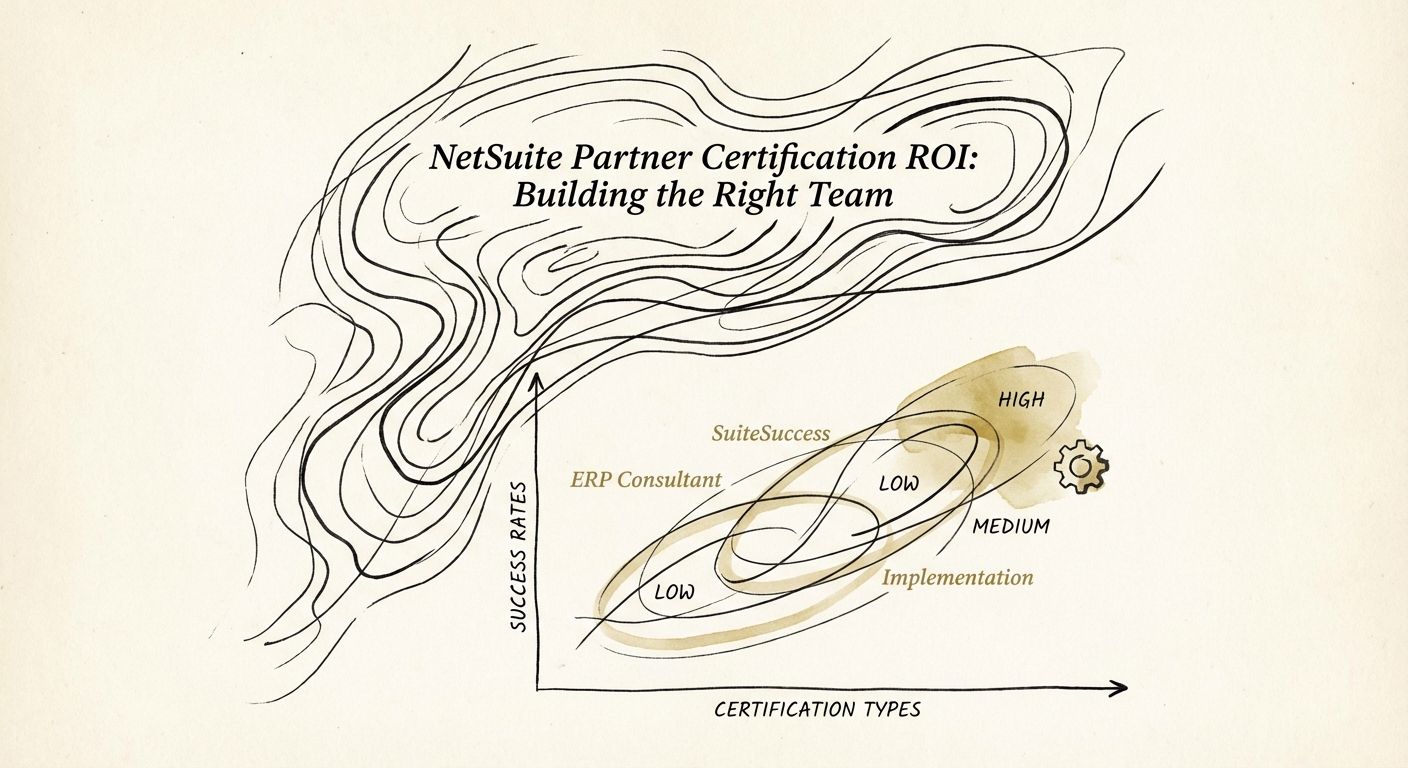
SuiteFoundation & Certified Administrator: These are the entry-level gates. They prove the individual knows the navigation, the terminology, and the basic settings. Do not pay a premium for this. If your "Senior Consultant" only holds these credentials, you are being overcharged. These are the equivalent of a driver's license—necessary to operate the vehicle, but no guarantee they can win a race.
2. The Value Drivers (Pay the Premium)
ERP Consultant & Certified Developer: These certifications require significantly more practical application. However, the real ROI multiplier is Vertical Experience. A Certified ERP Consultant who has done 10 SaaS implementations understands Deferred Revenue Waterfall reports implicitly. One who has done 10 Manufacturing implementations understands WIP and BOMs. If your partner assigns a Manufacturing expert to your SaaS subscription billing project, their certification is worthless to you.
3. The Red Flag: The "SuiteSuccess" Rigidity
Be wary of partners who lean too heavily on "SuiteSuccess" certifications as a methodology to skip requirements gathering. While SuiteSuccess promises a 100-day implementation, it often functions as a "take it or leave it" template. If your business process deviates from their pre-configured box, the certified consultant trained only in that box will flounder. The cost of "rescuing" a failed implementation typically runs 150% of the original budget. The most expensive consultant you will ever hire is the cheap one you have to fire three months post-go-live.
Building the Team: The "Golden Ratio"
Whether you are hiring a partner or building an internal Center of Excellence, stop looking for a team of unicorns. You don't need five Architects. You need a structured pyramid that balances cost with competency.
The Ideal Composition
- 1x Functional Architect (The Brain): This person must be fluent in your specific business model (e.g., "Fluent in ASC 606 for B2B SaaS"). They need the advanced ERP certification, but more importantly, they need to have failed at least once. Ask them: "Tell me about a migration that went sideways and how you fixed it." If they claim perfection, they are using inconsistent definitions or inexperienced.
- 1x Technical Lead (The Hands): Certified Developer. Essential for integrations (Salesforce, HubSpot, Banks). Do not let a functional consultant write your scripts; that is how you end up with "spaghetti code" that breaks every release.
- 2x Junior Admins (The Grunt Work): Certified Administrators. These resources should be billed at a lower rate (or hired internally for $80k-$100k). They handle data cleansing, form layouts, and user role setups.
The Final Diagnostic Question: When interviewing a potential partner, ask to see the bios of the delivery team, not the sales team. Cross-reference their certifications with their LinkedIn work history. If you see a "Senior Consultant" with a shiny certification but only 18 months of total work experience, send the SOW back. You are building a financial engine, not a study group.