The practical answer
- Short answer
- The 100-day plan finishes IT integration too fast and waits too long. Here's a 120-day sequence that front-loads risk and back-loads architecture decisions.
- Best fit
- Industry: Private Equity. Function: IT Operations
- Operating path
- Migration & Integration → Turnaround & Restructuring → Transaction Advisory Services
- Key metric
- 30-50% Of anticipated M&A value is lost due to slow integration (McKinsey)
The 100-day plan is the wrong instrument for IT
Most operating partners inherit a "100-Day Plan" template and apply it to IT integration the same way they apply it to finance and HR. That's the mistake. Finance integration is a known sequence: consolidate reporting, true up the chart of accounts, stand up the FP&A feed. IT integration is an excavation. You don't know what you bought until you start digging, and 100 days isn't enough time to dig and rebuild — but it's plenty of time to make an expensive decision on bad information.
The number that should keep you up at night isn't the synergy target in the deal model. It's that McKinsey attributes 30-50% of lost M&A value to slow or ineffective integration — and the IT layer is where the slowness compounds. Every week you run two CRMs, two identity systems, and two overlapping SaaS stacks, you're paying twice for infrastructure and seeing half the picture. That's not a line item; it's a tax on the whole thesis.
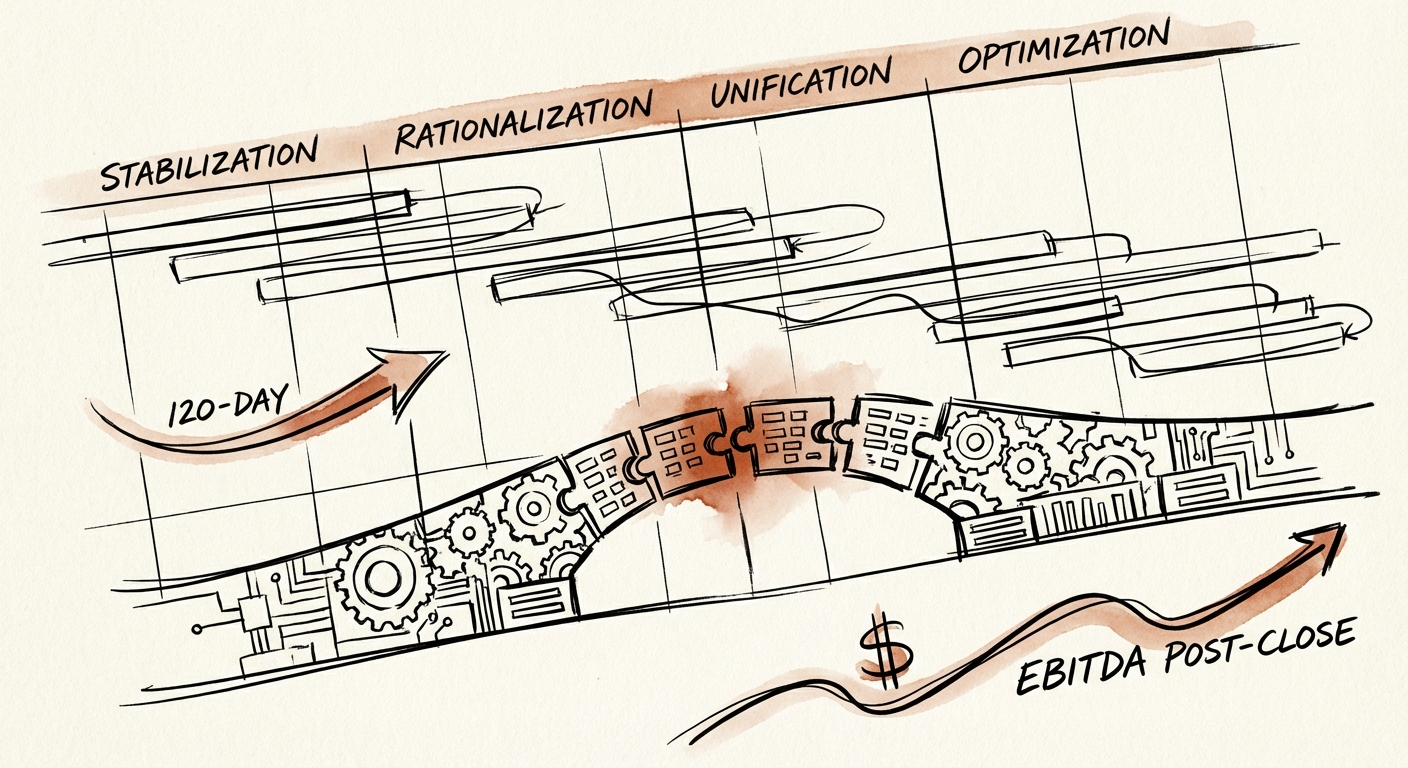
The fix isn't to go faster. It's to re-sequence. A 120-day roadmap buys you the extra month precisely where it matters: a full discovery cycle before any irreversible architecture call. Front-load the things that bleed value if you wait — security exposure, auto-renewing licenses, financial blindness. Back-load the things that destroy value if you rush — ERP, CRM merges, network re-architecture. The four weeks you "lose" relative to the 100-day plan are the four weeks that stop you from migrating onto the wrong platform.
Nobody loses a deal because they merged Slack tenants three weeks late. They lose it because they tried to pick an ERP in week two, before they even knew what they bought.
What goes in which 30-day block — and why the order is non-negotiable
The sequence below isn't arbitrary phasing. Each block is defined by a single question, and you don't earn the right to ask the next question until you've answered the current one.
Days 1–30: "What did I actually buy, and is it on fire?"
This is containment, not improvement. Force a password reset and enforce MFA on every inherited admin account in the first week — not because it's best practice, but because Forescout found 53% of acquirers discover undisclosed cybersecurity issues after close, and the integration window is exactly when monitoring is in flux and credentials are floating in shared spreadsheets. Run a discovery agent across the asset estate so you can see the shadow SaaS and the "ghost" servers nobody documented. Stand up a financial data bridge to the acquirer's reporting — even a manual one — because you cannot govern a number you can't see. Notice what's missing from this list: no migrations, no merges, no platform decisions. You don't have the data yet.
Days 31–60: "What can I cancel by Friday?"
Now you have an inventory, so now you can cut. Build the kill list of duplicate tooling — the Zoom-versus-Teams, Asana-versus-Monday overlaps — and fire the cancellation notices before the next auto-renewal posts. This is the block that funds the rest of the program. Pull the top 20 vendor contracts and re-price them against the combined volume of HoldCo and PortCo; you have leverage on day 31 that you'll never have again once renewals lock. Clean and map your CRM fields here — but do not merge instances. Mapping is reversible; a botched merge is a quarter of lost pipeline visibility.
Days 61–90: "How do I connect the people without a riot?"
Stabilized and de-bloated, you can now wire the workforces together. A unified SSO layer (Okta, Entra ID) lets both sides reach shared resources without a help-desk queue. Merge the Slack or Teams tenants — siloed comms are where "us versus them" calcifies. Grant sales role-based read access to the other side's accounts so the cross-sell thesis gets its first real test with live data instead of a board-deck assumption.
Days 91–120: "What's the one decision I can't unmake?"
Only now do you touch architecture. Make the ERP call — migrate, integrate, or sunset. It's an 18-month build either way, but the decision can't slip any further. Retire legacy VPNs toward a Zero Trust model. And run the technical-leadership review: identify who knows where the bodies are buried versus who's quietly resisting the new operating model. The reason this is week 13 and not week 2 is simple — make the call in week 2 and you're betting the integration on the discovery you hadn't done yet.
The two failure modes a perfect Gantt chart won't catch
You can sequence all 120 days flawlessly and still lose, because the two things that most often derail IT integration aren't on the technical roadmap at all.
The first is security debt that arrives dressed as a clean balance sheet. Sellers groom financials for the process; almost nobody grooms their security posture. So you inherit unpatched systems and over-provisioned access right as your own monitoring is half-rebuilt. IBM puts the average breach at $4.88 million — a number that lands directly in your deal model, not in some abstract risk register. Treat post-close security as a live process through all four phases, not a diligence checkbox you ticked before signing.
The second is the conqueror dynamic. If the acquired engineering team reads your integration as occupation, they'll comply on paper and hoard knowledge in practice — and migration velocity collapses to a crawl you can't fix with more project managers. Frame it as an upgrade for them: bigger budgets, better tooling, harder problems. You need their tribal knowledge more than they need your org chart.
If you do one thing Monday: pull the inherited admin-account list and the SaaS renewal calendar for the next 120 days, side by side. The first tells you your exposure; the second tells you your fundable savings. That single artifact decides what your first two phases actually look like — and it's consistent with what the Deloitte M&A trends data keeps showing: the integrators who move deliberately on the irreversible calls beat the ones who move fast on all of them.